



Buffet Food Cost Calculator: How to Price for 25% Profit
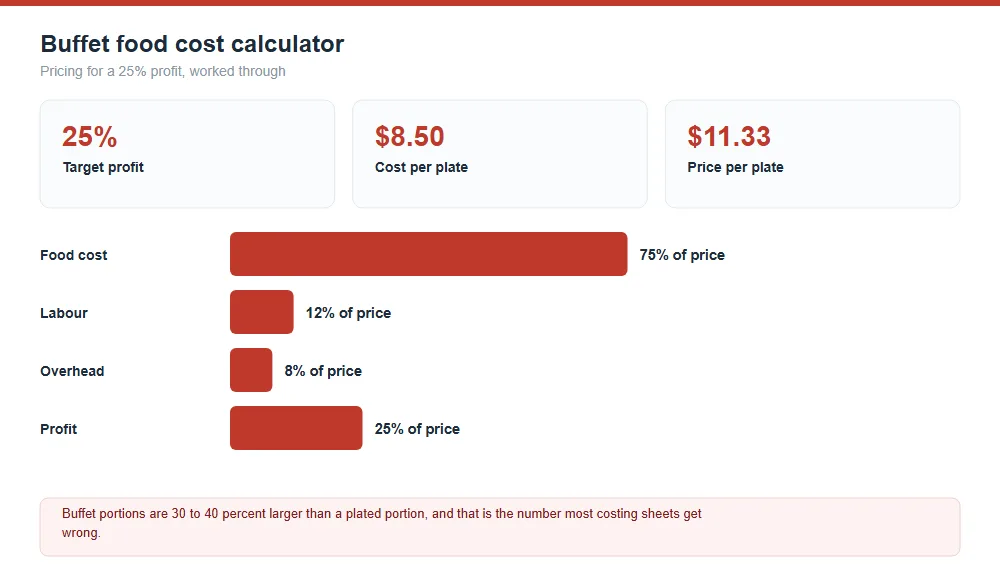
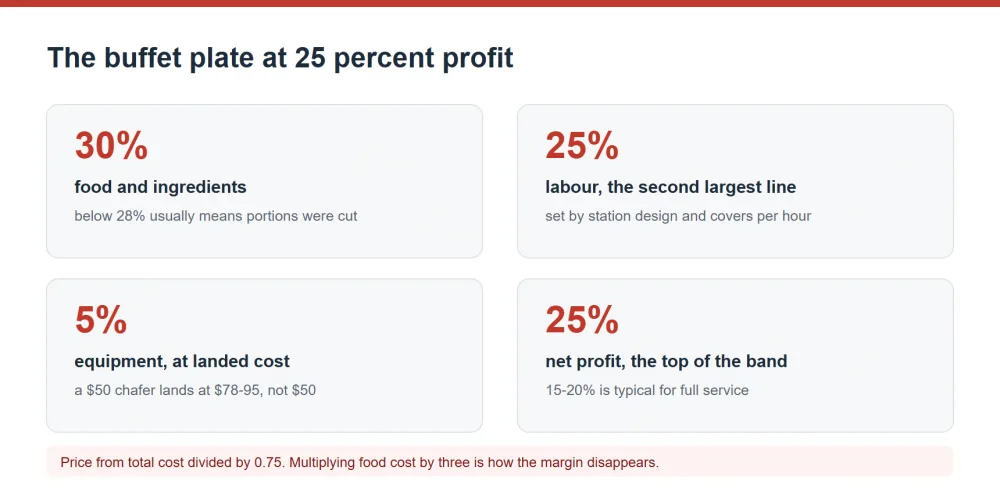
Short answer: A 25 percent net profit on a buffet means the plate price has to cover food at about 30 percent, labour at 25 percent, overhead at 12 percent, equipment at 5 percent and consumables at 3 percent, which leaves the quarter you keep. On a $12.50 plate that is $3.75 of food, $3.13 of labour, $1.50 of overhead, $0.63 of equipment and $0.38 of consumables. Equipment belongs in the calculation at landed cost, not sticker cost: a $50 chafer lands at $78 to $95 once freight, duty and packaging are counted. See chafing dishes.
You just quoted a wedding buffet for 150 guests. You did a quick mental math: food costs $10 per person, so you charge $25. Sounds fair, right?
But then the event happens. You rent 10 chafing dishes, hire 3 servers, drive 40 miles, and spend 3 hours setting up. At the end of the night, you look at your expenses and realize — you just lost $500 on the "easy" job.
This happens to 70% of new caterers. They price by food cost only, forgetting overhead, labor, waste, and profit. The difference between a profitable buffet and a money-loser? A simple 3-step formula that takes 2 minutes.
Here's how professional caterers price every event.
PRO TIP: Always price alcohol separately.
Drinks have 80% profit margin — but most new caterers give them away "for free" in the buffet price. Charge $5-10 per person for soft drinks, $15-25 for alcohol packages. This alone can double your profit.
KEY TAKEAWAY: Food cost should be 30-35% of your final price.
If food costs you $10.50, your final price should be $30-35 per person. Charge less and you lose money on every guest.
Quick Answer: How to Price Your Buffet
| Step | What You Do | Example |
|---|---|---|
| Step 1 | Add up all food cost per person | $10.50 |
| Step 2 | Divide by 0.35 (food cost percentage) | $10.50 / 0.35 = $30 |
| Step 3 | Divide by (1 - profit margin) | $30 / 0.75 = $40 |
| Final Price | $40 per person (25% profit margin) | |
Step 1: Calculate Food Cost Per Person
Add up every item you'll serve per guest. Be precise — don't guess.
| Category | Cost Per Person |
|---|---|
| Appetizers / Starters | $1.50 |
| Main Dish (Meat / Fish) | $4.00 |
| Sides (2 Vegetables + Starch) | $2.00 |
| Salad | $1.00 |
| Dessert | $1.50 |
| Bread / Rolls | $0.50 |
| TOTAL FOOD COST | $10.50 |
Step 2: Add Overhead Costs
Food is only 30-35% of your total cost. The rest is overhead. Here's where the other 65-70% goes:
| Cost Category | Percentage | Example (100 guests) |
|---|---|---|
| Food | 35% | $1,050 |
| Labor (Chefs, Servers) | 25% | $750 |
| Equipment Rental | 15% | $450 |
| Drinks & Service Ware | 10% | $300 |
| Transport & Setup | 10% | $300 |
| Waste (Overproduction) | 5% | $150 |
| TOTAL COST | 100% | $3,000 ($30/person) |
Quick formula: Total cost per person = Food cost / 0.35
Example: $10.50 / 0.35 = $30 per person
Step 3: Add Your Profit Margin
Standard catering profit margin is 20-30%. You need to make profit too!
Final Price = Total Cost / (1 - Profit Margin)
| Profit Margin | Formula | Final Price |
|---|---|---|
| 15% (Low) | $30 / 0.85 | $35.30 |
| 25% (Standard) | $30 / 0.75 | $40.00 |
| 30% (Premium) | $30 / 0.70 | $42.85 |
Quick Reference: Buffet Price Tiers
| Tier | Price Per Person | Best For |
|---|---|---|
| Budget | $15-25 | Office lunch, corporate events |
| Mid-range | $30-50 | Weddings, birthday parties |
| Premium | $60-100+ | 5-star hotel, galas, VIP events |
Common Pricing Mistakes
1. Underpricing alcohol: Drinks have 80% profit margin — but many new caterers give them away for free. Charge separately for alcohol packages.
2. Forgetting setup and cleanup time: Your team spends 2 hours setting up and 1 hour cleaning. That is paid time — include it in the price.
3. Not charging for extra guests: If 120 guests show up when you planned for 100, charge extra. Food cost scales linearly with guest count.
4. Ignoring equipment rental costs: Chafing dishes, tables, chairs, linens — all cost money to rent. Add 15% to your price for equipment.
5. Forgetting waste: You'll overproduce by 10-15%. Factor that in. Don't end up with 20 pounds of leftover food you paid for.
Buffet Pricing Terms to Know
When quoting buffet prices, you'll see these terms often:
- electric chafing dish with digital display
- buffet equipment checklist
- sterno vs electric chafing dish cost
- commercial heat lamp for buffet
- commercial induction cooker price
The Bottom Line
Use this 3-step formula for every quote: calculate food cost, divide by 0.35 to get total cost, then divide by 0.75 to get final price. It takes 2 minutes, and it ensures you make money on every event — not just the busy ones.
Looking to Save on Equipment?
BAVA manufactures commercial buffet equipment at factory prices. Owning your own chafing dishes and heat lamps saves you 15-20% per event compared to renting. All products CE, FDA certified, OEM/ODM available.
The cost structure of a buffet plate at 25 percent profit
Most operators price a buffet by multiplying the food cost by three and hoping, which works only when labour and overhead happen to be low. The honest version prices the plate from the total cost and divides by 0.75, and the table below shows what that structure looks like at three plate prices. The shares are targets, not laws, but if any line runs above the band the profit comes out of the same 25 percent.
| Cost line | Target share | On a $12.50 plate | On a $18.00 plate | On a $9.50 plate | The control lever |
| Food and ingredients | 30 percent | $3.75 | $5.40 | $2.85 | Portion control, yield, supplier price |
| Labour | 25 percent | $3.13 | $4.50 | $2.38 | Station design, refill batching, covers per hour |
| Overhead: rent, utilities, insurance | 12 percent | $1.50 | $2.16 | $1.14 | Seats per square metre, equipment efficiency |
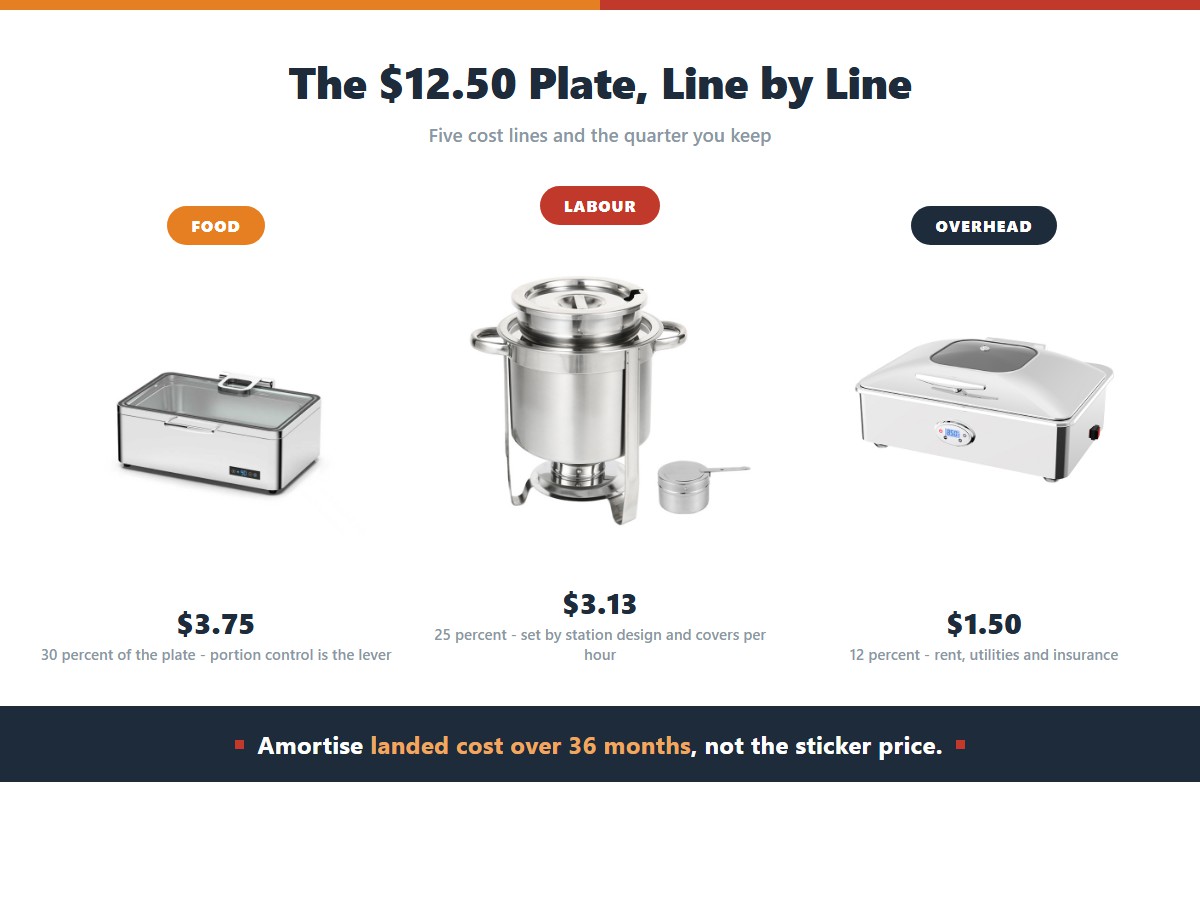
| Equipment amortisation | 5 percent | $0.63 | $0.90 | $0.48 | Landed cost over 36 months, not sticker price |
| Consumables, waste, breakage | 3 percent | $0.38 | $0.54 | $0.29 | Plates per guest, pan batching, trim discipline |
| Net profit | 25 percent | $3.13 | $4.50 | $2.38 | Everything above |
Where the 25 percent actually disappears
Five mistakes account for nearly every buffet that prices at 30 percent food cost and still earns single digits. They share one feature: the operator measured the plate price against the wrong denominator. The table below names each mistake, what it costs and the fix.
| Mistake | What operators do | What it costs | The fix |
| Pricing on food cost alone | Multiply the food cost by three | 8 to 15 points of profit | Price from total cost divided by 0.75 |
| Counting sticker equipment cost | Budget the catalogue price | 3 to 6 points | Amortise landed cost over 36 months |
| One price for every daypart | Run lunch and dinner at one price | 5 to 10 points | Two or three price tiers by daypart |
| Counting covers, not plate cycles | Buy one plate per guest | 10 to 20 percent more labour | Plan 1.5 plates per guest and a 30 second swap |
| Never measuring waste | Guess trim and leftovers | 2 to 4 points | Weigh waste for two weeks and reprice |
The equipment line deserves one more note, because it is the one operators leave out entirely. Fuel heating costs $0.50 to $0.75 per station per hour against $0.04 to $0.18 for electric, and over five years on ten stations that is the difference between $28,000 and $4,800 in the operating account. That difference is 10 to 15 points of the plate price in a high-volume operation, which is larger than most menu price increases an operator will dare to make in a year.
Frequently Asked Questions
Is 25 percent profit realistic for a buffet?
It is the top of the band. Full-service buffets typically run 15 to 20 percent, and reaching 25 percent needs food at or below 30 percent of price and labour under 25 percent, which usually means a self-service line with few servers. If your current structure runs 32 percent food and 30 percent labour, the realistic target is 15 percent, and pretending otherwise produces a price no guest will pay.
How do I calculate the break-even plate price?
Add the daily fixed cost, divide by the expected covers, add the variable cost per cover, and then divide the total by 0.75 for a 25 percent margin. For example, $1,200 of daily fixed cost across 150 covers is $8.00, plus $4.50 of variable cost gives $12.50 of true cost, and $12.50 divided by 0.75 gives a $16.67 plate. Anything below that price loses money at that cover count.
What food cost percentage should a buffet target?
28 to 32 percent for all-you-can-eat service, and 30 to 35 percent where there is carving or a live station, because labour on the carvery moves into the food line. Below 28 percent usually means portions have been cut or quality has dropped, and guests notice the portion before they notice the price.
Does equipment choice really move the margin?
Yes, and more than most menu decisions. Fuel against electric is $0.50 to $0.75 against $0.04 to $0.18 per station per hour, which over five years on ten stations is $28,000 against $4,800. Add the landed cost of the equipment itself, because a $50 chafer lands at $78 to $95, and the equipment line can easily be 5 points of the plate price rather than the 1 point operators assume.
How often should I reprice?
Reprice the food cost monthly, because ingredients move faster than anything else on the line. Reprice the plate quarterly, and immediately whenever a supplier moves more than 8 percent or a daypart changes its cover mix. Annual price reviews in an inflationary year are how a 25 percent operation quietly becomes a 12 percent one.
Related reading
- How Much Does a Commercial Chafing Dish Cost? 2026 Price Ranges
- Chafing Dish Price: Complete Cost Guide for Buyers
- Buffet Stove Price Breakdown: What Drives the Cost
- Buy Chafing Dishes in Bulk: Wholesale Prices for Restaurants
- 10 Wedding Buffet Ideas Guests Actually Remember
- Buffet Food Waste Cost: How Much Are You Losing Per Day?