



Opening a Buffet? The 2026 Equipment Checklist
Short answer: A 50 guest buffet needs six half-size chafing dishes, two single-head heat lamps, three 5 L beverage dispensers, two cake stands, one induction cooker and 75 plates at 1.5 per guest, which lands around $3,000 to $4,500 for the core line. The single biggest financial decision is fuel against electric heating: over five years on ten stations that is about $28,000 against $4,800, an 83 percent difference. Buy for the number of serving points the line needs, not for the largest single pan you can afford. See chafing dishes and heat lamps.
You signed the lease, the menu is designed, and one week before opening you stand in an empty kitchen asking what a buffet actually needs. Miss one item and opening day turns into a queue: guests wait, food goes cold, servers run ragged, and the first review mentions the wait rather than the food.
This guide is the list we hand operators sizing a first line, built around 50 guests, which is the cover count most first-year buffets run. Every quantity below is sized by serving point rather than by pan size, because that distinction moves the budget more than any single product choice.
The 50 guest checklist, station by station
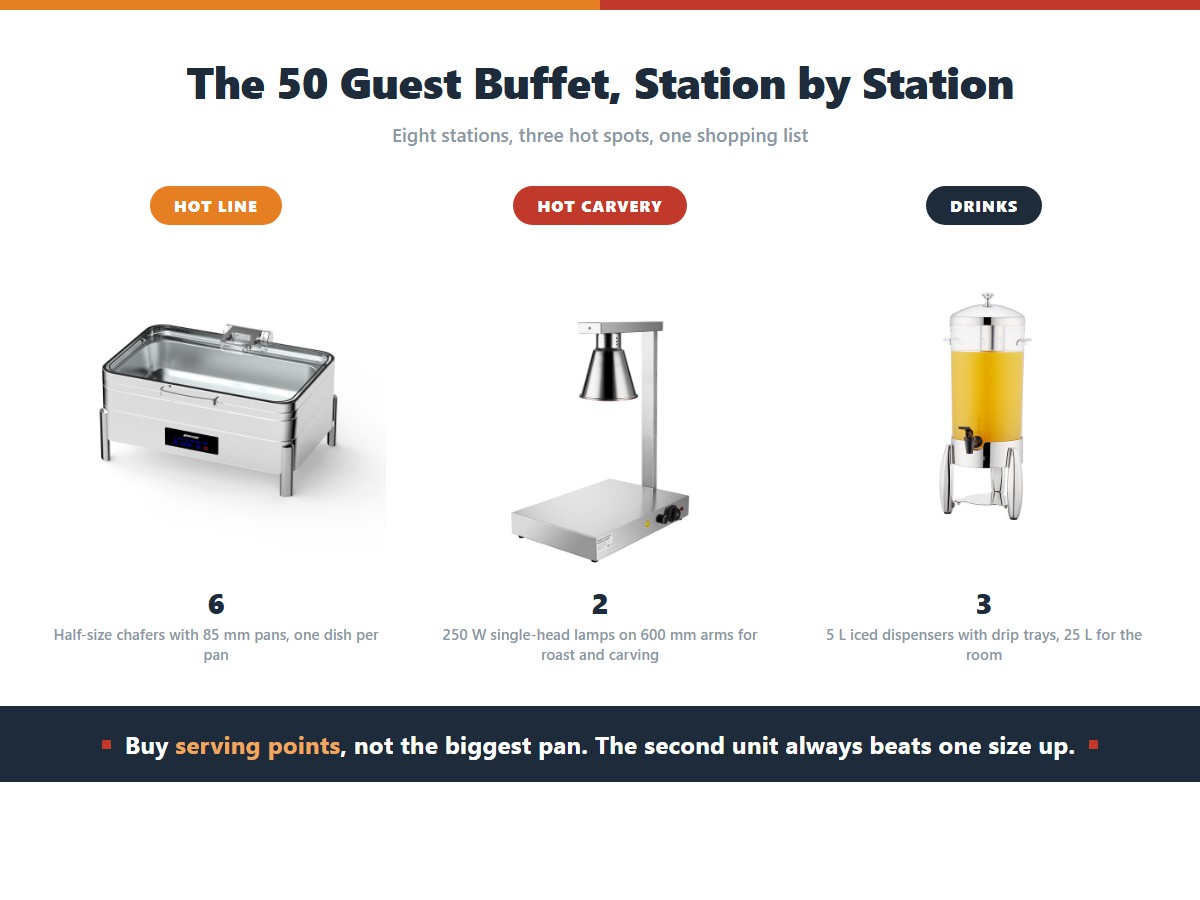
A buffet equipment list is a station list, not a shopping list. Each station has to hold temperature, clear a queue, and survive a refill without the whole line stopping. Read the last column first: the "what to skip" column is where first-year budgets are won or lost.
| Station | Equipment | Qty for 50 guests | Key spec | What to skip |
|---|---|---|---|---|
| Hot main line | Chafing dish, half size | 6 | 304 frame, 85 mm deep pan | Full-size pans if floor space is tight |
| Hot carvery | Heat lamp, single head | 2 | 250 W, 600 mm arm | Double heads on a single station |
| Cold display | Refrigerated case or iced well | 1 | Holds 0 to 4 C | Dry ice for anything recurring |
| Beverage | Dispenser, 5 L | 3 | Iced, with drip tray | One 8 L unit for the whole room |
| Dessert | Cake stand, 3 tier | 2 | Acrylic or glass | A 5 tier tower for 50 guests |
| Live cooking | Induction cooker | 1 | 3.5 kW single zone | Built-in units in year one |
| Plates | Plates, 9 inch | 75 | Melamine or ceramic | Disposables beyond 20 percent |
| Backup | Spare pans and 2 hours of fuel | 1 set | Same model as the fleet | Nothing, this is the line to protect |
Six half-size pans rather than four full-size pans is the single most common correction we make on site visits. Half-size units give you six dishes, six refill points and six temperature zones for the same floor space, and a dropped pan costs you one station instead of two. The backup row is not optional: the first service where a pan is dropped is the service where the line loses a station, and a spare pan of the same model swaps in during a refill cycle rather than mid-rush.
Fuel against electric: the five-year number
This is the decision that decides whether a first-year buffet is affordable, and it is almost always made on the wrong basis. Operators compare the purchase price of a fuel chafer against an electric one, see fuel win by $60, and stop reading. The purchase price is the small number.
| Type | Pros | Cons | Best For |
|---|---|---|---|
| Fuel (Sterno/Gel) | No power needed, portable, cheap upfront | Replace fuel every 2 hrs, open flame risk | Outdoor weddings, events, rentals |
| Electric | Temperature control, no flame, cheaper long-term | Needs power outlet, higher upfront cost | Hotel breakfast, daily restaurant use |
Reading the payback honestly
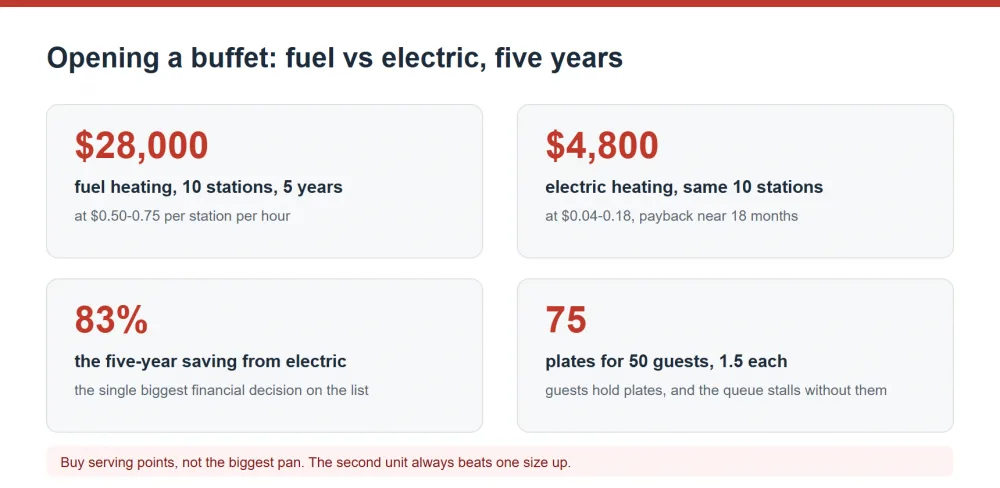
Electric pays back its higher purchase price in roughly 18 months of daily service, and that is the number to test against your own usage. If the line runs three services a day, payback lands inside the first year. If it runs twice a week, the payback stretches past three years and fuel stays defensible for that room. Fuel remains the correct answer for occasional events, outdoor sites without power, and as backup when the circuits are already committed. What is never defensible is fuel in a fixed daily service, where the five-year operating difference on ten stations is about $28,000 against $4,800.
The five decisions that decide the margin
Nearly every first-year buffet is decided by five purchasing decisions, and four of them look like savings at the till.
| Decision | The cheaper option | Five-year consequence | The right option | Why |
|---|---|---|---|---|
| Heating fuel | Fuel cans at $0.50 to $0.75 per hour | About $28,000 on ten stations | Electric at $0.04 to $0.18 per hour | About $4,800 on ten stations, payback near 18 months |
| Plate count | 50 plates, one per guest | Queue stalls, labour rises 10 to 20 percent | 75 plates, 1.5 per guest | Guests hold plates, and a 30 second swap clears the queue |
| Pan depth | 65 mm shallow pans | Food dries at the edges, more refills | 85 mm standard pans | Holds about 40 percent more per pan and refills less often |
| Serving points | One line with ten pans | Caps throughput at 70 to 110 guests per hour | Two lines of five pans | Same equipment, half the queue, two refill owners |
| First-year display | A 5 tier acrylic tower at $180 | Buys a photograph, not throughput | 2 tier, spend on heat and pans | Display sells the dessert, heat sells the whole line |
The rule underneath all five is that a buffet is a throughput business wearing a restaurant costume. Every dollar spent on heat and on a second serving point buys queue speed, which is the only thing guests actually notice. Every dollar spent on display buys a photograph, and the photograph does not refill a pan.
Where the honest trade-offs sit
Three trade-offs are real and worth stating plainly. First, electric needs committed circuits: a bank of electric chafers pulls real amperage, and an older kitchen often needs an electrician before the equipment arrives, which is a cost the fuel comparison never shows. Second, two lines of five pans need floor space and a second refill owner, and a small room may physically only fit one line, in which case the honest answer is fewer dishes and a shorter menu rather than the same menu squeezed into a narrower queue. Third, half-size pans refill more often than full-size pans, so a 90 minute service means more refill trips, not fewer. Weigh these against the queue numbers rather than pretending the cheaper option is free.
Layout order that keeps the line moving
A well-designed buffet line keeps guests moving in one direction and prevents crowding. The order that works is fixed by how people eat, not by where the sockets are.
- Entry and plates. Guests grab a plate first, so plates sit at the head of the line with the cutlery roll.
- Salad and cold dishes. Cold first, because a hot plate under salad wilts it and because cold stations clear fastest.
- Hot food stations. Chafing dishes and warmers in the middle, where the queue is slowest and needs the most width.
- Carving station or heat lamp. Placed after the hot line so carved portions land on a plate that already has its sides.
- Dessert table. Cake stands last among the food, so dessert is a decision rather than an obstacle.
- Beverage station. Drinks at the exit, which keeps spills away from the hot line and clears the room faster.
One-directional flow prevents bottlenecks, and it lets one server own refills from behind the line instead of crossing the queue. If the room forces a U shape, put the plates at both ends of the U rather than the middle, so guests entering late never walk against the flow.
Frequently Asked Questions
What is the minimum equipment to open a buffet?
For 50 guests: six half-size chafing dishes, two heat lamps, three 5 L beverage dispensers, two 3 tier cake stands, one induction cooker and 75 plates, which lands around $3,000 to $4,500 including freight. Add a set of spare pans and two hours of fuel on day one, because the first service where a pan is dropped is the service where the line loses a station.
Fuel or electric for a new buffet?
Electric for any fixed daily service. Fuel costs $0.50 to $0.75 per station per hour against $0.04 to $0.18 for electric, and on ten stations the five-year operating difference is about $28,000 against $4,800, with payback on the higher purchase price in roughly 18 months of daily use. Fuel remains correct for occasional events, outdoor sites without power and backup.
How many plates should I buy?
One and a half per expected guest, so 75 plates for 50 guests. Guests hold a plate for a long time and return for second and third helpings, and a buffet that runs out of clean plates stalls the entire line while one that has surplus clears in a 30 second swap. Disposables are fine up to about 20 percent of covers, beyond that the cost and the look both work against you.
What do first-time operators overspend on?
Display and single large units. Acrylic towers, signage and oversized centrepiece pans photograph well and do nothing for throughput, while the second serving point and the spare pans are what actually save the service. The second instance of any equipment is almost always a better buy than one size up on the first.
How much should I budget for 50 guests?
$3,000 to $4,500 for the core line landed, plus 10 to 15 percent for spares and consumables in year one. Budget the landed cost rather than the catalogue price, because freight, duty and packaging add 8 to 15 percent to an EXW quote and the equipment line is 5 percent of the plate price in the margin calculation.