



Sterno vs Gel vs Electric: Does Electric Save $23,000?
Short answer: yes, roughly. Ten electric chafers running 3 hours a day, 200 days a year, cost about $2,700 over five years including the price premium. The same ten on gel fuel cost about $27,000 in cans alone — a difference close to $24,000, the figure behind the $23,000 claim. Browse the electric models in our chafing dish collection.
The assumptions behind the number
| Input | Value used |
| Units | 10 full-size chafers |
| Service | 3 hours per day, 200 days per year |
| Electric draw | 400 W, $0.15 per kWh |
| Fuel burn | 1 can per 2 hours, $1.80 per can |
| Electric price premium | $90 per unit |
Five-year totals
| Line item | Electric | Gel fuel |
| Hardware (10 units) | $2,100 | $1,200 |
| Energy or cans, year 1 | $360 | $5,400 |
| Five-year consumables | $1,800 | $27,000 |
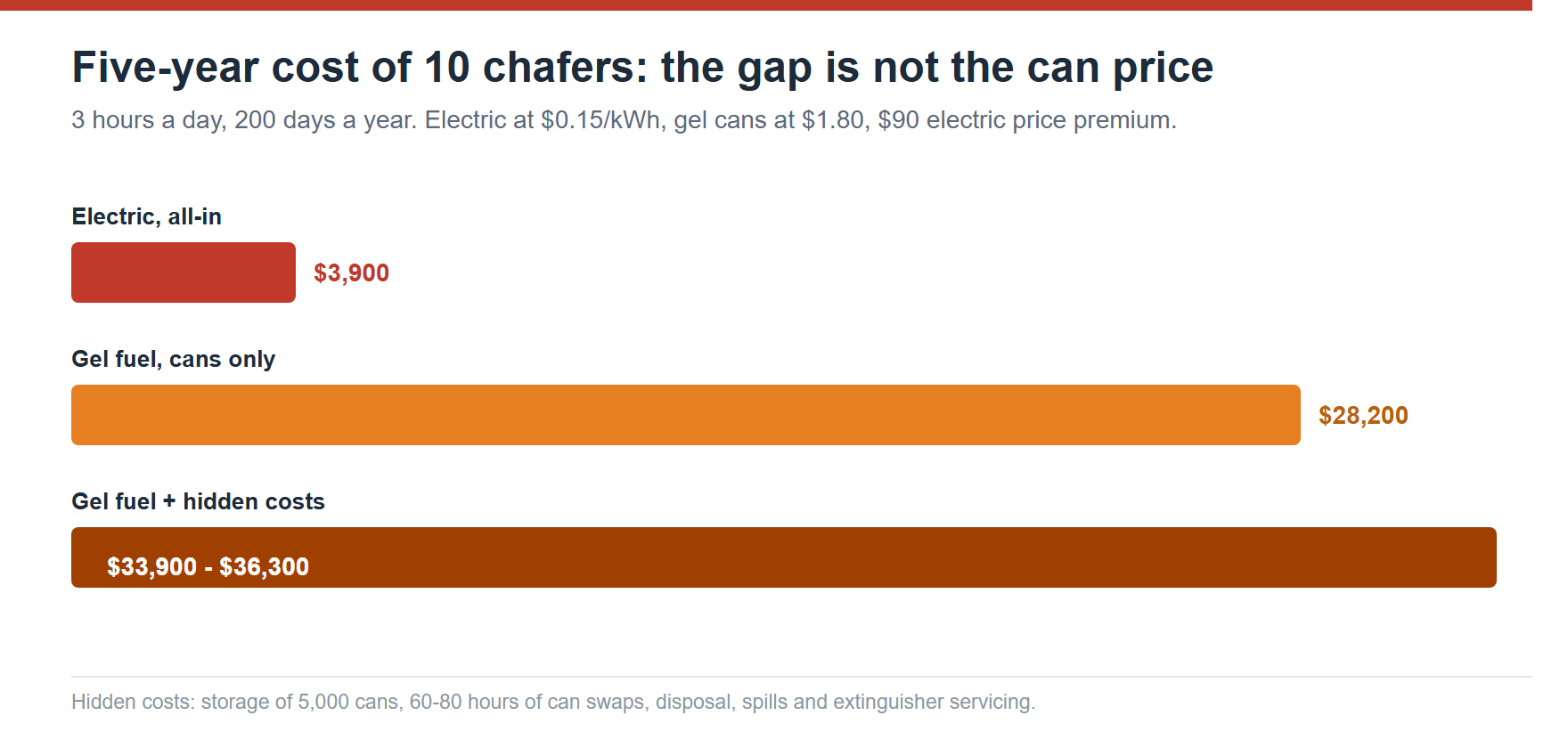
| Five-year total | $3,900 | $28,200 |
The gap is $24,300. Change any input and it moves: at $1.20 per can the fuel side drops to $18,000 and the gap to $14,100; at $3.00 per can it rises past $30,000.
Where the headline number breaks down
- Low volume. At one service a week, cans cost about $560 a year across ten units — real money, but a five-year gap of only $1,000.
- No sockets. If the venue has no power at the line, the comparison is theoretical.
- Short events. A two-hour wedding uses one can per pan; electric still wins, but by $200 a year, not $5,000.
- Cheap electricity is not universal. At $0.30/kWh the electric side doubles to $3,600 over five years and still beats fuel by a wide margin.
What the comparison leaves out
Cans also cost storage space, disposal, and about 90 seconds of staff time per swap. Ten units over five years means 15,000 can swaps — roughly 375 staff hours. Price that at $12 an hour and the fuel side gains another $4,500 of cost that never appears on an invoice.
When fuel still wins
Off-site catering, tents, historic buildings without circuits, and any station that relocates weekly. In those cases the electric premium buys a cable reel and a trip hazard. Hybrid is usually the honest answer: electric on the fixed wall, four fuel frames for the road.
Run the numbers for your own volume
The five-year gap scales almost linearly with hours, so a single multiplication gets you close:
- Count unit-hours per year: pans × hours per service × services per year.
- Fuel side: unit-hours ÷ 2 × can price.
- Electric side: unit-hours × 0.4 kW × your tariff, plus the hardware premium.
- Subtract. Divide the premium by the annual saving to get payback in years.
Example: 6 pans, 3 hours, 120 services a year = 2,160 unit-hours. Fuel: 1,080 cans at $1.80 = $1,944. Electric: 864 kWh at $0.15 = $130, plus $540 premium. First-year saving $1,814, and the premium is recovered in under four months.
What changes the answer fastest
| Variable | Effect on the five-year gap |
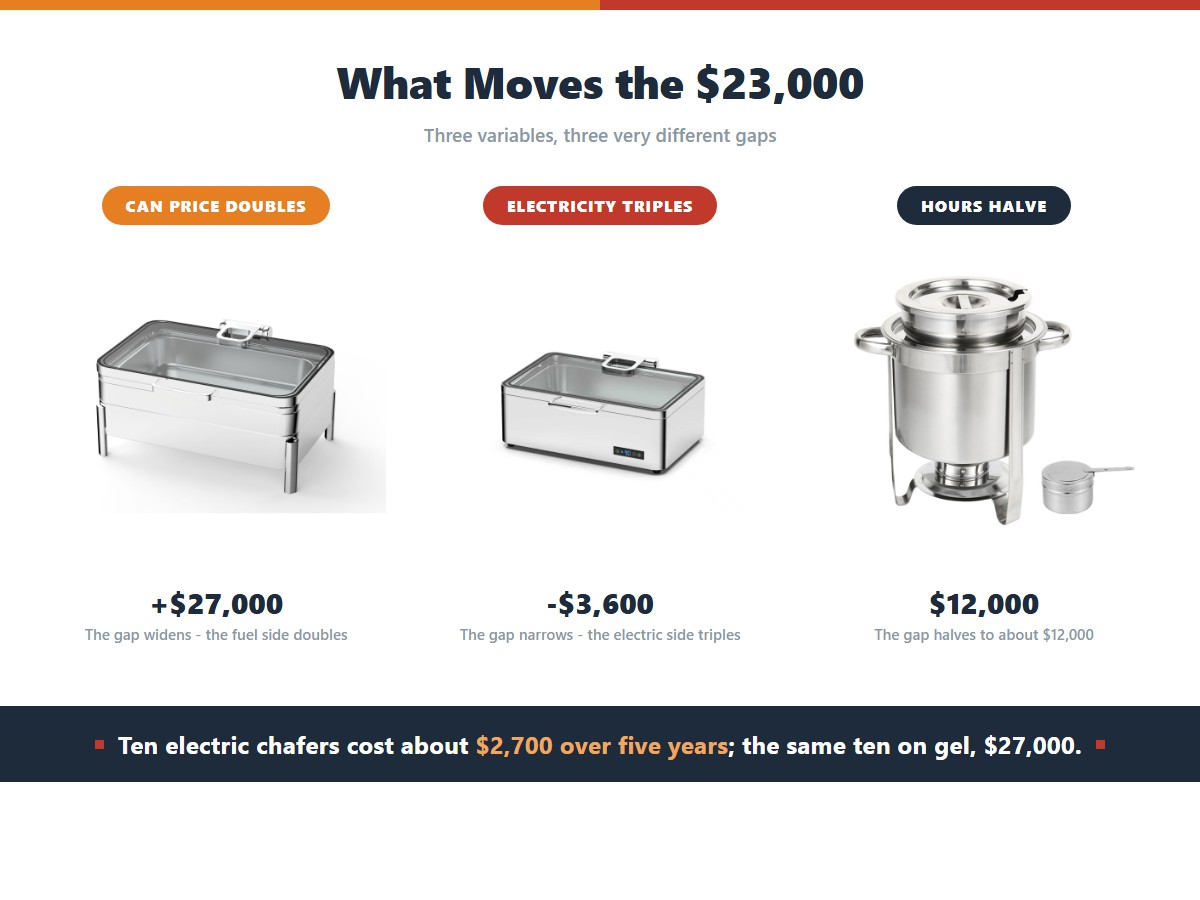
| Can price doubles | Fuel side doubles; gap widens by about $27,000 |
| Electricity triples | Electric side triples; gap narrows by about $3,600 |
| Hours halve | Gap halves to about $12,000 |
| Units drop from 10 to 3 | Gap drops to about $7,300 |
Every version of the model still favours electric for indoor daily service. The argument is only ever about how large the gap is, not which way it points.
How to verify the number in your own venue
Three measurements settle the argument in a week. First, weigh a case of cans and note the price — that sets the fuel cost per hour. Second, put a plug-in energy meter on one electric unit for a full service; a four-hour service typically reads 0.5-0.9 kWh, not the 1.6 kWh the nameplate suggests. Third, time one can swap and one pan refill. Those three numbers, multiplied by your annual services, reproduce the five-year total to within about 10%.
If the answer surprises you, it is usually because the fuel side was underestimated rather than the electric side overestimated. Cans are small, frequent purchases that never trigger a budget review the way a $200 piece of equipment does.
Frequently Asked Questions
Is $23,000 a realistic saving?
Yes for a high-volume operation running ten pans daily. It is not realistic for a venue serving two events a week, where the five-year gap is closer to $1,000-2,000.
Do gel cans cost the same as Sterno?
Gel and wick cans sit in a similar range, roughly $1.20-3.00 each depending on burn time and order size. Long-burn cans lower the per-hour cost but cannot be resealed mid-service.
How many cans does a 3-hour service need?
Two per pan: one full can plus a top-up, or a single 4-hour can if the format allows. Always carry 20% spares.
Does the electric side need extra ventilation?
No. Electric units add no combustion products, which is one reason many indoor venues prefer them.
What about induction instead of electric chafers?
Induction heats faster but needs induction-rated pans and costs more per unit. For holding, a water-bath chafer is cheaper and gentler on food.