



Fuel vs Electric: The 5-Year Cost Nobody Calculates
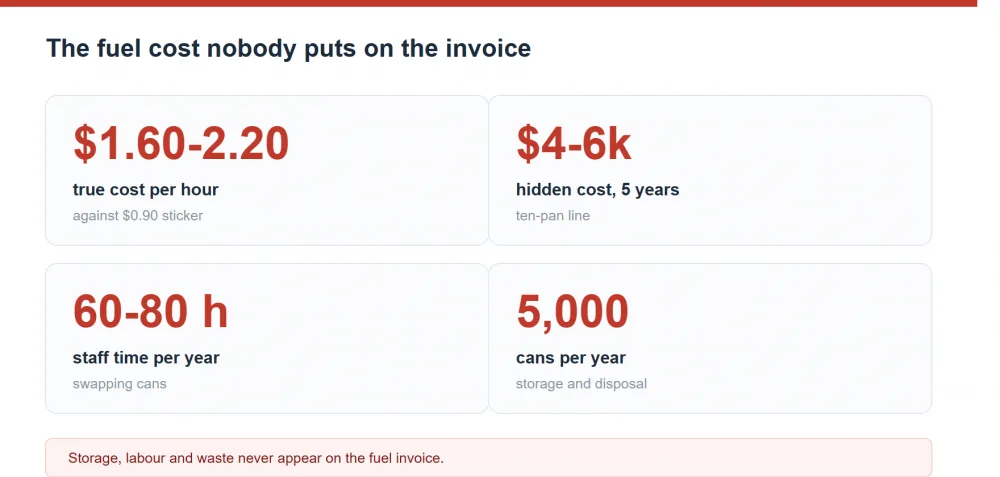
Short answer: the visible comparison — can price against electricity price — misses $4,000-6,000 over five years in storage, disposal, staff time and breakage on a ten-pan fuel line. Add those and the real fuel cost per service hour is closer to $1.60-2.20, not $0.90. Compare frames in our chafing dish range.
What the invoice shows, and what it hides
| Cost | On the invoice | In reality |
| Fuel cans | Yes | Yes, at $1.20-3.00 each |
| Storage space | No | 0.4-0.6 cubic metres per 500 cans |
| Disposal | No | Metal cans to recycling, gel residue to waste |
| Staff time to swap cans | No | 60-90 seconds per swap |
| Spill and breakage | No | Gel stains linen and floors; cans dent in transit |
| Ventilation and fire safety | No | Extinguisher servicing, no-flame signage |
Storage: the quiet cost
A 500-can pallet needs about half a cubic metre and must stay dry and away from heat. In a city venue, that half cubic metre is often the difference between a usable store room and a corridor. Price the space at even $50 per square metre per month and storage adds $300 a year for a ten-pan operation.
Disposal and cleaning
Empty cans are metal, but gel residue is not drain-safe and must go to general waste. Plan 20-30 seconds per can for handling and binning; across 5,000 cans a year that is 25-40 hours of work nobody schedules.
Staff time: the largest hidden line
Every two hours, every pan needs a can swap: open the holder, remove the hot can, seat the new one, relight, check the flame. That is 60-90 seconds of trained attention, plus the walk. On ten pans over a three-hour service it is 15-20 minutes per service — 60-80 hours a year at 200 services.
| Item | Annual hours | Cost at $12/h |
| Can swaps (10 pans, 200 services) | 60-80 | $720-960 |
| Storage handling | 10-15 | $120-180 |
| Disposal and cleaning | 25-40 | $300-480 |
| Total | 95-135 | $1,140-1,620 |
Breakage, spills and insurance
Gel fuel stains linen permanently and is slippery on tile. A single spill at a wedding can cost a tablecloth and a floor clean-up. Many indoor venues also require a fire extinguisher within 10 m of any open flame and annual servicing — a cost that never appears in the fuel comparison.
The corrected total
| Five-year cost | Electric | Fuel |
| Hardware | $2,100 | $1,200 |
| Energy or cans | $1,800 | $27,000 |
| Hidden costs | $0 | $5,700-8,100 |
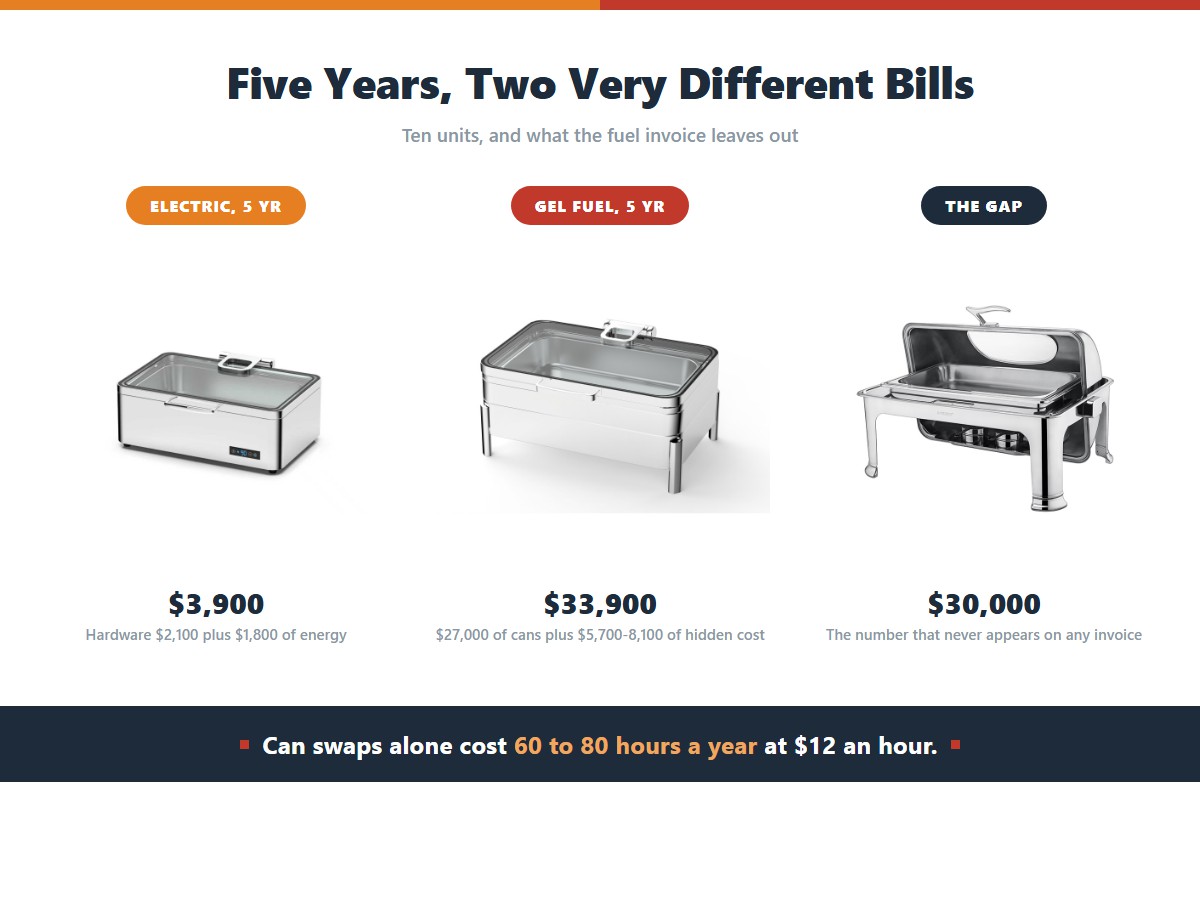
| Total | $3,900 | $33,900-36,300 |
The gap is not $24,000. It is closer to $30,000 once the invisible lines are counted — and that is before the first cable, extinguisher service or stained tablecloth.
The one-page comparison for your finance team
Finance approves equipment, not opinions. Give them a single sheet: hardware cost, energy or consumables per year, labour hours per year, storage and disposal, and a five-year total for each option. Leave out the adjectives. When the fuel column carries four extra lines and the total is three times the electric column, the decision makes itself, and the sheet becomes the reference when somebody proposes switching back to cans next season.
Keep the sheet updated once a year. Can prices move faster than electricity tariffs, and a comparison built on last year's prices quietly stops being true — which is how operations end up paying a premium for the convenience of not redoing the arithmetic.
Frequently Asked Questions
Why do most comparisons stop at the can price?
Because the can price is the only cost that arrives as an invoice. Storage, labour and disposal are absorbed into overheads, so they never appear next to the electricity bill.
Does the hidden cost apply to small operations too?
Proportionally yes, but the absolute number is smaller. A two-pan operation might carry $600-900 of hidden cost over five years rather than $6,000.
Which hidden cost is largest?
Staff time on can swaps, typically 60-80 hours a year for a ten-pan line. It is also the easiest to measure — time one swap and multiply.
Can I reduce fuel hidden costs without switching?
Partly: buy long-burn cans to cut swaps, store in a dedicated rack, and use a snuffer rather than waiting for cans to burn out. That recovers perhaps a third of the gap.
Does electric have hidden costs of its own?
Cables, socket installation and element replacement. Those total a few hundred dollars over five years, far below the fuel side.