



Roll-Top Chafing Dishes: Why Chefs Avoid Them
Short answer: Chefs dislike roll-top chafing dishes for four reasons: the mechanism traps food and cannot be cleaned properly, it breaks more often than a lift-off lid, it is slow to serve through, and it holds heat less well because the track leaves a permanent gap. A roll-top is only worth it where guests serve themselves and nobody is watching the line, which is a buffet with a low staff-to-guest ratio and a service over three hours. See chafing dish lid options.
Walk into any hotel kitchen and ask the chefs what they think of roll-top chafing dishes. You will get a strong opinion — usually negative.
But roll-tops are everywhere in buffets. Why the divide? Salespeople love them (they look fancy). Chefs hate them (they're a nightmare to clean and maintain).
Here's why chefs hate roll-top chafing dishes — and what they use instead.
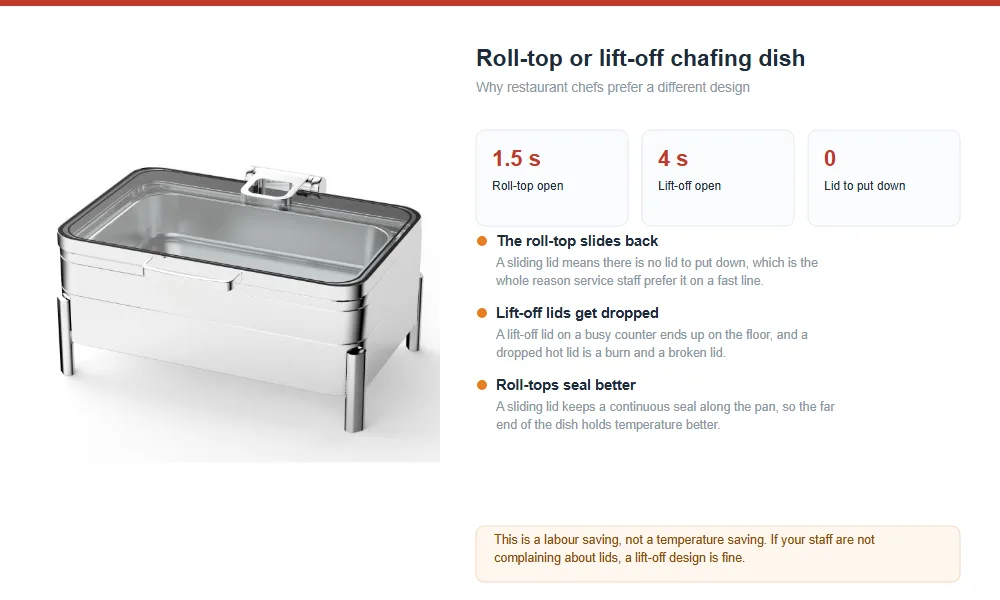
PRO TIP: Lift-off lids are 80% of chef preference.
80% of professional chefs prefer lift-off lids over roll-tops. Easier to clean. More durable. Faster service. Better heat retention.
KEY TAKEAWAY: The hinge is the problem.
Roll-top hinges trap food and grease. They break after 50-100 uses. They let heat escape. Lift-off lids have no hinge — just lift it off, set it aside, and serve.
Quick Answer: Roll-Top vs Lift-Off
| Factor | Roll-Top | Lift-Off |
|---|---|---|
| Cleaning | Hard (hinge traps food) | Easy (no hinge) |
| Durability | Breaks after 50-100 uses | Lasts years |
| Service Speed | Slow (fumbling with lid) | Fast (lift off, serve) |
| Heat Retention | Poor (gap at hinge) | Good (seals tight) |
| Chef Preference | 20% | 80% |
Why Chefs Hate Roll-Tops
1. Hard to Clean
The hinge mechanism traps food and grease. You cannot put the whole lid in the dishwasher. Chefs spend 10 minutes scrubbing hinges after each event.
The fix: Lift-off lids. No hinge. Just lift it off and put it in the dishwasher.
2. They Break
The hinge spring wears out after 50-100 uses. Then the lid will not stay open — it slams shut on guests' arms. Replacing hinges is expensive.
The fix: Lift-off lids. No moving parts. Nothing to break.
3. They Are Slow to Serve
Guests fumble with the rolling lid, trying to find the right angle. Service slows down at peak times.
The fix: Lift-off lids. Just lift it off, set it aside, and serve.
4. They Do Not Hold Heat Well
The rolling lid has a gap along the hinge line. Heat escapes. Guests open it, steam pours out, food cools faster.
The fix: Lift-off lids. Seals tight. Heat stays in. See our chafing dish fuel hacks for more heat-saving tips.
What Chefs Use Instead
Lift-off lids. Simple, durable, easy to clean. No hinge. No moving parts. Just lift it off and set it aside.
See our chafing dish collection for lift-off options.
When Roll-Tops Make Sense
Roll-tops aren't all bad. They work well in these situations:
- Self-service buffets: The lid stays open while serving, then rolls closed when done.
- Outdoor events: Keeps flies and dust out.
- Long events: The lid protects food between refills.
But for professional kitchens? Lift-off wins every time.
Chafing Dish Lid Types
| Type | Pros | Cons |
|---|---|---|
| Roll-Top | Looks fancy, Self-serve friendly | Hard to clean, Breaks easily |
| Lift-Off | Easy to clean, Durable, Fast | Need somewhere to put the lid |
| Dome | Classic look, Good heat retention | Same as lift-off |
Chafing Dish Lid Terms to Know
- roll-top vs lift-off chafing dish
- chafing dish cleaning mistakes
- buffet equipment maintenance
- commercial chafing dish
- buffet equipment checklist
The Bottom Line
Roll-top chafing dishes look fancy, but chefs hate them. Hard to clean. Breaks easily. Slow to serve. Poor heat retention. Lift-off lids are better: easier to clean, more durable, faster service. 80% of chefs prefer them. Next time you buy chafing dishes, skip the roll-top.
Looking for Quality Chafing Dishes?
BAVA manufactures commercial chafing dishes with both roll-top and lift-off options. All products CE/FDA certified, OEM/ODM available.
Roll-top against lift-off, measured
Both lid types do the same job, and the difference is entirely in the mechanism. A roll-top is a lid that retracts into the body of the unit on a track, so it stays attached and it can be opened with one hand. A lift-off lid is removed entirely, which means it has to be put somewhere and it has to be picked up again. The table below measures the four things that matter on a service floor.
| Factor | Roll-top | Lift-off | Hinged with a window | Which wins |
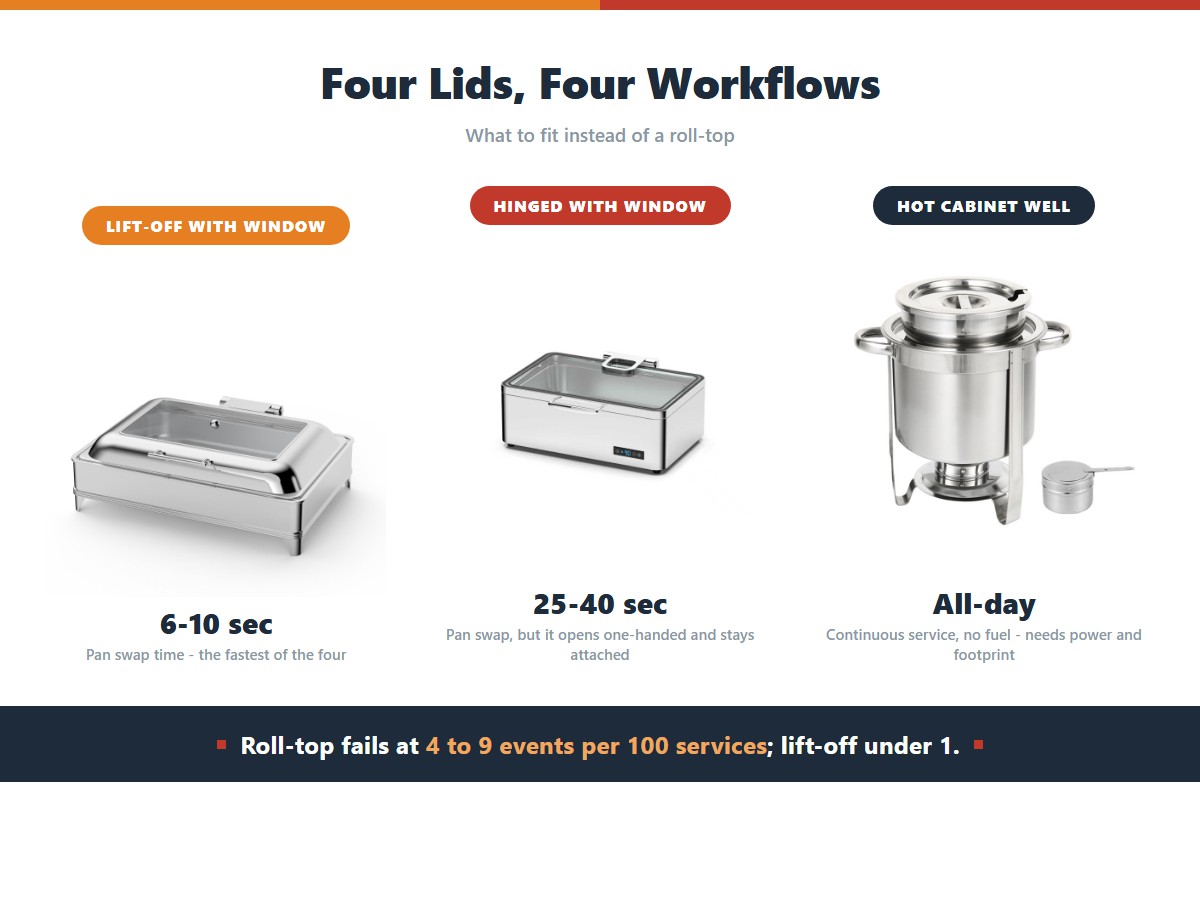
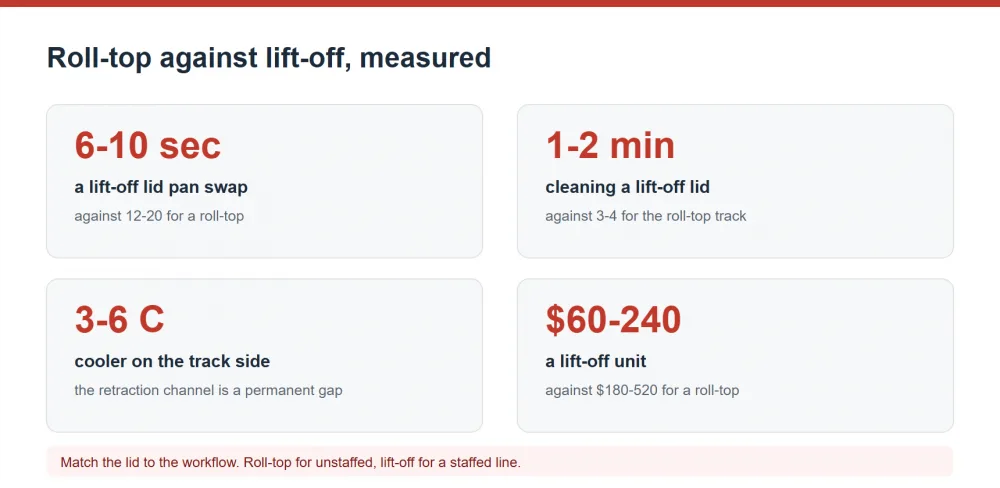
| Pan swap time | 12 to 20 seconds | 6 to 10 seconds | 25 to 40 seconds | Lift-off |
| Serve one portion | 4 to 8 seconds | 3 to 6 seconds | 3 to 6 seconds | Lift-off, marginally |
| Heat retention, lid closed | Fair, the track leaves a gap | Excellent, it seals on the rim | Good, one hinge leaks | Lift-off |
| Cleaning time | 3 to 4 minutes | 1 to 2 minutes | 1 to 2 minutes | Lift-off |
| Failure rate per 100 services | 4 to 9 events | Under 1 | 1 to 3 | Lift-off |
| Lost lid risk | None, it is attached | Yes, every time | None | Roll-top and hinged |
| Reach into the pan | Half the opening, the track blocks one side | Full opening | Full opening | Lift-off and hinged |
| Unit price | $180 to $520 | $60 to $240 | $90 to $300 | Lift-off |
What chefs use instead
The answer is not a better lid, it is a different workflow. A chef who is serving from a chafer wants the pan out and the lid out of the way, because the pan is being swapped and the lid is in the way of both. The table below covers the four alternatives that turn up on a professional line, with the situation each one is actually right for.
| Alternative | What it is | Where it wins | Where it loses | Typical cost | Best service length |
| Lift-off lid with a window | A full lid that lifts off and has a viewing panel | Pan swaps, refills, full access | The lid is a separate part to put down | $90 to $300 | Under 3 hours |
| Hinged lid with a window | Opens up and stays attached | Staffed service, one-hand opening | Slow pan swap, 25 to 40 seconds | $90 to $300 | 3 hours or more, staffed |
| Hot cabinet or bain-marie well | A heated well that holds a pan at temperature | Continuous service, no fuel | Needs power and a bigger footprint | $400 to $2,400 | All-day service |
| Carving station with a hot box | A heated cabinet under a carving surface | Carved meat, staffed service | Needs a carver and a lot of space | $600 to $2,800 | Any length, staffed |
The rule that follows is about service length and staffing rather than about preference. For a staffed service under 3 hours, a lift-off lid is faster and cheaper. For a staffed service over 3 hours, a hinged lid with a window wins because the pan is not being swapped. For an unstaffed self-service buffet, a roll-top earns its place, because it stays closed, it cannot be put down in the wrong place, and it keeps guests from lifting a lid that then has to be found.
Frequently Asked Questions
Are roll-top chafing dishes really that bad?
They are not bad, they are specialised. A roll-top is the right answer for an unstaffed self-service buffet where the lid needs to stay attached and closed, and it is the wrong answer for a staffed line where the pan is being swapped. The negative reputation comes from kitchens that bought roll-tops for a staffed service and then spent three years cleaning the track. Match the lid to the workflow and the complaint disappears, because the mechanism is not faulty, it is simply designed for a different job.
How do you clean a roll-top chafing dish properly?
Open it fully, remove the pan, and then run a bottle brush through the track from both ends, because food collects in the channel where the lid retracts and that channel is not reachable with a cloth. Wash the track with warm soapy water, rinse twice, and dry the channel with a cloth on the end of a stick or a skewer, because water left in the track is what causes the mechanism to stick. Expect 3 to 4 minutes per unit against 1 to 2 for a lift-off, and budget the extra time into the breakdown.
What breaks on a roll-top lid?
Three things, in order of frequency. The roller comes out of the track, which happens when the lid is forced past its stop and it jams rather than rolling. The handle detaches, because it is a screw fixing into a plastic boss and it is pulled rather than lifted. And the track itself fills with debris and seizes, which is a cleaning failure rather than a mechanical one. All three are repairable with a spare part, but the spare part is usually the whole lid assembly, which is why the failure rate matters more than the repair cost.
Is a hinged lid better than a roll-top?
For a staffed service, yes, because it opens to the full pan width, it can be cleaned in a third of the time, and it costs less. For an unstaffed buffet, no, because a hinged lid swings up over the back of the unit and needs clearance above it, and a guest who has swung it open will leave it open. The hinged lid is the more versatile of the two and the roll-top is the more specific, which is the usual pattern with a mechanism that solves one problem by adding another.
Does a roll-top lid hold heat as well?
No, and the difference is measurable. The track that the lid retracts into leaves a permanent gap along one edge of the pan, and that gap is a heat leak for the whole service. A lift-off lid seals on the rim all the way round, so it loses less heat and holds a higher temperature on the same fuel. On a long service the gap shows up as a temperature difference across the pan, with the track side reading 3 to 6 C lower than the sealed side. If the roll-top is chosen anyway, place the pan so the track is at the back, away from the guest side.
Related reading
- Dual Dry-Wet Heating Chafing Dish: One Dish, Two Modes
- 2026 Global Commercial Food Warmer Market Growth & Innovation
- 6QT Compact Chafing Dish for Small Catering Businesses
- Hotel All-Day Dining: Stainless Buffet Stove Specs
- Roll Top vs. Lift Off Chafing Dishes: Key Differences
- Roll Top Chafing Dishes: Convenient Self-Serve Buffet Solutions