



Your Chafing Dish Is Too Hot: The 135°F Myth
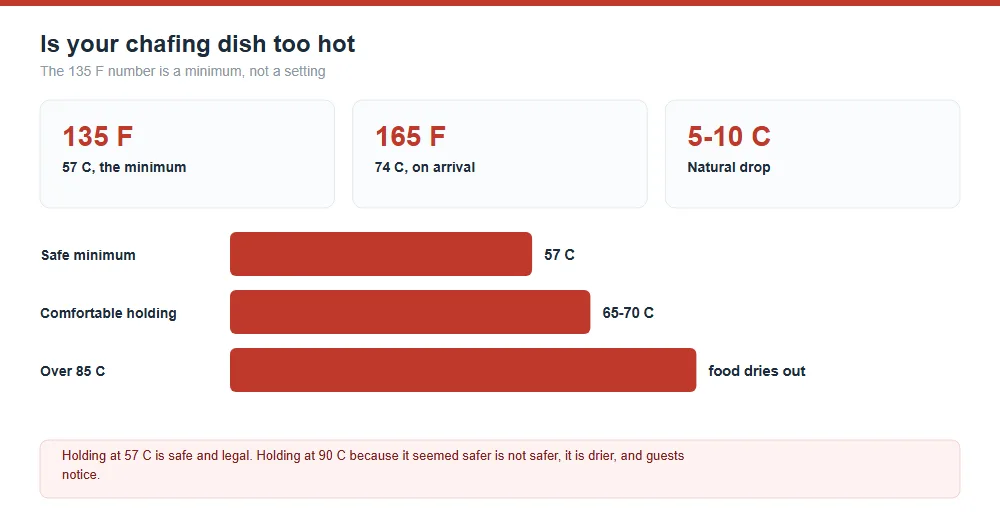
Short answer: 60 C (140 F) is the legal hot-holding floor, and the 135 F (57 C) figure is a myth that comes from confusing a minimum legal temperature with a target. A chafer holding at 57 C has only 3 C of margin, and a 15 minute uncovered service takes it into the danger zone. The correct target is 70 to 75 C for gravy, poultry and minced meat, and 65 to 70 C for whole joints and vegetables. See chafing dish and heat lamp temperature control.
Most caterers think hotter is better. They crank the heat, keep two fuel cans burning, and wonder why their roast beef is dry and their vegetables are mushy.
The truth: the 135°F (57°C) minimum is a safety floor, not a target. The ideal hot holding temperature is 140-150°F (60-65°C) — not 180°F.
If your chafing dish is above 70°C, you're not keeping food safe — you're cooking it further and ruining it.
PRO TIP: Use one fuel can, not two.
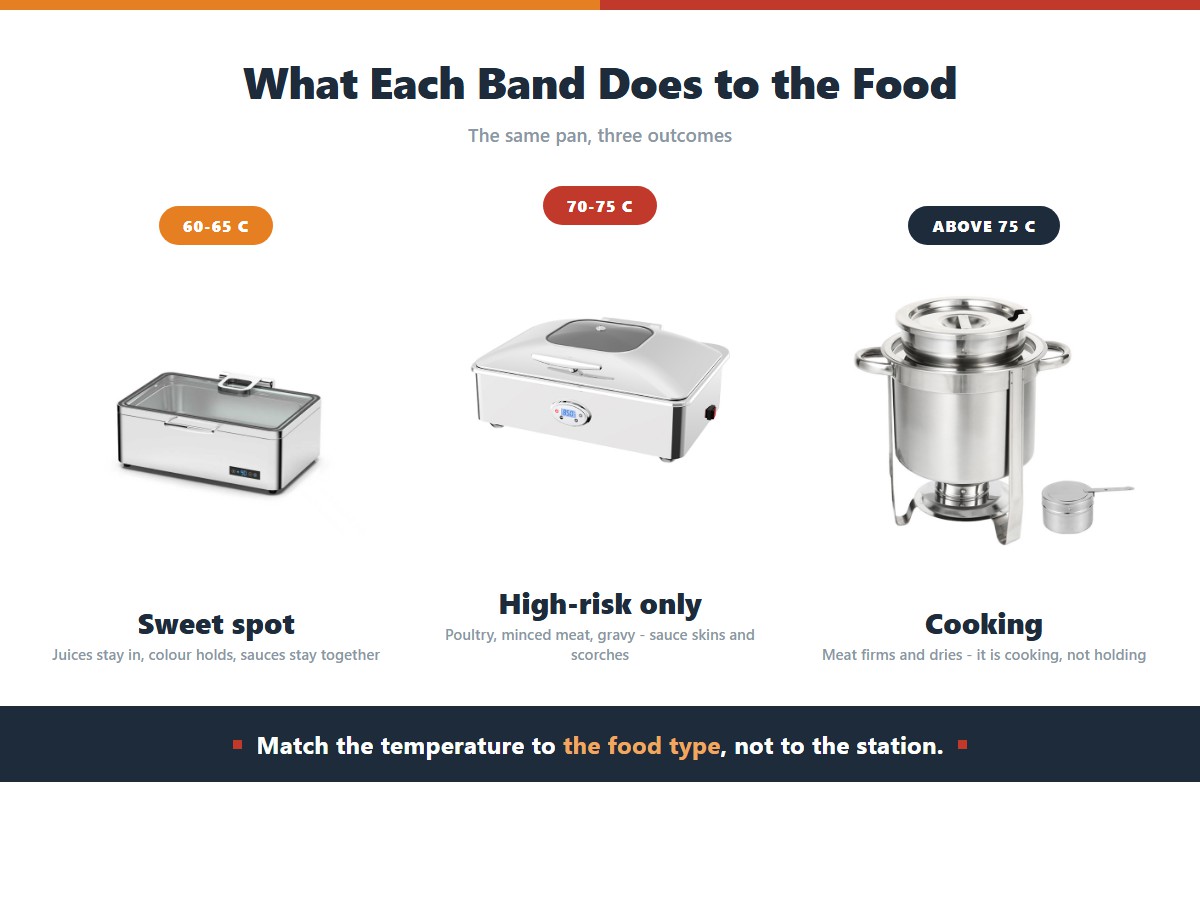
Two fuel cans = 80°C+ = food dries out. One fuel can = 60-65°C = perfect. Start with one. Check the temperature. Add a second only if it drops below 60°C.
KEY TAKEAWAY: 60-65°C is the sweet spot.
Food stays safe at 60°C+. But above 70°C, quality drops fast. Proteins shrink. Vegetables turn to mush. Sauces separate. Meat loses 10% of its moisture in an hour.
Quick Answer: Temperature Zones
| Temperature | Zone | Result |
|---|---|---|
| Below 60°C (140°F) | Too Cold | Food safety risk |
| 60-65°C (140-150°F) | Perfect | Safe + good quality |
| 65-70°C (150-158°F) | Max for delicate | OK for dense foods |
| Above 70°C (158°F) | Too Hot | Quality drops, food dries out |
Why Hotter Is Not Better
Above 70°C (158°F), food quality degrades fast:
- Proteins tighten and shrink: Meat gets tough.
- Vegetables turn to mush: Broccoli, carrots, green beans get soggy.
- Sauces separate: Gravy splits. Oil rises to the top.
- Meat loses 10% moisture: In just one hour.
You're not keeping food safe — you're cooking it further and ruining it. See our food holding temperature chart for more details.
Ideal Temperatures by Food Type
| Food Type | Ideal Temp | Notes |
|---|---|---|
| Fish, seafood | 60-65°C | Delicate, dries out fast |
| Vegetables | 60-65°C | Don't overheat |
| Poultry | 65-70°C | Higher safety requirement |
| Roast beef, pork | 65-70°C | Dense, holds heat well |
| Soups, stews | 65-70°C | Liquid, stays moist |
| Sauces, gravies | 60-65°C | Don't overheat, they separate |
The 135°F Myth
Most people think 135°F (57°C) is the target. It's not. It's the minimum safety requirement.
135°F (57°C): Safety floor. Below this, bacteria grow fast. You must be above this.
140-150°F (60-65°C): Ideal. Food stays safe, texture stays good.
160°F+ (70°C+): Too hot. Quality drops. Food dries out. Fuel burns faster.
See our chafing dish fuel vs electric cost comparison for more savings tips.
5 Quality-Killing Temperature Mistakes
| Mistake | What Happens | Fix |
|---|---|---|
| Two fuel cans always | 80°C+ = food dries out | Start with one |
| No thermometer | Guessing temperature | Use probe thermometer |
| Same temp for all foods | Fish gets overcooked | Match temp to food type |
| Too hot heat lamp | Food dries out on top | 40-60cm height |
| No humidity | Food gets dry | Water pan for steam |
Chafing Dish Temperature Terms to Know
- chafing dish temperature guide
- food holding temperature chart
- chafing dish fuel hacks
- heat lamp mistakes
- electric chafing dish with thermostat
The Bottom Line
Hotter is not better. The 135°F minimum is a safety floor, not a target. The ideal temperature is 60-65°C. Above 70°C, quality drops fast. Use one fuel can. Check the temperature with a probe thermometer. Do that, and your food stays hot, moist, and delicious for the whole service.
Looking for Temperature-Controlled Chafing Dishes?
BAVA manufactures electric chafing dishes with adjustable thermostats so you can set the exact temperature. All products CE/FDA certified, OEM/ODM available.
Where 135 F comes from, and what it should be
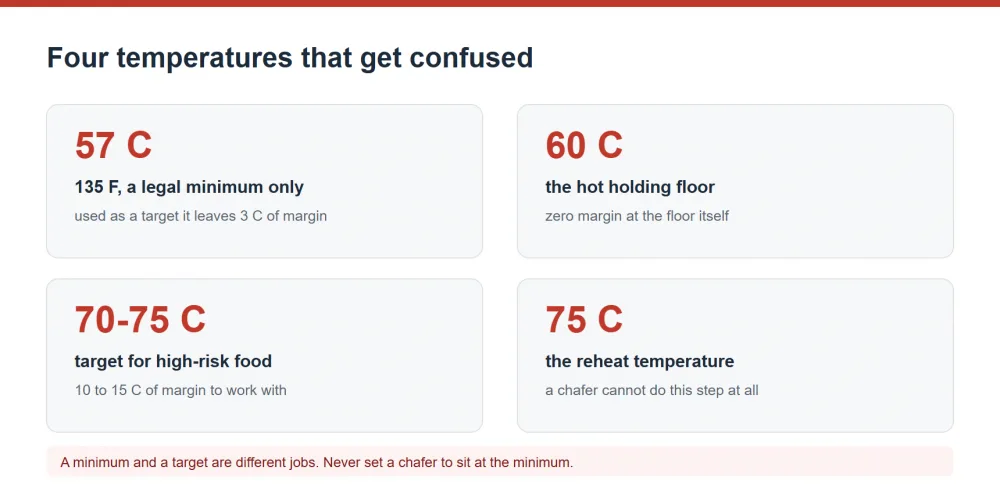
The 135 F figure is not invented, and that is why it survives. It is a real number in a real standard, but it is a minimum, and treating a minimum as a target removes every margin the standard was designed to leave. A chafer set to sit at 57 C will drift below 60 C the moment the lid comes off, and the drift happens exactly when the guests are being served. The table below separates the three numbers that get confused.
| Number | What it actually is | Use it as | What happens if you use it as a target | Margin at that setting |
| 57 C, 135 F | A legal minimum in some codes, and the bottom of the hot holding band | Never as a target, only as a floor | The pan is below 60 C within 20 to 40 minutes of an uncovered service | 3 C, effectively none |
| 60 C, 140 F | The hot-holding floor in most international codes | The absolute floor of your operating band | Still below the operating band for high-risk food | 0 C at the floor |
| 70 to 75 C | The correct operating band for gravy, poultry, minced and stuffed dishes | The setpoint for high-risk items | Nothing, this is the right number | 10 to 15 C |
| 65 to 70 C | The correct operating band for joints, fish, rice and vegetables | The setpoint for standard hot items | Nothing, this is the right number | 5 to 10 C |
What the heat actually does to the food
Heat does not just keep food hot; it keeps cooking it, and every extra degree has a cost that shows up on the plate before it shows up on the probe. The table below is the honest trade-off between a safe hold and a good plate, and it is why the target sits in a band rather than at a single number.
| Holding temperature | What it does to protein | What it does to vegetables | What it does to sauces | Fuel or power cost | What it holds safely |
| Below 60 C | Nothing visible yet | Nothing yet | Nothing yet | Lowest | Nothing, the 2 hour clock is running |
| 60 to 65 C | Juices stay in, texture holds | Colour holds | Stays together | Baseline | Most hot items, the sweet spot |
| 65 to 70 C | Juices begin to leave | Colour dulls slowly | Starts to thin | Moderately higher | Dense items, joints, rice, pasta |
| 70 to 75 C | Moisture loss accelerates | Softens | Sauce skins and scorches | Noticeably higher | High-risk items, poultry, minced meat, gravy |
| Above 75 C | Meat firms and dries, up to 10% moisture an hour | Mushy, colour gone | Separates, oil rises | Roughly double the baseline | Nothing new; it is cooking, not holding |
The practical rule follows from the table: hold high-risk food at the top of the band where safety needs the margin, hold dense and delicate food in the middle where quality survives, and treat anything above 75 C as an equipment fault rather than a setting. A chafer that sits at 80 C is not more sterile, it is just burning fuel and drying the food, and the same dish held at 62 C will be served as a better plate for roughly half the fuel.
Frequently Asked Questions
Is 135 F wrong or just out of date?
It is a real minimum in some codes, and it is used wrongly as a target. The problem is that a minimum and a target are different jobs. A minimum is the point at which you are still legal, and a target is the point at which you are safe after the lid comes off, a guest reaches in and the pan is refilled. Set a chafer to 57 C and a 15 minute uncovered service takes it to 55 C, which is in the danger zone, and you have no record and no margin. Set it to 72 C and the same service leaves you at 70 C, which is still above the floor.
How do I measure the temperature of a chafing dish?
Measure where the food is slowest to respond, which is the centre of the pan, and ignore what the probe reads in the water or in the sauce sitting on top. Take a reading at the centre and at each corner of a large pan and use the lowest figure, because a pan can show 68 C at the edge while the middle has never reached 60 C. Calibrate the probe once a month in an ice bath, write each reading against a time on the log, and vary where you probe between checks, because the spot you keep testing is the spot that has already been disturbed by the probe.
Will a lid on the chafer raise the temperature?
A lid does not add heat, it stops the heat leaving, and the difference is large enough to show up as a whole service held safely. Run the same chafer open and covered on the same fuel and the covered one keeps the water at holding temperature for roughly twice as long, which is the difference between a dish that drifts into the danger zone and one that holds. Keep the lid down between serves and lift it only while a guest is serving, and do not leave it propped open for display, because the steam that reads as "warm" is the heat leaving the food.
Does a heat lamp hold food at a safe temperature?
It slows cooling and it does not hold a temperature, which is why a heat lamp is a display device and a chafer is a holding device. A heat lamp over carved meat keeps the surface warm and the centre cools, so a probe reading at the surface will flatter the food. The correct use is a heat lamp above a carving station as a supplement to a hot cabinet underneath, not as the only control. A heat lamp alone is acceptable only for food that will be served within 15 to 20 minutes.
What temperature should a cold buffet hold at?
5 C or below, measured in the food rather than in the well, and 8 C is the point at which the 2 hour clock has already started. A cold well with ice keeps a salad at 2 to 5 C for about 90 to 150 minutes before the ice needs replacing, so a long service needs a restock plan for the ice as well as for the food. Yogurt and dairy-based salads are the highest-risk cold items, and they should be portioned from a refrigerated backup rather than sitting in a well from the start of the service.
Related reading
- Dual Dry-Wet Heating Chafing Dish: One Dish, Two Modes
- 2026 Global Commercial Food Warmer Market Growth & Innovation
- 6QT Compact Chafing Dish for Small Catering Businesses
- Hotel All-Day Dining: Stainless Buffet Stove Specs
- 900W Fast-Heat Chafing Dish: Hot Food in 10 Minutes, Not 30
- Why Your Chafing Dish Has Hot Spots (And How to Fix It)