

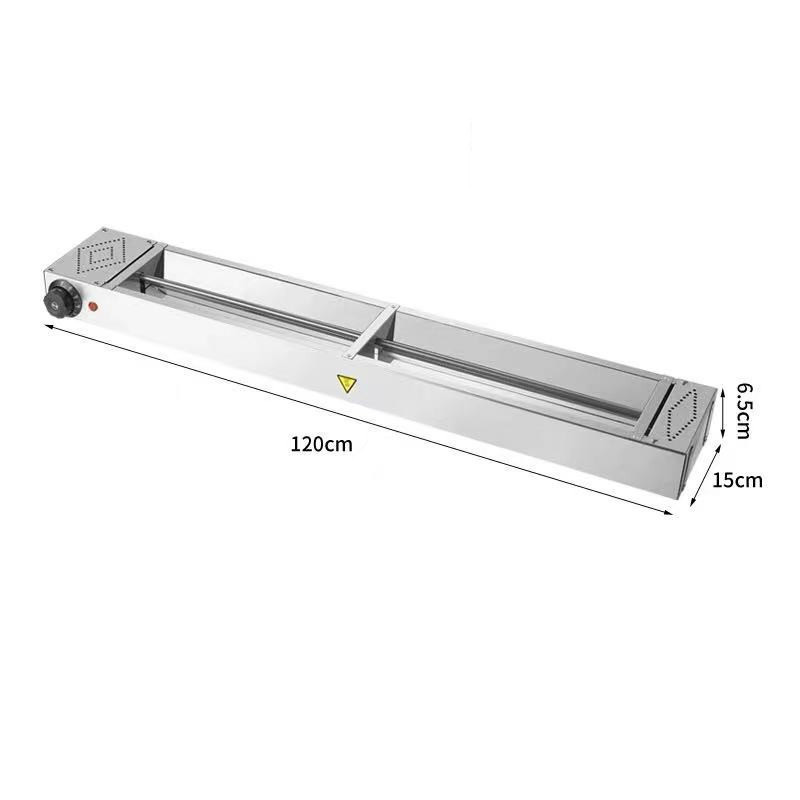


Food Holding Temperature Chart: The 2-Hour Rule You Can't Ignore
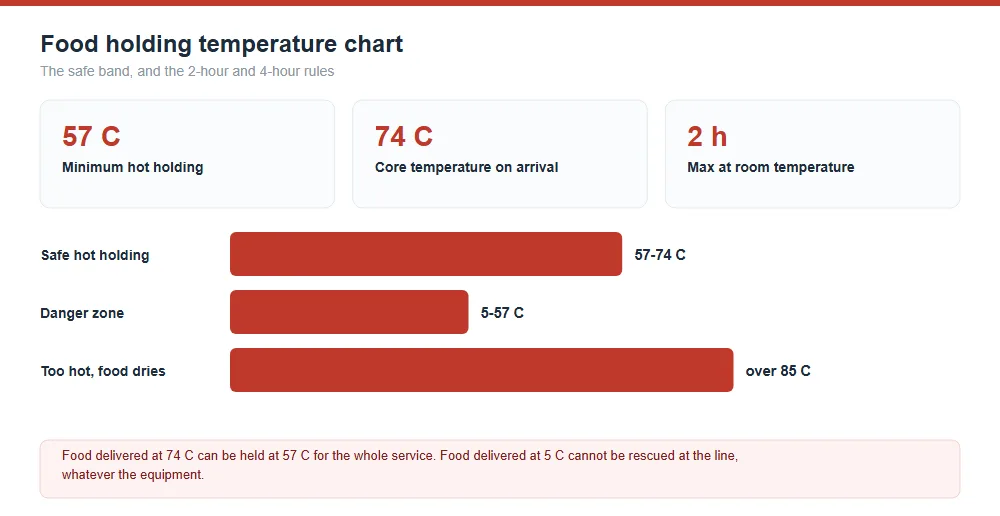
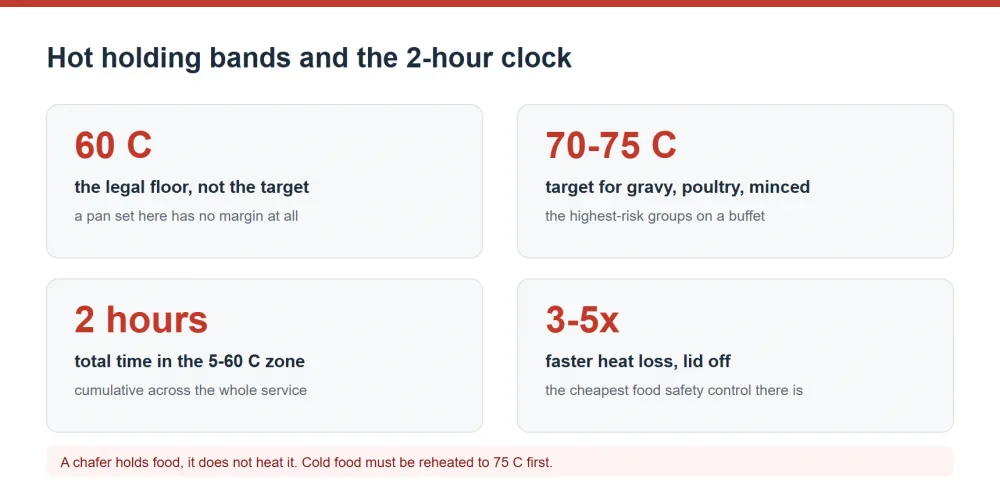
Short answer: Hot food must hold at 60°C or above and cold food at 5°C or below, and the 2-hour rule means food may sit in the 5–60°C danger zone for two hours before it is reheated to 75°C or discarded. That window is cumulative, not per service: a product that has spent 90 minutes on a cold buffet has 30 minutes left. A chafer at 58°C has only 2°C of margin, and a lid is the only thing that reliably recovers it. See chafing dish and heat lamp options.
You're running a buffet. The chicken came out of the oven at 180°C. You put it in the chafing dish and turn on the heat lamp. You think it's safe. But an hour later, the food has dropped to 50°C. You're now in the danger zone.
Food safety isn't just about cooking. It's about holding temperature. If food sits in the danger zone too long, bacteria grow to dangerous levels. One bad batch and you're facing a health code violation.
Here's the food holding temperature chart you need to keep your buffet safe and pass every health inspection.
PRO TIP: Use a probe thermometer, not a guess.
"It feels hot" isn't good enough. Stick a probe thermometer into the thickest part of the food. Check every 30 minutes. Your buffet chafing dish looks hot from the outside, but the center might be in the danger zone.
KEY TAKEAWAY: 2 hours max in the danger zone.
Bacteria double every 20 minutes between 5°C and 60°C. After 2 hours, you're at unsafe levels. Throw it out. Don't risk it.
Quick Answer: Temperature Zones
| Zone | Temperature | What Happens |
|---|---|---|
| Cold Holding | Below 5°C (41°F) | Bacteria growth slows down |
| Danger Zone | 5°C - 60°C (41°F - 140°F) | Bacteria multiply rapidly |
| Hot Holding | Above 60°C (140°F) | Bacteria growth stops |
Hot Holding Temperatures by Food Type
| Food Category | Minimum Temp | Notes |
|---|---|---|
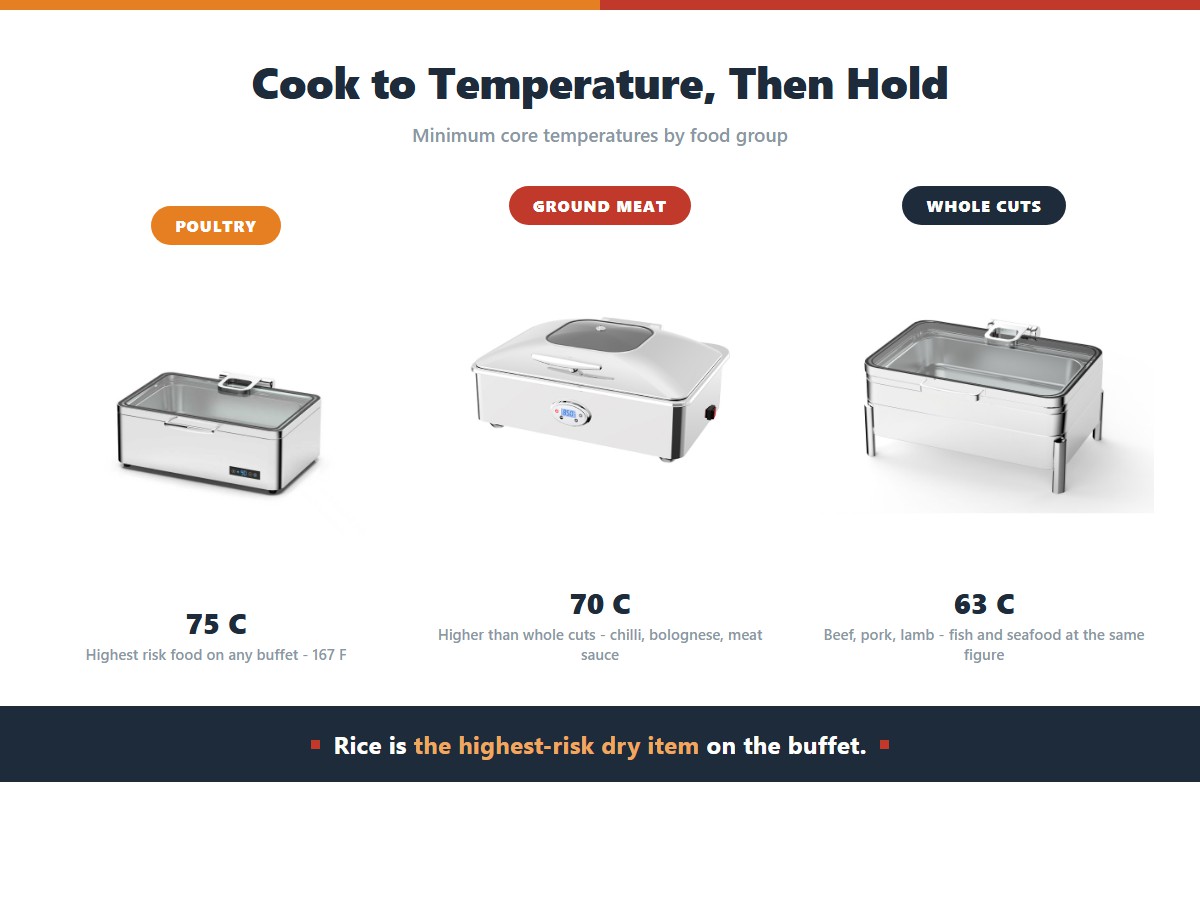
| Poultry (chicken, turkey) | 75°C (167°F) | Highest risk food |
| Ground meat | 70°C (158°F) | Higher than whole cuts |
| Whole cuts of meat | 63°C (145°F) | Beef, pork, lamb |
| Seafood | 63°C (145°F) | Fish, shellfish |
| Rice, pasta | 60°C (140°F) | Bacillus cereus risk |
| Soups, sauces | 60°C (140°F) | Keep covered |
Cold Holding Temperatures
Cold food must stay below 5°C (41°F). This includes salads, fruit, desserts, and cold cuts.
- Use refrigerated display cases
- Or use ice beds (ice must be below the container)
- Check temperature every 30 minutes
- Never leave cold food out for more than 2 hours
See our buffet equipment checklist for more tips.
The Danger Zone Explained
The danger zone is 5°C to 60°C. This is where bacteria grow fastest. Bacteria double every 20 minutes in this range.
2 hours rule: Don't leave food in the danger zone for more than 2 hours. After 2 hours, throw it out. You can't "kill" the bacteria by reheating — some toxins are heat-stable.
What happens:
- 0-30 min: Bacteria start multiplying
- 30-60 min: Bacteria double every 20 min
- 1-2 hours: Dangerous levels reached
- 2+ hours: Food must be thrown out
5 Temperature Mistakes
| Mistake | What Happens | Fix |
|---|---|---|
| Guessing temperature | Food in danger zone | Use probe thermometer |
| Not checking regularly | Temperature drops unnoticed | Check every 30 min |
| Overfilling chafing dish | Center stays cold | Don't overfill |
| Leaving lids off | Temperature drops fast | Keep lids on |
| Reheating cold food in chafing dish | Spends too long in danger zone | Reheat separately |
Temperature Terms to Know
- food holding temperature chart
- chafing dish cleaning guide
- heat lamp re-lamping
- buffet equipment checklist
- commercial heat lamp
The Bottom Line
Food safety comes down to one rule: keep hot food hot (60°C+), keep cold food cold (5°C-), and never leave food in the danger zone for more than 2 hours. Use a probe thermometer. Check every 30 minutes. It's the difference between passing a health inspection and a customer getting food poisoning.
Looking for Temperature-Safe Buffet Equipment?
BAVA manufactures commercial buffet equipment designed to hold food at safe temperatures. All products CE/FDA certified, OEM/ODM available.
The temperature bands, by food group
The band is not one number, and quoting 60 C alone causes over-cooking on a long service and under-holding on a short one. What the food actually needs is a target with a band, and the band is set by the moisture the food loses at the top of it. The table below uses the common buffet groups and the figures that a food safety record will be checked against.
| Food group | Hold at | Absolute minimum | Maximum practical | Max time in the zone | Notes |
| Gravy, sauce and soup | 70 to 75 C | 60 C | 80 C | 2 hours cumulative | The most common source of a temperature complaint |
| Minced and ground meat | 70 to 75 C | 60 C | 78 C | 2 hours cumulative | Chilli, bolognese, meat sauce |
| Poultry and stuffed dishes | 70 to 75 C | 60 C | 78 C | 2 hours cumulative | Highest risk group on any buffet |
| Whole meat joints and carved meat | 65 to 70 C | 60 C | 75 C | 2 hours cumulative | Carving at the table is the biggest risk point |
| Fish and seafood | 65 to 70 C | 60 C | 72 C | 1.5 hours cumulative | Dries and flakes quickly above 72 C |
| Rice, pasta and grains | 65 to 70 C | 60 C | 75 C | 2 hours cumulative | Rice is the highest-risk dry item |
| Vegetables and sides | 65 to 70 C | 60 C | 75 C | 2 hours cumulative | Leafy greens lose colour above 75 C |
| Cold salads and dairy | 2 to 5 C | 5 C | 8 C | 2 hours cumulative | Above 8 C the 2 hour clock is already running |
| Frozen desserts | -18 to -12 C | -12 C | -6 C | Not applicable | A chilled well is not a freezer |
Where the 2-hour rule actually gets spent
The two hours are consumed in four places, and only one of them is the service itself. The most common failure is a venue that has technically met the rule at every stage and still has no margin, because the food has spent time in the zone between stages and nobody counted it. The table below is the honest accounting for a standard 4 hour buffet service.
| Stage | Typical time in the 5 to 60 C zone | Is it counted | What to do | Margin left |
| Cooking to service | 0 to 10 minutes | No, cooking is above the zone | Nothing | Full 2 hours |
| Plating and transporting | 15 to 40 minutes | No, nobody counts it | Insulated carriers, not open trays | 1 hour 20 minutes to 1 hour 45 minutes |
| Waiting before doors open | 10 to 30 minutes | No | Lids on, water pans already hot | 1 hour to 1 hour 30 minutes |
| The service itself | 0 to 30 minutes per refill | Yes, this is the part people do count | Refill in smaller batches, not one full pan | Whatever is left |
| Clearing and breakdown | 20 to 45 minutes | No | Lids back on until the pan is emptied | Effectively gone |
The practical consequence is that a 2 hour buffet has a comfortable margin and a 4 hour buffet does not, because a 4 hour service spends the first hour getting to the line and the last 30 minutes clearing it. For anything above 3 hours, refill in half-pan batches rather than full pans, and hold the backup food above 60 C rather than letting it sit in the zone waiting for the pan to empty. A 60 minute refill cycle costs one extra refill and protects the whole clock.
Frequently Asked Questions
Is the 2-hour rule about total time or about temperature?
It is about total time in the danger zone, which is 5 to 60 C, and it is cumulative across the whole service, not reset at each refill. A pan of chilli that has been on a cold buffet for 45 minutes before it is heated has 1 hour 15 minutes left, regardless of how long it is then held above 60 C. This is the single most misunderstood point in buffet food safety, and the way to manage it is to record the time the food entered the zone, not the time it was plated.
Can I reheat food that has been in the danger zone for 2 hours?
No. After two cumulative hours in the 5 to 60 C band the food must be discarded, because reheating does not reverse the toxins that some organisms produce, and it does not restore the quality. This is why the rule is enforced as a time limit rather than as a temperature check: a probe reading of 70 C tells you the food is hot now, not that it is safe. If the food has been in the zone for under 2 hours it may be reheated to 75 C once, and it must then be served immediately.
Does a lid on the chafer change the temperature rule?
A lid does not change the rule, but it changes the margin enormously. A covered pan loses heat roughly 3 to 5 times more slowly than an uncovered one, so the same fuel or the same element holds a higher temperature for longer. In practice an uncovered pan at a busy station drifts below 60 C within 20 to 40 minutes, while a covered one holds for 2 hours or more. On a long service the lid is the single most effective food safety control on the buffet, and it costs nothing.
How do I measure holding temperature correctly?
Insert the probe into the centre of the food, not into the water pan and not into the sauce on top, because the centre is the slowest part to heat and the last part to cool. Take a reading at two or three points across the pan and record the lowest one, because a pan can read 68 C at the edge and 58 C in the middle on a large volume. Calibrate the probe monthly in an ice bath, and record the reading against a time, because a record is what an auditor asks for and a feeling is not.
What is the difference between hot holding and reheating?
Hot holding keeps food that has already been cooked above 60 C, and it does not kill anything. Reheating takes food that has been cooked and cooled and brings it back above 75 C, which is the temperature at which pathogens are actually destroyed. A chafing dish is a hot holding device and nothing more, which is why it is not a substitute for a proper reheat step, and why food that was cooked the previous day must be reheated to 75 C before it goes into the pan at all.
Related reading
- Food Holding Temperatures: The Safe Zones Every Caterer Must Know
- Commercial Chafer Dish with Temperature Control for Food Safety
- Buffet Food Temperature Log Template (Free Structure)
- Adjustable Heat Lamps: When Variable Temperature Pays
- FDA Food Code 135°F Hot Holding: What Caterers Must Do
- Heat Lamp vs Chafing Dish: Which Food-Holding Method to Choose