



5 Chafing Dish Hacks That Cut Fuel Cost by Half
Short answer: Five changes cut chafer fuel cost by roughly half: preheat the water rather than the dish, use the marked water level, keep the lid on except while serving, burn one can instead of two, and turn off 15 minutes before the end. On a 6 QT unit the first three alone save 20–30 percent, because most fuel goes on reheating food that has cooled rather than keeping it hot. A single 3 hour can at $0.90–$1.40 covers a 4 hour service if preheated correctly. See chafing dish fuel options.
Fuel is the hidden cost of every buffet. You're running 10 chafing dishes at a wedding. You go through 2-3 fuel cans per chafing dish per event. That's 20-30 fuel cans per event. At $1 each, that's $20-30 wasted on fuel.
But half of that fuel is wasted. You're heating cold water from the start. You've got the lid open the whole time. You're using two fuel cans when one would do.
These 5 hacks cut fuel use by 50% without dropping food below the 60°C food safety threshold.
PRO TIP: Preheat the water with a kettle.
Most people pour cold water into the water pan and light the fuel immediately. The fuel spends the first 15 minutes heating the water instead of keeping food warm. Instead: boil a kettle of water before service, pour it into the pan, then light the fuel. The fuel now only maintains temperature — and lasts twice as long.
KEY TAKEAWAY: 1-2cm water level is perfect.
Too much water = fuel wastes energy heating extra litres. Too little = water boils dry. The correct level: 1-2cm (half inch) deep in the water pan. That's enough steam for 90 minutes of service.
Quick Answer: The 5 Hacks
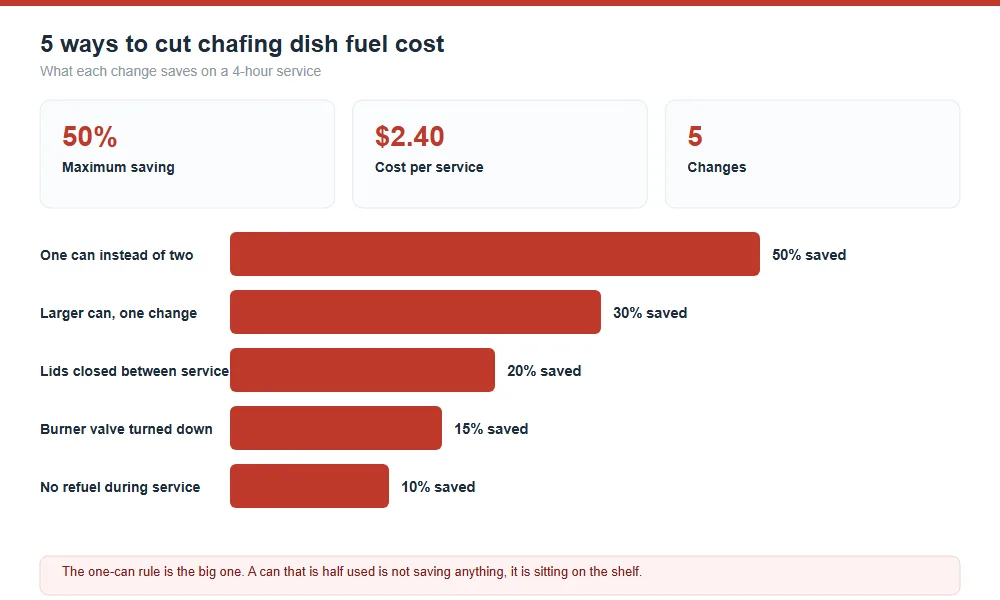
| # | Hack | Savings |
|---|---|---|
| 1 | Preheat water with kettle | 30% |
| 2 | Right water level (1-2cm) | 10% |
| 3 | Keep lid on except when serving | 20% |
| 4 | One fuel can instead of two | 50% |
| 5 | Turn off 15 min before end | 10% |
Hack 1: Preheat the Water, Not the Dish
Most people pour cold water into the water pan and light the fuel immediately. The fuel spends the first 15 minutes heating the water instead of keeping food warm.
Do this instead: Boil a kettle of water before service. Pour the hot water into the water pan. Then light the fuel. The fuel now only maintains temperature — and lasts twice as long.
See our chafing dish fuel vs electric cost comparison for more savings tips.
Hack 2: Use the Right Water Level
Too much water = fuel wastes energy heating extra litres. Too little = water boils dry and the dish overheats.
The correct level: 1-2cm (half inch) deep in the water pan. That's enough to generate steam for 90 minutes of service.
Hack 3: Keep the Lid On — Except When Serving
Every 30 seconds with the lid open drops food temperature by 5°C. That means the fuel has to work harder to bring it back up.
Do this: Keep the lid closed except when someone is serving. It saves fuel and keeps food hotter. See our food holding temperature chart for more details.
Hack 4: Use One Fuel Can Instead of Two
Most people use two fuel cans per chafing dish. But if you preheated the water and kept the lid on, one fuel can is enough.
Do this: Start with one fuel can. Check the temperature after 30 minutes. If it's holding at 60°C+, you don't need the second can.
Hack 5: Turn Off 15 Minutes Before the End
Food stays hot for 15-20 minutes after you turn off the fuel. The chafing dish and the food retain heat.
Do this: Turn off the fuel 15 minutes before service ends. The food will still be hot when guests go back for seconds.
How Much Can You Save?
Let's do the math:
- Before: 2-3 fuel cans per chafing dish per event
- After: 1 fuel can per chafing dish per event
- Savings: 50% fuel cost
At $1 per fuel can, and 10 chafing dishes per event, that's $10-20 saved per event. At 50 events per year, that's $500-1,000 saved per year.
See our buffet food cost calculator for more ways to save.
5 Fuel Wasting Mistakes
| Mistake | What Happens | Fix |
|---|---|---|
| Cold water from the start | Fuel wastes time heating water | Preheat with kettle |
| Too much water | Fuel wastes energy heating extra litres | 1-2cm water level |
| Lid always open | Heat escapes | Keep lid closed |
| Two fuel cans always | Overkill | Start with one |
| Fuel on until the end | Wasted fuel | Turn off 15 min early |
Fuel Saving Terms to Know
- chafing dish fuel saving tips
- fuel vs electric cost comparison
- food holding temperature
- buffet equipment checklist
- electric chafing dish
The Bottom Line
These 5 hacks cut fuel cost by 50% without dropping food below safe temperatures. Preheat the water. Use the right water level. Keep the lid on. Start with one fuel can. Turn off 15 minutes early. Do that, and you'll save $500-1,000 per year.
Looking for Fuel-Efficient Chafing Dishes?
BAVA manufactures energy-efficient chafing dishes designed to hold heat longer. All products CE/FDA certified, OEM/ODM available.
Where the fuel actually goes
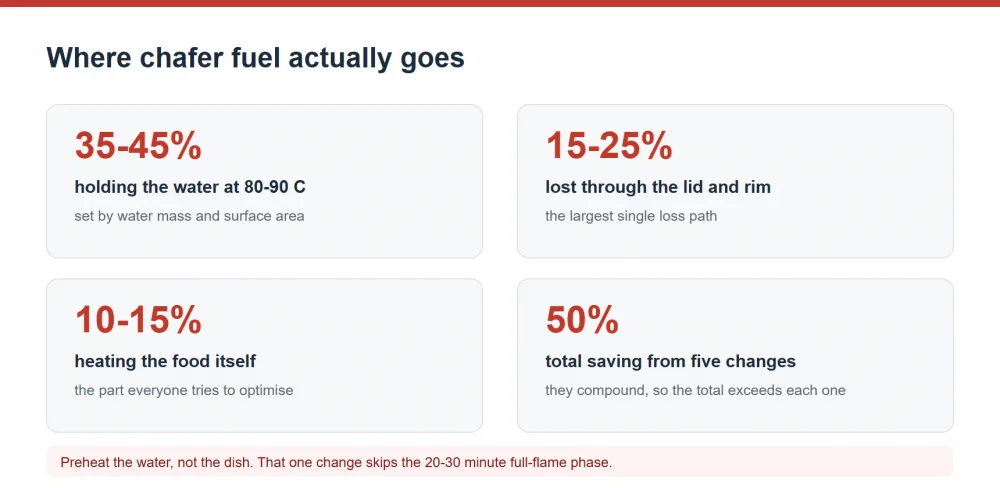
A chafer does not burn fuel to keep food hot. It burns fuel to keep water hot, and the water keeps the food hot, and the amount it burns is set by how much heat escapes rather than by how much heat the food needs. The table below is the honest accounting for a 6 QT unit over a 4 hour service, and it shows that the savings are in the losses, not in the load.
| Heat path | Share of total heat | What drives it | Can it be reduced | Saving available |
| Holding the water at 80 to 90 C | 35 to 45 percent | The water mass and the surface area | Yes, use the marked level | 5 to 10 percent |
| Evaporation from the water pan | 10 to 20 percent | An uncovered pan and a high setting | Yes, lid on, correct level | 8 to 15 percent |
| Heat lost through the lid and rim | 15 to 25 percent | Lid on or off, and the seal condition | Yes, lid on, good seal | 10 to 18 percent |
| Heat lost through the sides | 5 to 10 percent | Wall thickness and draughts | Yes, move the unit out of a draught | 3 to 6 percent |
| Heating the food itself | 10 to 15 percent | The mass and the starting temperature | Yes, preheat the food | 5 to 10 percent |
The five changes, ranked by saving
Most operators guess at fuel savings, and the guess is wrong because the guess is about the flame. The flame is a fixed cost; the savings are in the losses. Each change below is ranked by the saving it delivers per unit of effort, and the first two are the ones that are almost always being done wrong.
| Change | What it is | Saving | Effort | Why it works | Common error it fixes |
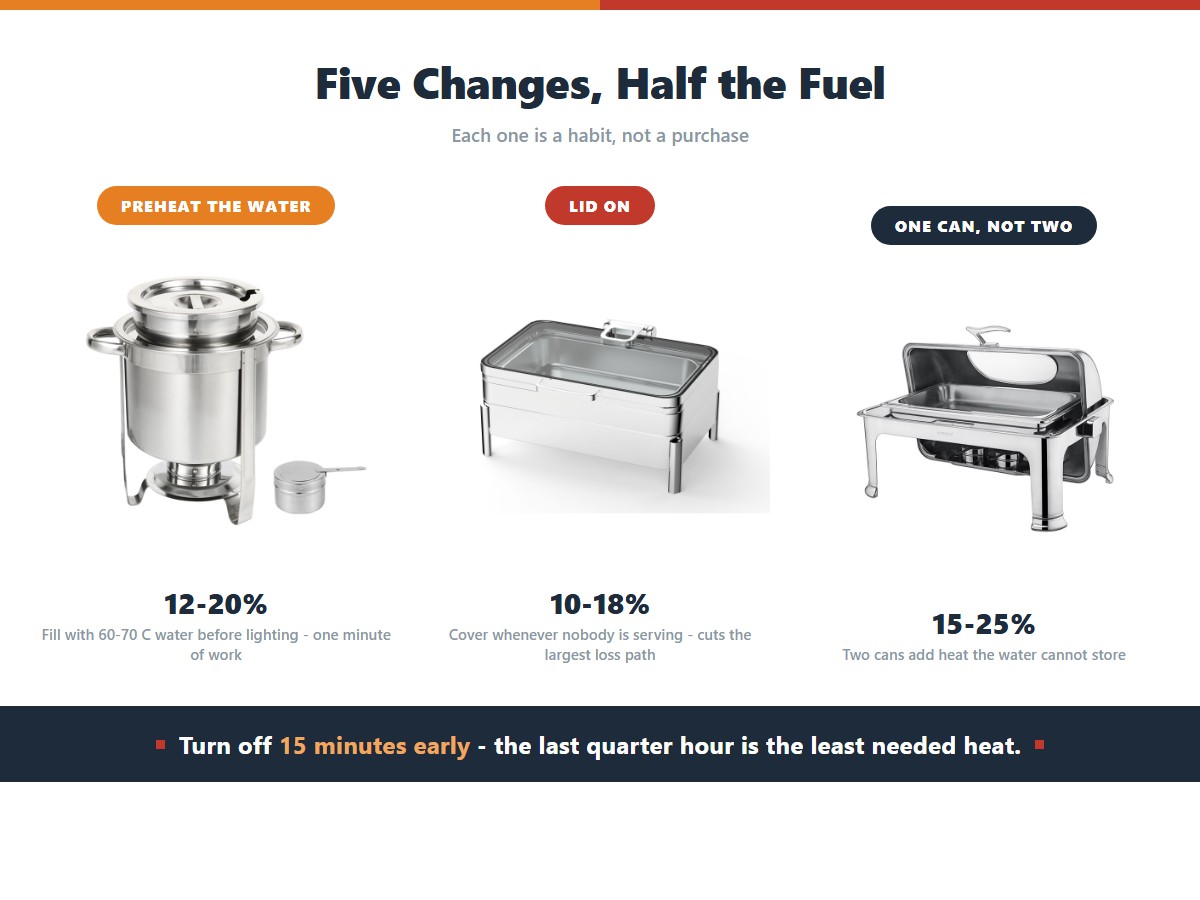
| 1. Preheat the water, not the dish | Fill with hot water at 60 to 70 C before lighting | 12 to 20 percent | 1 minute | Skips the 20 to 30 minutes where the flame runs full to warm cold water | Lighting the can over cold water and leaving the flame high |
| 2. Use the marked water level | Fill to the marked line, about 25 to 35 mm | 5 to 10 percent | 10 seconds | Less water to heat and less surface to evaporate | Overfilling, which roughly doubles the water mass |
| 3. Lid on except while serving | Cover the pan whenever nobody is serving | 10 to 18 percent | Zero | Cuts the largest single loss path | Leaving the lid off so guests can see the food |
| 4. One can instead of two | A single can at a moderate setting | 15 to 25 percent | Zero | Two cans add heat the water cannot store, so it all goes out the sides | Using two cans on a 6 QT unit that only needs one |
| 5. Turn off 15 minutes early | Extinguish before the last guests are served | 8 to 15 percent | Zero | The last 15 minutes of a full pan is the least needed heat | Leaving the can burning through breakdown |
The reason these add up to more than 50 percent is that they compound. Preheating the water means the flame spends less time at full output, which means less total heat to lose, which means a lower setting holds the same temperature. On a fleet of 20 units running two services a week, the combined saving is typically 30 to 60 cans a year, which is a real line on an equipment budget even though each individual can costs about a dollar.
Frequently Asked Questions
Does preheating the water really save fuel?
Yes, and it is the single biggest saving available. A chafer lit over cold water spends its first 20 to 30 minutes at full flame output warming 4 to 6 litres of water, and all of that heat is spent before the food is even on the line. Filling with hot water at 60 to 70 C removes most of that phase entirely, so the can reaches its steady holding state in a fraction of the time and burns less overall. It costs one trip to the kettle and it is the change that pays for itself on the first service.
Should I use two fuel cans on a 6 QT chafer?
Almost never. A 6 QT unit holds about 4 to 6 litres of water, and one can at a moderate setting is enough to hold that at 80 to 90 C. A second can adds heat the water cannot store, so the surplus leaves through the sides and the lid, and the food cooks rather than holds. The exception is a cold outdoor service in wind, where a second can compensates for the draught. Indoors, in still air, one can at the right setting is both cheaper and better for the food.
How much water should go in a chafing dish?
To the marked line, which is usually 25 to 35 mm deep, and never to the rim. Overfilling is the commonest error and it is expensive twice: more water to heat at the start, and more surface area to evaporate throughout. Underfilling is worse in a different way, because the pan runs dry, the element or the flame contacts the pan base directly, and the food burns. Check the level every hour on a long service, because a pan at 90 C loses visible water in 30 to 45 minutes.
Is it cheaper to run an electric chafer instead of fuel?
On energy cost alone, usually yes. A 400 W electric unit at a typical commercial electricity rate uses about $0.05 to $0.09 per hour, against $0.30 to $0.47 per hour for a single fuel can. The offset is that an electric unit needs a circuit, needs a preheat period, and stops working the moment the power fails, while a fuel unit is entirely self-contained. For an indoor venue with reliable power and a daily service, electric wins on running cost. For an outdoor or temporary event, fuel wins on total cost including the power infrastructure.
How do I know if my chafer is wasting fuel?
Three signs. The water pan boils vigorously, which means the flame is too high and the water is being lost to evaporation rather than held as heat. The food at the edge of the pan is noticeably hotter than the food in the middle, which means the pan is being heated unevenly and the flame is too close to one side. And the can burns out in less than its rated 2 to 3 hours, which means the unit is losing heat faster than it can hold it, usually through a failed seal or a lid that no longer seats. All three are fixable in under a minute and all three cost 10 to 20 percent.
Related reading
- Chafing Dish Hacks: Pro Tips for Caterers & Event Planners
- Dual Dry-Wet Heating Chafing Dish: One Dish, Two Modes
- 2026 Global Commercial Food Warmer Market Growth & Innovation
- Hotel All-Day Dining: Stainless Buffet Stove Specs
- How Much Fuel Does a Chafing Dish Use? Cost per Event
- Chafing Dish Total Cost of Ownership: Purchase, Fuel, Labour
- What Fuel Do You Use for a Chafing Dish? All Options Explained