
Why Does My Electric Chafing Dish Trip the Breaker?
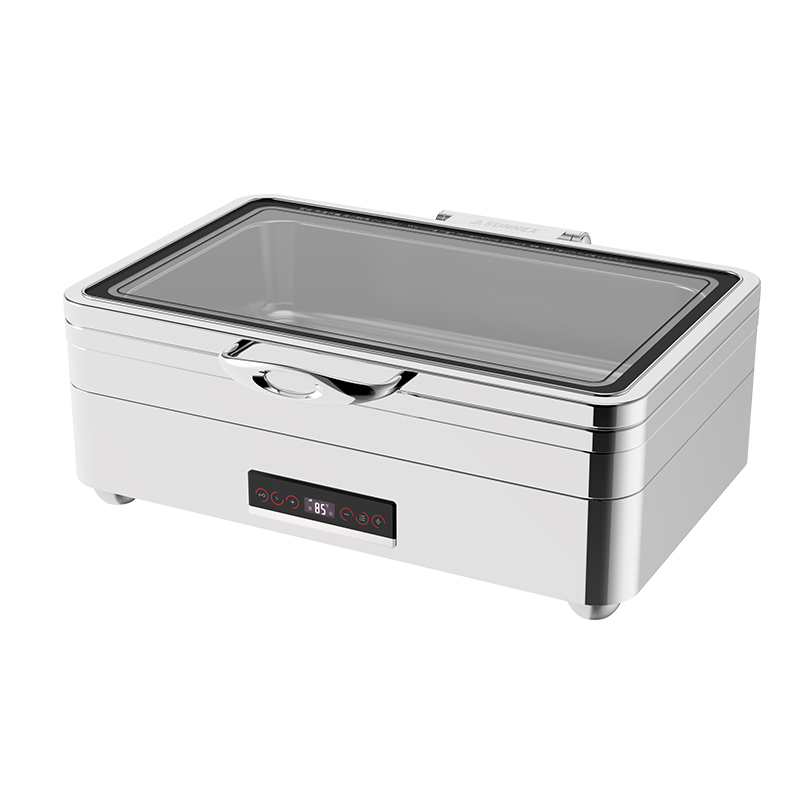
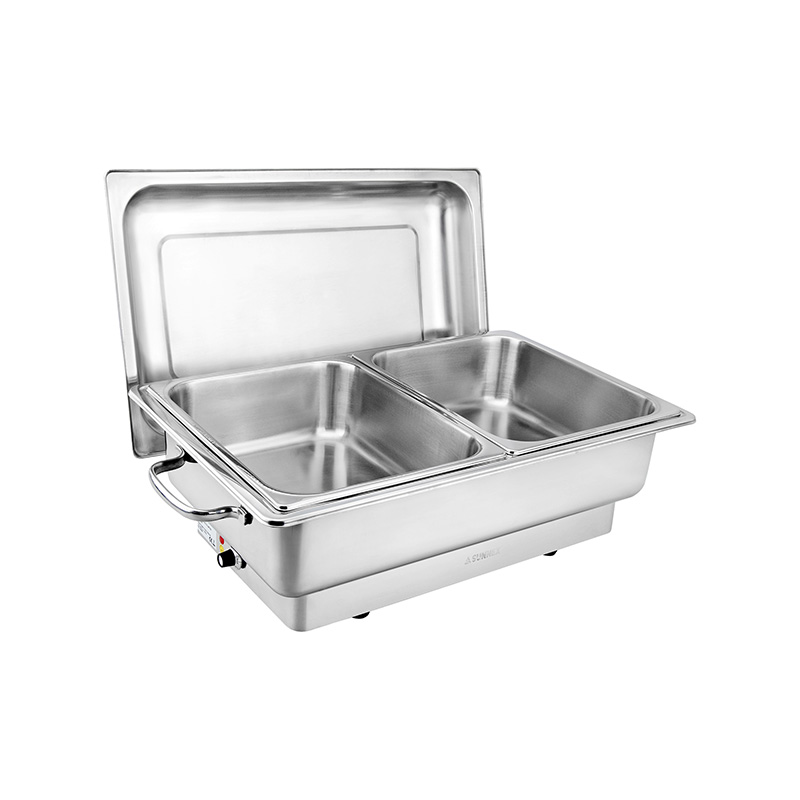
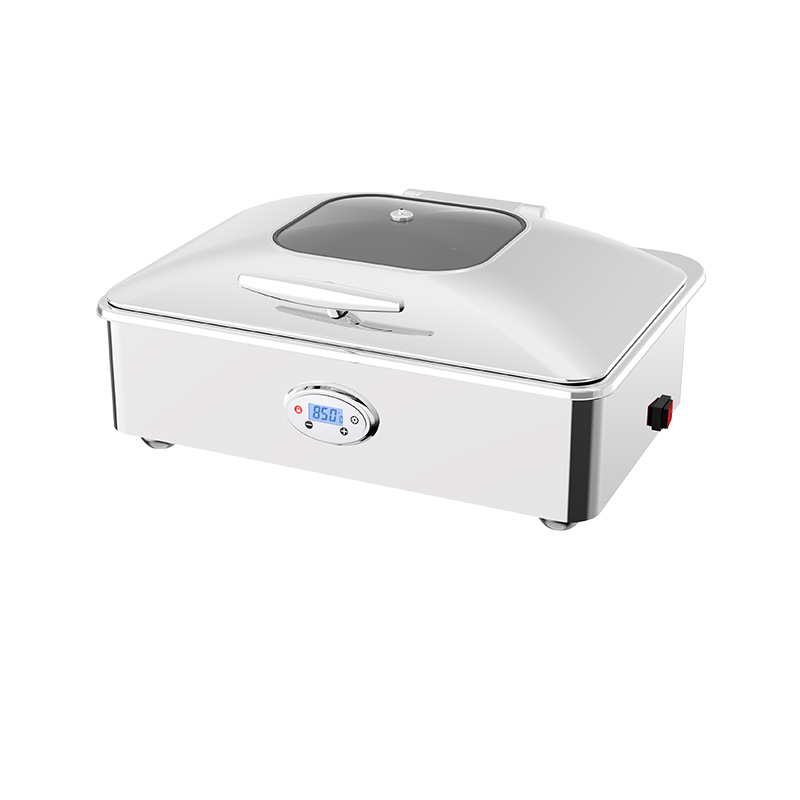
Short answer: a breaker trips because the circuit is overloaded or because a single unit has an earth fault. Four 800 W chafers draw about 13.9 A at 115 V, which already exceeds the continuous-load limit of a 15 A circuit once anything else is connected. Plan two to three units per dedicated 15-16 A circuit, and test a suspect unit alone on a known-good socket to tell overload from fault. Power planning matters most with electric models in our chafing dish range.
Current draw by voltage
The same appliance draws very different current at 115 V and 230 V. This is the single most common source of confusion when equipment moves between markets.
| Appliance | Power | Current at 115 V | Current at 230 V | Units per 16 A circuit |
| Electric chafer, small | 300 W | 2.6 A | 1.3 A | 6-8 |
| Electric chafer, standard | 500 W | 4.3 A | 2.2 A | 4-5 |
| Electric chafer, large | 800 W | 7.0 A | 3.5 A | 2-3 |
| Heat lamp, single head | 250 W | 2.2 A | 1.1 A | 8-10 |
| Heat lamp, triple head | 750 W | 6.5 A | 3.3 A | 2-3 |
| Beverage dispenser, heated | 600 W | 5.2 A | 2.6 A | 3-4 |
| Coffee urn | 2,500 W | 21.7 A | 10.9 A | 1 (dedicated) |
Apply the 80% continuous-load rule: a 16 A circuit should carry no more than about 13 A continuously. Catering equipment runs for hours, so it counts as continuous load, not intermittent.
Overload versus earth fault
The pattern of the trip tells you which problem you have. Getting this right saves a service call.
| Pattern | Diagnosis | Test | Fix |
| Trips minutes after switching on several units | Overload | Switch on one at a time | Redistribute across circuits |
| Trips immediately, every time, one unit | Earth fault or short | Try the unit alone elsewhere | Replace lead or element |
| Trips when the element cycles on | Failing element | Insulation resistance test | Replace element |
| Trips only in damp conditions | Moisture ingress | Dry and retest | Improve IP rating, dry unit |
| Breaker warm to touch, trips after an hour | Chronic overload | Measure actual current | Add a circuit |
| RCD trips, breaker does not | Earth leakage | RCD test | Find the leaking unit |
Test each unit alone on a known-good socket. If it runs, the problem is circuit capacity; if it trips, the unit itself is faulty and should be removed from service immediately.
Planning circuits for a buffet line
Design the power layout before the equipment arrives. Retrofitting circuits in a finished room costs ten times more than planning them at fit-out.
| Line size | Equipment | Total load | Circuits needed (16 A) |
| 4 chafers | 4 x 500 W | 2.0 kW | 2 |
| 6 chafers | 6 x 500 W | 3.0 kW | 3 |
| 8 chafers + 2 lamps | 4 kW + 0.5 kW | 4.5 kW | 4 |
| Full breakfast line | Chafers, coffee, dispenser | 6-9 kW | 5-6 |
| Mobile generator setup | Mixed fleet | 3-5 kW | 2-3 plus spare |
Label every socket with its circuit number and breaker position. In a trip during service, the difference between a 30-second reset and a 10-minute search is usually whether the sockets are labelled.
Power planning checklist before an event
Electrical problems discovered on the day are the hardest to fix. This checklist takes 15 minutes at the site visit and prevents the majority of trips.
| Check | How to verify | Action if failed |
| Circuit count and rating | Read the distribution board | Reduce electric units |
| Socket positions | Walk the line with a tape | Plan cable runs, avoid aisles |
| Existing load on circuits | Ask the venue for a schedule | Move to dedicated circuits |
| RCD protection present | Test button on the board | Use your own RCD |
| Cable ratings | Check the sheath marking | Replace undersized leads |
| Generator, if used | Size against connected load plus 30% | Upgrade or reduce load |
Photograph the distribution board at the site visit. It lets you plan the circuit assignment back at the office, and it settles arguments with the venue about what was available.
Frequently Asked Questions
How many electric chafers can I run on one circuit?
Two to three 500-800 W units on a 16 A circuit at 230 V, and two on a 15 A circuit at 115 V. Never fill a circuit to its nominal rating with continuous loads.
Why does it trip after an hour rather than immediately?
Breakers trip on heat as well as on current. A circuit at 95% of rating will hold for a while and then trip as the breaker warms up.
Can I use an extension lead?
Only a heavy-duty, fully unwound lead rated above the load, and never daisy-chained. Coiled leads overheat and are a common cause of trips and fires.
Is a generator safe for buffet equipment?
Yes if sized with surge allowance, correctly earthed and fitted with RCD protection. Sensitive thermostats prefer an inverter generator with clean output.
Should I switch to fuel chafers to avoid this?
If the venue has limited power, yes. A mixed fleet of fuel and electric units halves the connected load and keeps service running if a circuit fails.
Related reading
Related Articles

How Many Chafing Dishes Do You Need Per 50 Guests?
Plan 1 full-size chafer per 25-30 guests for each entree and 1 per 35-40 for sides. Includes a guest...

How Long Can Food Stay Under a Heat Lamp? The 4-Hour Rule
Food can stay under a heat lamp for up to 4 hours if it stays above 135°F (57°C); quality usually ...

How Much Does a Commercial Chafing Dish Cost? 2026 Price Ranges
Wholesale chafing dishes run $22-55 for 201 fuel units, $45-90 for 304 stainless, $65-180 for electr...

What Size Food Pan Fits a Full-Size Chafing Dish? GN Sizes Explained
A full-size chafer takes one GN 1/1 pan (530 x 325 mm), or two GN 1/2, or three GN 1/3. Includes ful...
Is Food Under a Heat Lamp Safe? A Straight Answer
Food under a heat lamp is safe when three conditions are met: above 135°F (57°C), under 4 hours, a...

How Much Water Goes in a Chafing Dish Water Pan?
Fill a full-size water pan with 1.5-2.5 L of hot water to about two-thirds depth, keeping the level ...