
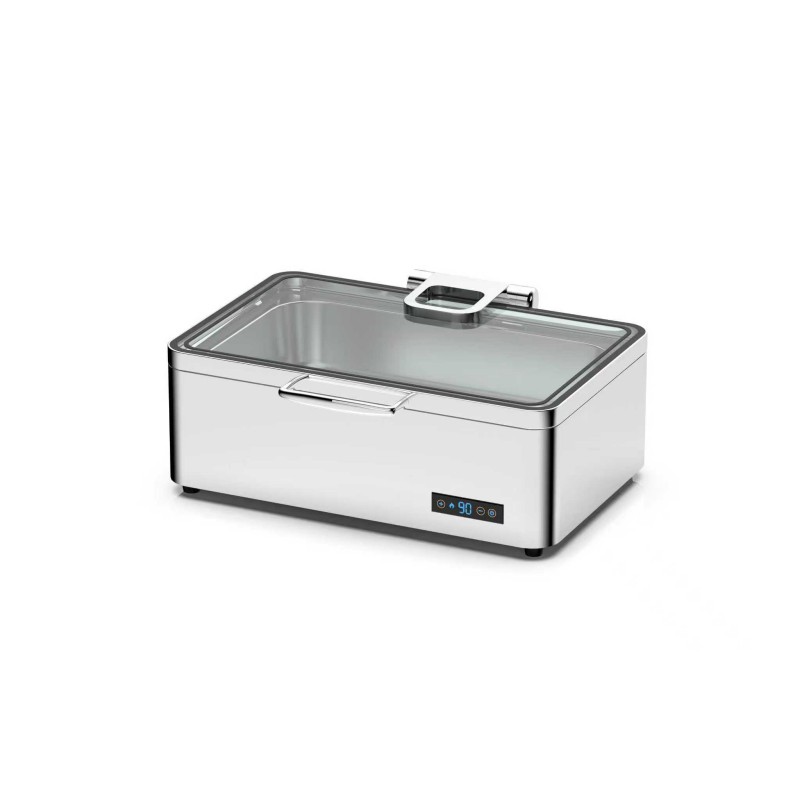
How Many Chafing Dishes Do You Need Per 50 Guests?
Short answer: budget one full-size chafing dish for every 25-30 guests per entree and one for every 35-40 guests per side dish. A 50-guest buffet with two entrees and two sides therefore needs 4-6 full-size chafers, plus one spare. That ratio assumes a 90-minute service window and a standard 65 mm food pan holding roughly 45-50 portions. See our commercial chafing dishes for the capacities these numbers are based on.
The formula behind the ratio
Three variables drive the count: how many guests, how long service runs, and how many menu items are hot at the same time. Operators go wrong when they plan for a single pass instead of refills.
| Variable | Typical value | Effect on count |
| Portions per full-size pan (65 mm) | 45-50 at 100-120 g | Base unit of the whole calculation |
| Guests served per pan, one pass | 25-30 (entree), 35-40 (side) | Sides are taken in smaller scoops |
| Service window | 90 min before quality drops | Longer service needs more pans in rotation |
| Refill capacity on site | 1 backup pan per 3 on the line | Without backups you need more chafers on the line |
| Self-service vs plated | Self-service takes 15-25% more | Guests serve themselves larger portions |
So the working equation is: chafers = (guests / guests-per-pan) x number of hot items, rounded up, plus 10% spare.
Guest-to-chafer planning table
The table below assumes a standard three-course hot buffet (two entrees, two sides, one starch) running 90 minutes.
| Guests | Entree chafers | Side & starch chafers | Total on line | With 10% spare |
| 25 | 1-2 | 1-2 | 3 | 4 |
| 50 | 2 | 2 | 4 | 5 |
| 100 | 4 | 3-4 | 7 | 8 |
| 150 | 6 | 5 | 11 | 12 |
| 200 | 7-8 | 6-7 | 14 | 16 |
| 300 | 11-12 | 9-10 | 21 | 24 |
Above roughly 200 guests, most caterers split the room into two identical lines rather than one very long line. Two lines of 100 keep queue time under four minutes; one line of 200 pushes it past eight, and the last guests arrive at food that has been holding far longer than intended.
Worked example: a 50-guest wedding brunch
Menu: scrambled eggs, bacon, roasted potatoes, sauteed vegetables, plus a pancake station. Eggs and bacon are the entrees, potatoes and vegetables the sides. Pancakes come from a separate griddle and do not need a chafer.
Eggs: 50 guests / 28 per pan = 1.8, round up to 2. Bacon: 50 / 30 = 1.7, round up to 2. Potatoes: 50 / 38 = 1.3, round up to 2. Vegetables: 50 / 40 = 1.25, round up to 2. Total 8, or 6 if you run potatoes and vegetables in half-size pans inside one full-size frame each. Add one spare and you order 7-9 chafers.
If the room only has power for four electric units, the same menu can be run with two electric chafers on the line and fuel chafers for the rest. That is the usual reason mixed fleets exist.
Why self-service changes the maths
Plated or served buffets behave differently from guest-served lines. When a chef or attendant portions the food, portions run 10-20% smaller and more consistent, so the same pan covers more guests. When guests serve themselves, the first third of the pan disappears quickly — people take more when the pan looks full — and the last third is picked over, so usable yield is lower than the arithmetic suggests.
| Service style | Average portion | Guests per full-size entree pan | Planning note |
| Attendant-served | 90-110 g | 30-36 | Most predictable, least waste |
| Guest-served, standard | 110-140 g | 25-30 | Default planning assumption |
| Guest-served, premium menu | 140-180 g | 18-24 | Steak, prawns, carved items |
| Children's service | 50-70 g | 50-65 | Plan separate lower reach station |
Adjust the base ratio by these figures before finalising an order. A premium carving menu can need nearly twice the chafers of a pasta buffet for the same headcount.
Frequently Asked Questions
Do round chafers serve fewer guests than rectangular ones?
Yes, typically 20-30% fewer. A round chafer usually takes a shallower pan with less usable surface, so plan one round unit per 20-25 guests for an entree rather than 25-30.
How many portions are really in a full-size 65 mm pan?
Around 45-50 portions at 100-120 g per portion. You never fill to the rim: filling to about two-thirds depth leaves room to stir without spilling and keeps the food surface closer to the heat.
Should I count a spare chafer for every event?
Yes, at least one per 10 units on the line. A spare covers a failed fuel can, a tripped breaker or a pan that empties faster than expected, and it costs far less than an empty station mid-service.
Does a longer service time mean more chafers?
Not necessarily more frames, but more pans in rotation. For service beyond 90 minutes, plan a second pan of each item held above 135°F in a back kitchen so you swap rather than top up.
Is one chafer enough for 30 guests if the item is a side dish?
Yes for most sides. Vegetables, rice and pasta are taken in smaller portions, so one full-size unit comfortably covers 35-40 guests per pass.
Related reading
Related Articles

How Many Chafing Dishes Do You Need Per 50 Guests?
Plan 1 full-size chafer per 25-30 guests for each entree and 1 per 35-40 for sides. Includes a guest...

How Long Can Food Stay Under a Heat Lamp? The 4-Hour Rule
Food can stay under a heat lamp for up to 4 hours if it stays above 135°F (57°C); quality usually ...

How Much Does a Commercial Chafing Dish Cost? 2026 Price Ranges
Wholesale chafing dishes run $22-55 for 201 fuel units, $45-90 for 304 stainless, $65-180 for electr...

What Size Food Pan Fits a Full-Size Chafing Dish? GN Sizes Explained
A full-size chafer takes one GN 1/1 pan (530 x 325 mm), or two GN 1/2, or three GN 1/3. Includes ful...
Is Food Under a Heat Lamp Safe? A Straight Answer
Food under a heat lamp is safe when three conditions are met: above 135°F (57°C), under 4 hours, a...

How Much Water Goes in a Chafing Dish Water Pan?
Fill a full-size water pan with 1.5-2.5 L of hot water to about two-thirds depth, keeping the level ...