



Starting a Catering Business? Buy These 5 Things First
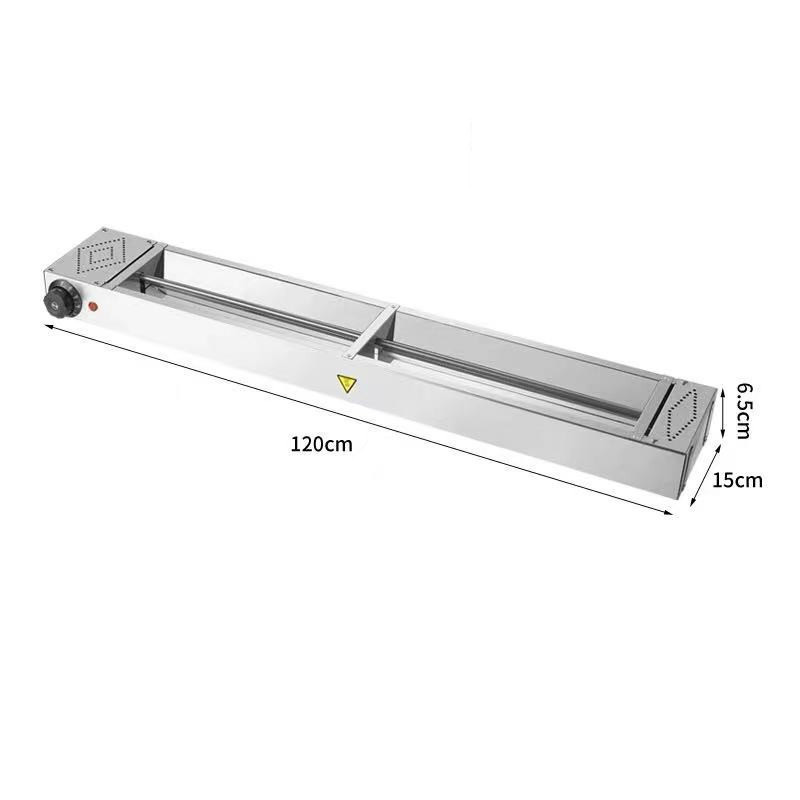
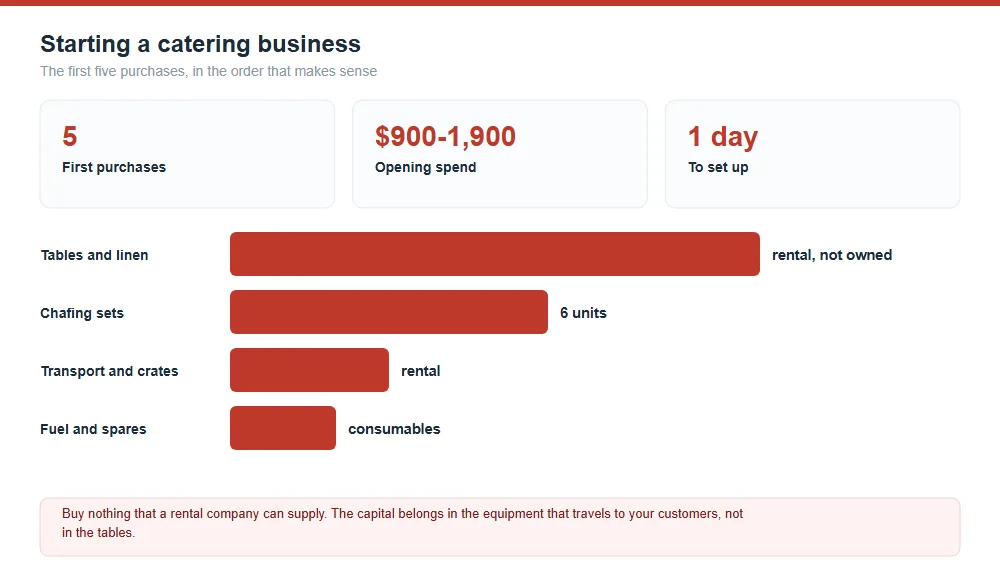
Short answer: A catering startup should buy five things before anything else: four half-size chafing dishes rather than two full-size, two portable heat lamps, insulated food carriers, folding banquet tables and a basic utensil kit. The total is $700 to $1,900, and the chafing dish choice is the one that matters, because four half-size pans serve two points instead of one and cost the same as two full-size. What not to buy first is anything fixed, anything electric above 1,100 W, and anything that only holds one dish. See chafing dishes and buffet stations.
Starting a catering business is exciting — but buying equipment is where most new caterers waste money. They buy too much, too soon, and end up with a storage unit full of unused gear.
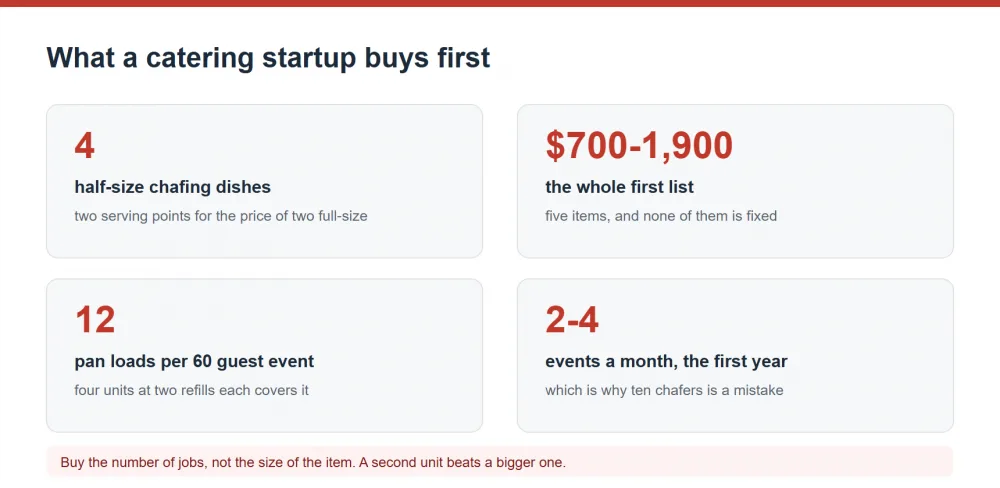
Your first 5 events will be small: office lunches, birthday parties, 30-50 guests. You don't need 10 full-size chafing dishes. You need 4 half-size ones. You don't need a commercial kitchen. You need the right basics.
Here are the 5 things you actually need before your first event.
PRO TIP: Start with half-size, not full-size.
Most new caterers buy 10 full-size chafing dishes for big events. But your first 5 events will be small. Half-size chafing dishes are more flexible: you can serve 4 different dishes, or combine two to make a full size. Start with 4, add more as you grow.
KEY TAKEAWAY: Total startup cost: $800-1,200.
You don't need to spend $10,000 to start. 4 half-size chafing dishes + 2 heat lamps + insulated carriers + folding tables + basic utensils = $800-1,200. That's enough for your first 10 events.
Quick Answer: The 5 Things
| # | Item | Quantity | Cost |
|---|---|---|---|
| 1 | Half-Size Chafing Dishes | 4 | $320-600 |
| 2 | Portable Heat Lamps | 2 | $100-160 |
| 3 | Insulated Food Carriers | 2 | $200-300 |
| 4 | Folding Banquet Tables | 4 | $120-200 |
| 5 | Basic Utensil Kit | 1 set | $50-100 |
| Total | $800-1,360 | ||
1. 4 Half-Size Chafing Dishes (Not Full-Size)
Most new caterers buy 10 full-size chafing dishes for big events. But your first 5 events will be small: office lunches, birthday parties, 30-50 guests.
Why half-size: More flexible. You can serve 4 different dishes. Or combine two to make a full size. Start with 4 half-size, add more as you grow.
See our chafing dish collection for half-size options.
2. 2 Portable Heat Lamps
Heat lamps are the cheapest way to upgrade your buffet. A single portable heat lamp ($50-80) keeps fries, roasted vegetables, and fried chicken crispy for 2 hours.
Why 2: Buy 2 on adjustable stands — you can move them between stations. This is one of the highest ROI purchases for a new caterer. See our heat lamp collection.
3. Insulated Food Carriers
You need to transport food from your kitchen to the event. An insulated food carrier keeps food hot for 4 hours. No power needed.
How many: 2 carriers. One for hot food, one for cold. $100-150 each.
4. Folding Banquet Tables
You need tables to set up your buffet. Folding banquet tables are cheap and easy to transport.
How many: 4 tables. 6-foot tables. $30-50 each.
5. Basic Utensil Kit
You need serving spoons, tongs, ladles, spatulas. A basic kit costs $50-100.
What's in it: 4 serving spoons, 2 tongs, 2 ladles, 2 spatulas. Stainless steel.
What NOT to Buy First
These are the things new caterers waste money on. Don't buy these yet:
- Full-size chafing dishes: Too big for small events. Start half-size.
- Commercial oven/range: Use your home kitchen until you need more.
- Expensive decor: Your food matters more than your decor.
- Custom branding: Focus on the food first. Brand later.
- Website design: A Facebook page is enough to start.
See our buffet equipment checklist for more details.
When to Upgrade
Once you've done 10 events, you'll know what you need. Upgrade when:
- You're turning down events because you don't have enough equipment: Buy more chafing dishes.
- You're doing 20+ events a month: Get a commercial kitchen.
- You're doing weddings (100+ guests): Buy full-size chafing dishes.
Catering Startup Terms to Know
- catering equipment startup checklist
- buffet equipment checklist
- catering event timeline
- portable heat lamp for catering
- half-size chafing dish
The Bottom Line
Starting a catering business doesn't have to cost $10,000. You can start with $800-1,200: 4 half-size chafing dishes, 2 heat lamps, 2 insulated carriers, 4 folding tables, and a basic utensil kit. That's enough for your first 10 events. Start small. Add more as you grow.
Looking for Catering Equipment?
BAVA manufactures commercial buffet equipment for caterers. Half-size chafing dishes, portable heat lamps, and more. All products CE/FDA certified, OEM/ODM available.
The five first purchases, with real numbers
The list is deliberately unglamorous, because the first year of a catering business is decided by throughput and by transport rather than by the quality of any single item. Every purchase below is chosen for the number of jobs it does, and the chafing dish choice in particular is a throughput decision disguised as a size decision. The figures assume a business doing 2 to 4 events a month at 40 to 80 guests.
| Purchase | Quantity | Cost | Jobs it does | Why this and not the alternative | What it replaces |
| Half-size chafing dishes | 4 | $180 to $400 | Two serving points, four dishes, transportable | Four half-size serve two points for the price of two full-size | Hiring equipment at $8 to $18 per unit per event |
| Portable heat lamps | 2 | $90 to $260 | Carving, holding, display, warm plates | Two lamps cover a carving station and a display | A carving station hire fee |
| Insulated food carriers | 2 to 4 | $120 to $400 | Transport, holding, temperature margin | Keeps food out of the danger zone in transit | Food written off on a long journey |
| Folding banquet tables | 2 to 4 | $90 to $320 | Buffet surface, prep, display, bar | The cheapest flexible surface there is | Venue furniture charges |
| Basic utensil kit | 1 | $60 to $180 | Serving, carving, plating, cleaning | Everything else depends on it | Buying utensils one at a time |
What to buy later, and why
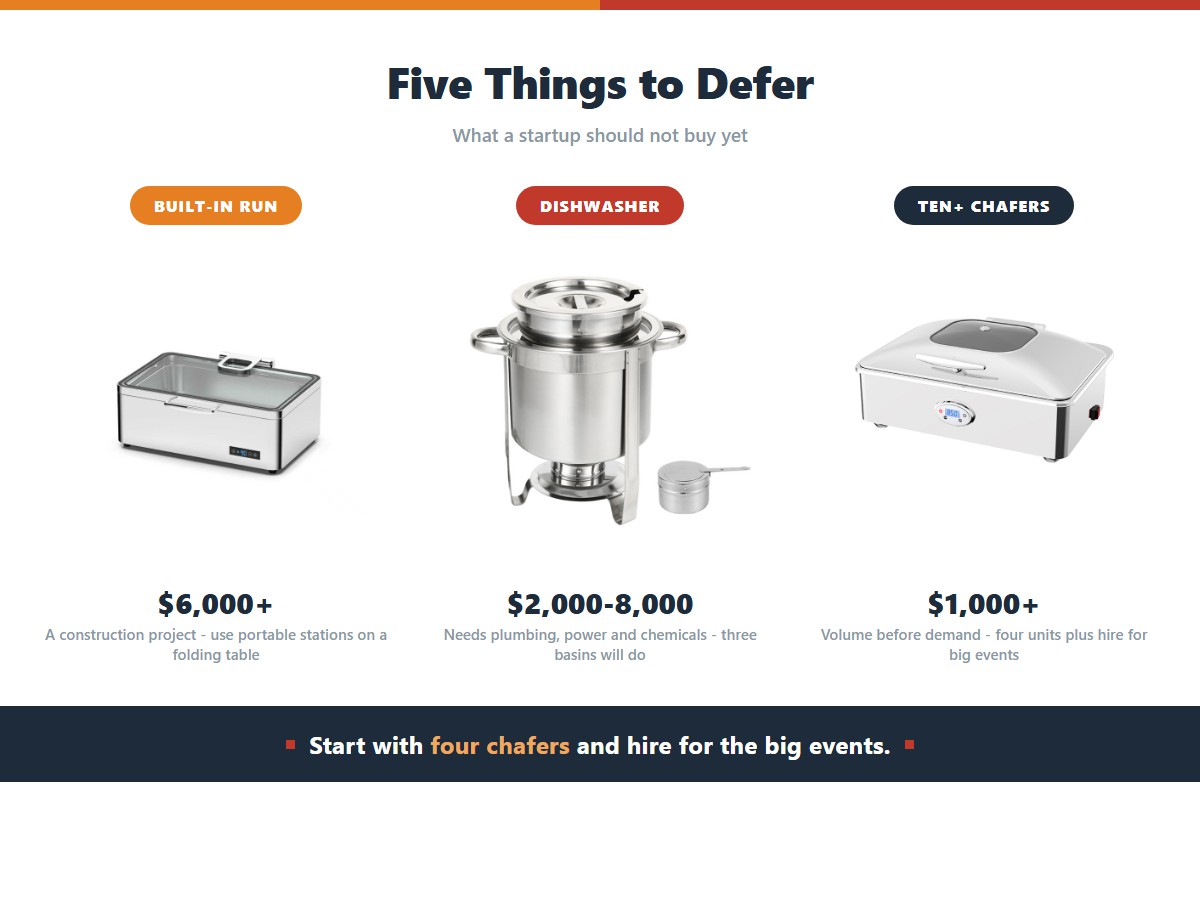
The list of things not to buy is as important as the list of things to buy, and every item on it is a purchase that a new caterer makes once and regrets. The pattern is consistent: anything fixed, anything high-wattage, and anything that only does one job should wait until the business has a booking that requires it. The table below is the deferral list with the trigger that should eventually unlock each purchase.
| Deferred purchase | Typical cost | Why it waits | What to do instead | Buy it when |
| Built-in buffet run | $6,000 and up | It is a construction project, not a purchase | Portable stations on a folding table | You serve 150 covers a day from one line |
| Commercial dishwasher | $2,000 to $8,000 | It needs plumbing, power and chemicals | Three-basin sink and a rack | You wash more than 60 pans a day |
| Electric soup kettle, 3 kW and up | $400 to $1,400 | It needs a dedicated circuit most venues do not have | Two chafers on two sockets | You have a venue with a 20 A supply |
| Refrigerated display | $900 to $4,000 | It is one job only and it is heavy to move | Cold wells with ice | You have a fixed contract |
| Chafing dish in a non-standard finish | +$60 to $200 per unit | It costs more and cleans the same | Standard 304 stainless | A client specifies a finish |
| Ten or more chafing dishes | $1,000 and up | Volume before you have the demand | Four, plus hire for the big events | You are turning down work for lack of stock |
The arithmetic behind the whole list is simple. A business doing three events a month at 60 guests uses about 12 half-size pan loads per event, which is four units at two refills each. Buying ten chafing dishes before that demand exists ties up $1,000 and stores eight of them for a year, while the same $1,000 spent on a second heat lamp and a third carrier removes the constraint that actually appears, which is transport and holding rather than pan capacity.
Frequently Asked Questions
Why four half-size chafing dishes instead of two full-size?
Because two serving points always beat one, and four half-size pans cost roughly the same as two full-size ones. A single full-size pan produces a single queue, and a single queue is the constraint on the whole service. Two half-size pans on the same line feed the same guests faster and produce a shorter visible wait, and they also let you serve two different dishes at once. The extra unit also means you can carry a spare, which is what turns a failure at an event into an inconvenience.
How many chafing dishes does a catering business actually need?
Four half-size units covers 40 to 80 guests at two serving points with one spare, which is the right first purchase for a business doing 2 to 4 events a month. Add a unit when you find yourself hiring rather than declining work, and add the fifth and sixth when you start running two lines at the same event. Ten units is a business doing 6 to 10 events a month, and buying that many before the bookings exist is the most common capital mistake a new caterer makes.
Should I buy electric or fuel chafing dishes first?
Fuel, for a new business. A fuel unit is self-contained, needs no circuit, works indoors and outdoors, and cannot be defeated by a venue with an overloaded distribution board. An electric unit is cheaper to run and needs no fuel logistics, but it fails the moment the power does, and a new caterer is usually working in venues they did not choose. Buy electric once you have a regular venue with a reliable supply and a daily service pattern, and buy fuel for everything else.
What is the most common first-purchase mistake?
Buying a single large item instead of several small ones. A new caterer buys one 11 litre chafer, one large soup kettle or one refrigerated display, and then discovers that every event needs two of everything and that the large item only does one job. The rule is to buy the number of jobs, not the size of the item, and the cheapest way to increase the number of jobs is almost always a second unit rather than a bigger one.
Do I need a heat lamp or is a chafing dish enough?
Both, and they do different jobs. A chafing dish holds food in a water bath, which is the correct way to hold a sauced or wet dish. A heat lamp holds carved meat and keeps it presentable, and it is the only practical way to display a roast without a water bath. Two lamps cover a carving station and a display, and they are the cheapest way to make a small buffet look like a large one. A business that only offers sauced dishes can start with chafers alone and add the lamps at the first carving job.
Related reading
- Why Chafing Dishes Are Essential for Every Catering Business
- Chafing Dishes for Sale: Best Deals for Catering Businesses
- 5 Benefits of Buffet Stoves for Catering Businesses
- 6QT Compact Chafing Dish for Small Catering Businesses
- Upgrading a Buffet Line: What to Replace First
- Heat Lamp Replacement Parts: What Wears Out First