



Hotel Breakfast Buffet on a $5,000 Budget: Exact List
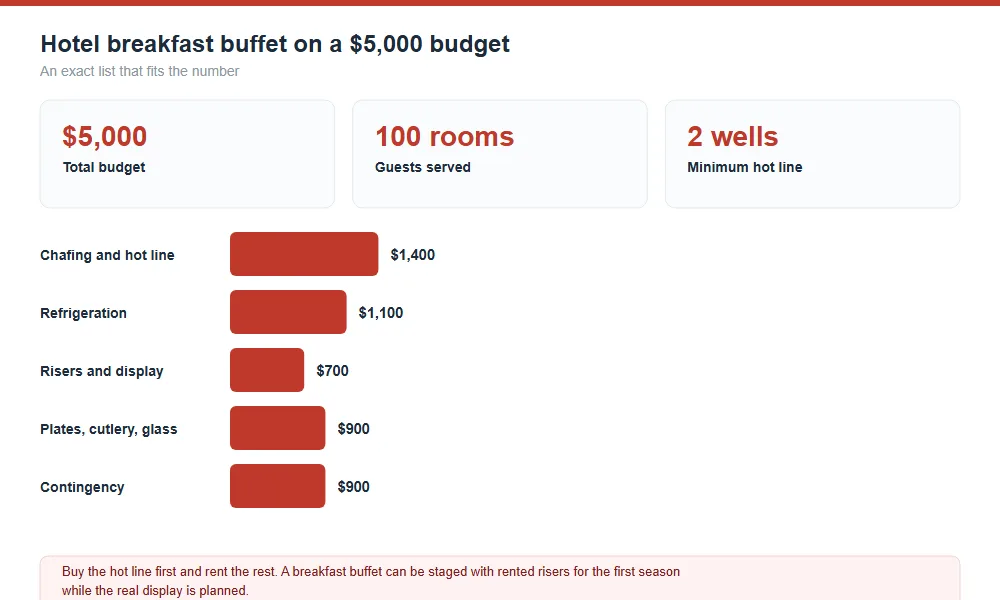
Short answer: A $5,000 hotel breakfast buffet buys four half-size chafers rather than two full-size, two heat lamps, a 3-head cereal dispenser, two 5 L beverage dispensers and a small refrigerated display, which is about 60 to 70 guests at two serving points. The single highest-return line item is the second chafer, because a second serving point removes the queue that a single larger pan creates. What to skip first is anything with a fixed footprint or a coating, and anything that only holds one dish. See chafing dishes and beverage dispensers.
Setting up a hotel breakfast buffet from scratch can cost $20,000 if you buy everything premium. But you can open a fully functional, professional-looking breakfast buffet for under $5,000.
Most hotel owners overspend on fancy displays and under-spend on the basics. You don't need a marble countertop. You need chafing dishes that work, heat lamps that keep food hot, and dispensers that look clean.
Here is the exact shopping list for a $5,000 hotel breakfast buffet.
PRO TIP: Buy the refrigerated display bar used.
The refrigerated display bar is the most expensive single item ($1,500). But you can buy one used from a restaurant closing down. Save $500-700. Everything else, buy new.
KEY TAKEAWAY: Total cost: $4,950.
Core equipment $3,200 + tables & displays $800 + smallwares $500 + contingency $450 = $4,950. That's under $5,000 for a full breakfast buffet setup.
Quick Answer: The Shopping List
| Category | Items | Cost |
|---|---|---|
| Core Equipment | 6 chafing dishes, 2 heat lamps, cereal dispenser, 2 beverage dispensers, refrigerated bar | $3,200 |
| Tables & Displays | 4 folding tables, tablecloths, risers | $800 |
| Smallwares | Plates, cups, utensils, serving tools | $500 |
| Contingency | Extra for unexpected costs | $450 |
| Total | $4,950 | |
Core Equipment ($3,200)
6 Half-Size Electric Chafing Dishes: $1,080
$180 each. Buy basic stainless steel, no fancy glass lids. Electric because you run daily — fuel cost would eat the budget. See our electric chafing dish collection.
2 Heat Lamps on Stands: $150
$75 each. For pastries, fried items, and carved meats. See our heat lamp collection.
1 3-Head Cereal Dispenser: $250
Hotel breakfasts need cereal. 3 heads covers 3 types. See our cereal dispenser collection.
2 5L Beverage Dispensers: $120
$60 each. One for water, one for juice or iced tea.
1 Refrigerated Display Bar: $1,500
Buy used. For salads, yogurt, fruit. This is the most expensive single item — but non-negotiable for cold items.
Tables & Displays ($800)
- 4 Folding Banquet Tables: $30 each = $120
- Tablecloths (white): $20 each = $80
- Acrylic Risers (for display height): $100
- Stainless Steel Trays: $15 each × 10 = $150
- Other display items: $350
Smallwares ($500)
- Plates (100 count): $100
- Cups & Saucers (50 count): $80
- Utensils (100 sets): $100
- Serving spoons, tongs, ladles: $100
- Other smallwares: $120
See our buffet equipment checklist for the full list.
Money-Saving Tips
- Buy used refrigerated bar: Save $500-700.
- Buy basic chafing dishes: Skip the roll-top lids. Lift-off is cheaper and better.
- Skip the fancy decor: White tablecloths + clean equipment = looks professional.
- Buy smallwares in bulk: Restaurant supply stores are cheaper online.
What NOT to Buy
- Marble countertops: Too expensive. Use folding tables + tablecloths.
- Custom branding: Not needed for your first year.
- Expensive coffee machine: Start with a basic drip coffee maker.
- Silver-plated everything: Stainless steel looks just as good.
Hotel Breakfast Buffet Terms to Know
- hotel breakfast buffet equipment list
- catering startup equipment
- buffet equipment checklist
- electric chafing dish for hotel
- cereal dispenser for hotel
The Bottom Line
You can set up a hotel breakfast buffet for under $5,000. 6 electric chafing dishes, 2 heat lamps, a cereal dispenser, 2 beverage dispensers, a used refrigerated bar, folding tables, and smallwares. That's enough for a professional-looking breakfast buffet. Start basic. Upgrade as you grow.
Looking for Hotel Buffet Equipment?
BAVA manufactures commercial buffet equipment for hotels and restaurants. Electric chafing dishes, heat lamps, dispensers. All products CE/FDA certified, OEM/ODM available.
The $5,000 list, line by line
A breakfast buffet is the most demanding daily service a hotel runs, because it is the only one where every guest is served in a 90 minute window with no alternative. The list below is built around that constraint, which is why it buys serving points rather than capacity. Every line includes the quantity, the reason for that quantity and what happens if you cut it.
| Item | Quantity | Cost | What it does | What happens if you cut it | Priority |
| Half-size electric chafers | 4 to 6 | $900 to $1,400 | Two to three serving points for hot items | One queue for the whole room, and it shows | Essential |
| Heat lamps on stands | 2 | $150 to $320 | Carving, holding, warm plates, display | Carved meat cools in the pan and looks grey | Essential |
| Cereal dispenser, 3 head | 1 | $250 to $520 | Dry cereal, no spillage, no refill queue | Cereal boxes on the counter, constantly restocked | Essential |
| Beverage dispensers, 5 L | 2 | $120 to $300 | Juice and milk at two points | One queue at the only cold drink | Essential |
| Refrigerated display bar | 1 | $900 to $1,600 | Yoghurt, cold cuts, fruit, dairy | Ice wells, and a restock plan for the ice | High |
| Toaster or toaster oven | 1 | $200 to $500 | Toast on demand, not held in a pan | Bread goes soft in a covered pan in 20 minutes | High |
| Smallwares and signage | 1 set | $250 to $450 | Tongs, labels, sneeze guards, plate stack | Guests lift every lid, and the queue stops | High |
| Folding tables or counter run | 2 to 4 | $200 to $600 | The surface everything sits on | Nowhere to put anything | Essential |
What to spend last, and what to spend first
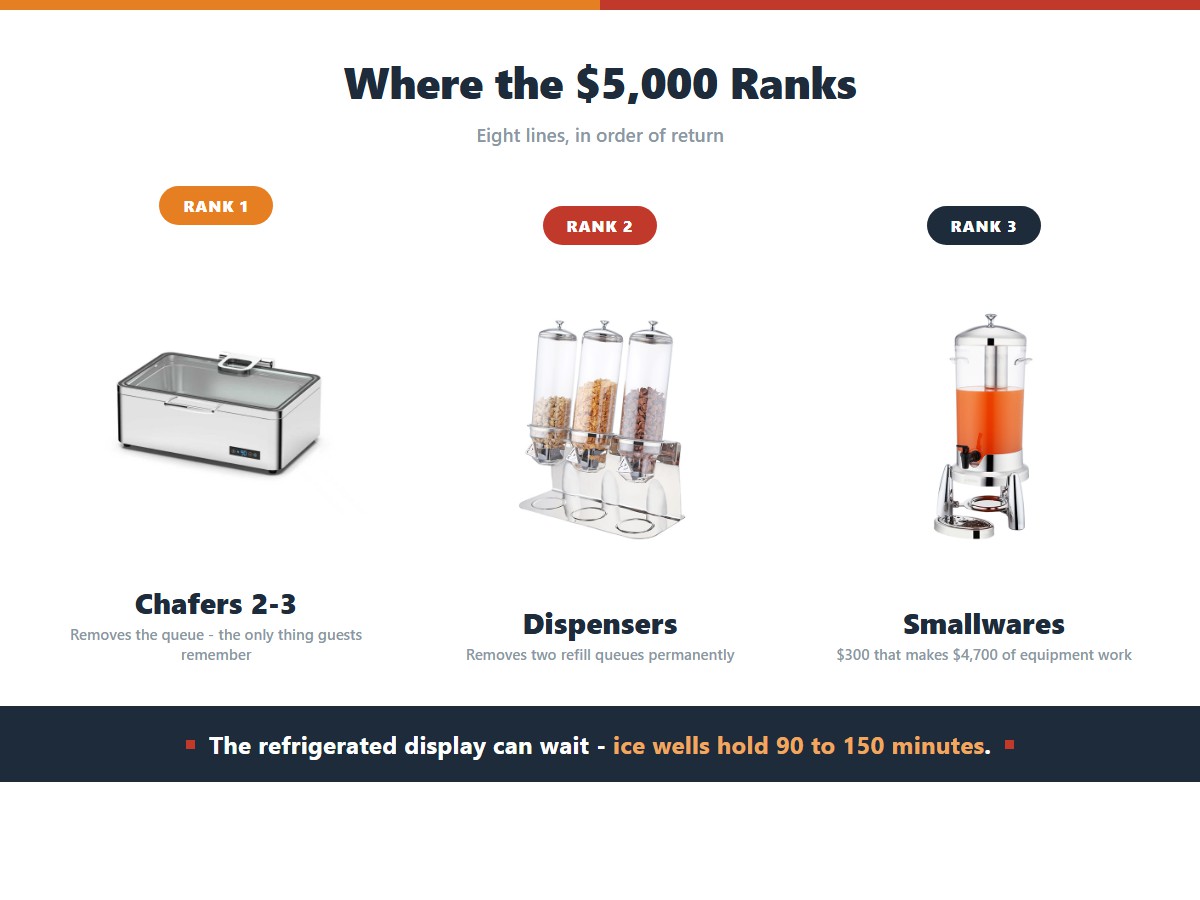
The instinct is to spend the budget on the most visible item, which in a breakfast room is the refrigerated display. The correct order is the reverse: spend it on the serving points, because the queue is what guests actually experience and the display is what they see after they have been served. The table below ranks the eight lines by the return they produce per dollar.
| Rank | Line | Return | Why it ranks here | Spend it when |
| 1 | The second and third chafer | Highest | Removes the queue, and the queue is the only thing guests remember | Immediately, before anything else |
| 2 | Cereal and beverage dispensers | High | Removes two refill queues permanently | Immediately |
| 3 | Smallwares and signage | High | $300 that makes $4,700 of equipment work | Immediately |
| 4 | Heat lamps | Medium high | The only way to display carved food without a water bath | With the second or third event |
| 5 | Toaster | Medium | Toast is the highest-volume hot item and it cannot be held | With the second event |
| 6 | Refrigerated display | Medium | Cold items can be held in ice wells for 90 to 150 minutes | Last, or hire for the first season |
| 7 | A second cereal dispenser head | Low | Only helps if the first head is the bottleneck | When the queue moves to it |
| 8 | A premium finish on any item | Lowest | Costs 20 to 60 percent more and cleans identically | When a client specifies it |
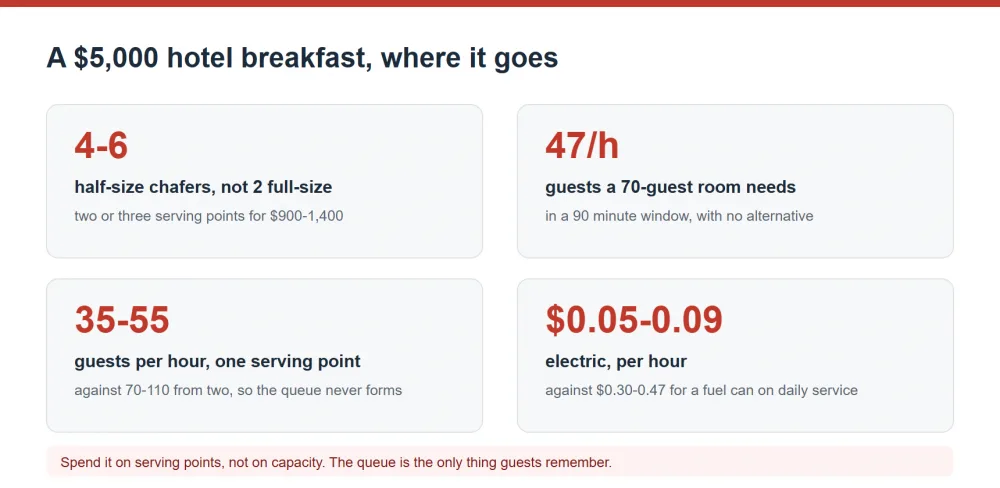
The arithmetic that makes the ranking work is simple. A 70 guest breakfast in a 90 minute window needs a throughput of about 47 guests an hour, and a single serving point delivers 35 to 55. Two points deliver 70 to 110, which means the queue never forms. Spending the last $1,200 of the budget on a refrigerated display instead of on the fourth chafer produces a room that looks better and waits longer, which is the wrong trade.
Frequently Asked Questions
Is $5,000 enough to equip a hotel breakfast buffet?
Yes, for 60 to 70 guests at two or three serving points, provided the budget is spent on serving points rather than on capacity. The line items that matter are four to six half-size chafers, two heat lamps, a cereal dispenser, two beverage dispensers and the smallwares that make them work. What $5,000 does not buy is a built-in buffet run, a refrigerated display and enough stock for 150 guests, and a hotel that needs all three should budget $9,000 to $14,000 or hire for the first season.
Should I buy electric or fuel chafers for a daily breakfast?
Electric, without much hesitation. A breakfast service runs 90 minutes every day at a predictable time, which is the ideal case for electric: the circuit is known, the preheat can be scheduled, and the running cost is a fraction of fuel. A 400 W unit costs about $0.05 to $0.09 an hour against $0.30 to $0.47 for a fuel can. Buy fuel only for the outdoor and temporary services, where the power is not there and the self-contained unit wins on total cost including the infrastructure.
How many chafing dishes do 70 breakfast guests need?
Four to six half-size units, which gives two to three serving points plus a spare. Two half-size pans on one line feed 70 guests in about 45 minutes and produce no visible queue, because each pan serves 35 to 55 guests an hour. The spare matters more than it sounds, because a failed unit at 7 am on a Tuesday is a room full of guests and no alternative, and a $150 spare is the cheapest insurance available.
What is the first thing a hotel breakfast buffet should skip?
A refrigerated display, if the budget is tight. Cold items can be held in ice wells for 90 to 150 minutes with a restock plan, and a $900 display is the single most expensive line on the list. The second thing to skip is any coated or non-standard finish, because it costs 20 to 60 percent more and cleans identically. What must not be skipped is the second serving point, because that is the one line that changes what the guest experiences.
How do I keep a breakfast buffet looking full for 90 minutes?
Refill in half-pan batches rather than full ones, and keep a backup held above 60 C so the refill is a swap rather than a reheat. A half-pan refill takes 30 to 60 seconds and keeps the line at the same height, while a full-pan refill takes 3 to 4 minutes and leaves a visible gap. Place the backup food in a hot cabinet or a second chafer at the end of the line, and rotate so the pan at the front is always the fullest.
Related reading
- Hotel Breakfast Buffet Equipment: What 100 Rooms Really Need
- Return on Investment of a Hotel Breakfast Buffet
- Chafing Dishes for Catering: The Exact Startup Kit You Need
- Hotel All-Day Dining: Stainless Buffet Stove Specs
- Sterno vs Gel vs Electric: Does Electric Save $23,000?
- Cereal Dispensers for Hotel Breakfast: What to Specify