



Outdoor Wedding Buffet: Wind, Sun and Rain Survival Guide
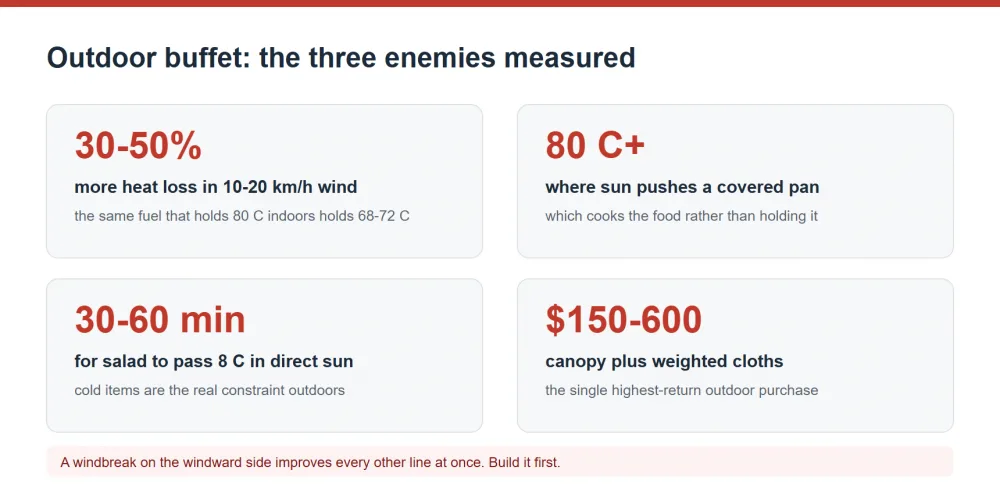
Short answer: Wind is the first enemy because it multiplies heat loss and blows dust into open pans, sun is second because it heats a covered pan above 80°C and dries the food, and rain is third because it reaches everything uncovered. A windbreak alone cuts heat loss 30–50 percent, and a canopy plus weighted tablecloths is the highest-return outdoor purchase at $150–$600. Plan for 20–40 percent higher fuel or power consumption than indoors, and hold the food 3–5°C hotter to keep the same margin. See chafing dishes and heat lamps.
Outdoor weddings are beautiful — until the wind picks up, the sun beats down on the chafing dishes, or it starts to rain.
Indoor buffets are easy. Outdoor buffets require a different set of equipment and a different plan. Wind blows your napkins away. Sun melts your chocolate. Rain ruins your setup.
Here's how to survive outdoor buffet weather.
PRO TIP: Use electric chafing dishes, not fuel.
Wind does two things: it blows napkins away, and it makes fuel chafing dishes impossible. Open flame in wind = flame blows sideways, uneven heating, fire risk. Electric chafing dishes = no open flame = no wind problem.
KEY TAKEAWAY: Always have a backup tent.
Outdoor weather is unpredictable. Always have a backup tent or indoor space ready. If it starts raining, you can move the buffet inside.
Quick Answer: The 3 Weather Enemies
| Enemy | Problem | Solution |
|---|---|---|
| Wind | Blows napkins, kills fuel flame | Use electric chafing dishes |
| Sun | Melts chocolate, overheats food | Keep food in shade |
| Rain | Wets equipment, ruins setup | Have backup tent |
Wind: The #1 Enemy
Wind does two things: it blows napkins and plates away, and it makes fuel chafing dishes impossible. Open flame in wind = flame blows sideways, uneven heating, fire risk.
Solutions:
- Use electric chafing dishes, not fuel. No open flame = no wind problem. See our electric chafing dish collection.
- Weight everything: metal plate weights, heavy tablecloths, weighted napkin dispensers.
- Build a windbreak: portable screens, or position the buffet behind a wall or hedge.
- Use lids on every dish — uncovered food gets covered in leaves and dust.
Sun: The Silent Killer
Direct sun does two things: it heats food above safe temperatures, and it melts butter and chocolate desserts.
Solutions:
- Set up the buffet in the shade. Under a tree, or under a canopy.
- Use reflective tablecloths. Light colors reflect heat.
- Keep cold foods in insulated containers. Add ice packs underneath.
- Skip the melted chocolate fountain. Sun + chocolate = disaster.
See our chafing dish temperature guide for more details.
Rain: The Backup Plan
You can't control the weather. But you can have a backup plan.
Solutions:
- Always have a backup tent or indoor space ready.
- Use waterproof covers for all equipment.
- Position the buffet close to the building. Easy to move inside.
- Have a rain plan in your contract. Tell clients what happens if it rains.
Essential Outdoor Buffet Gear
| Item | Why You Need It |
|---|---|
| Electric chafing dishes | No open flame = no wind problem |
| Heavy tablecloths | Don't blow away in wind |
| Portable windbreak | Blocks wind from the buffet line |
| Canopy tent | Shade from sun, cover from rain |
| Waterproof covers | Protect equipment from rain |
See our wedding buffet ideas for more outdoor tips.
Outdoor Buffet Terms to Know
- outdoor wedding buffet tips
- wedding buffet ideas
- chafing dish fuel hacks
- electric chafing dish for outdoor
- buffet equipment checklist
The Bottom Line
Outdoor buffets are beautiful, but they come with weather challenges. Wind, sun, and rain are the three enemies. Use electric chafing dishes instead of fuel. Weight everything. Keep food in the shade. Always have a backup tent. Do that, and your outdoor wedding buffet will go smoothly — rain or shine.
Looking for Outdoor Buffet Equipment?
BAVA manufactures electric chafing dishes perfect for outdoor events. No open flame, consistent temperature. All products CE/FDA certified, OEM/ODM available.
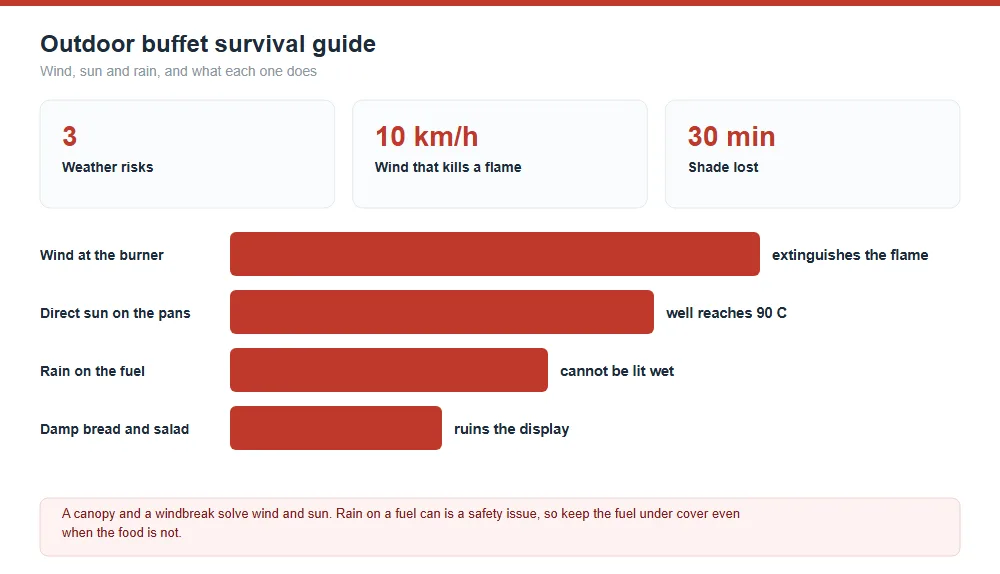
What each weather enemy actually does
Outdoor service is not indoor service with worse weather. It is a different heat balance, a different contamination risk and a different failure mode for every mechanism on the line. The table below measures the three enemies against the things they change, because the fixes are specific and cheap once you know which problem you are solving.
| Enemy | Heat loss effect | Food quality effect | Safety effect | Equipment effect | Primary defence |
| Wind, 10 to 20 km/h | 30 to 50 percent more heat loss | Food dries at the surface, sauces skin over | Blows dust and pollen into open pans | Fuel cans burn 20 to 40 percent faster | A windbreak on the windward side |
| Direct sun, 25 C or above | Reduces heat loss, which is not a benefit | Food climbs above 80 C, dries and discolours | Cold items pass 8 C within 30 to 60 minutes | Acrylic tanks yellow, ice melts fast | Shade over the whole line |
| Light rain | Modest, the water cools the sides | Water dilutes sauce, wets the plate stack | Contamination from splash and drips | Electrical parts are exposed to water | A canopy with a drip line clear of the food |
| Heavy rain or storm | Severe, the line becomes unusable | Not applicable | Not applicable | Everything is at risk | An indoor fallback, always |
| High humidity, above 70 percent | Slower evaporation, less cooling | Fried items go soft within 15 minutes | Cold items warm faster | Condensation on every cold surface | Serve fried items in small batches |
The outdoor equipment list, and what each item is for
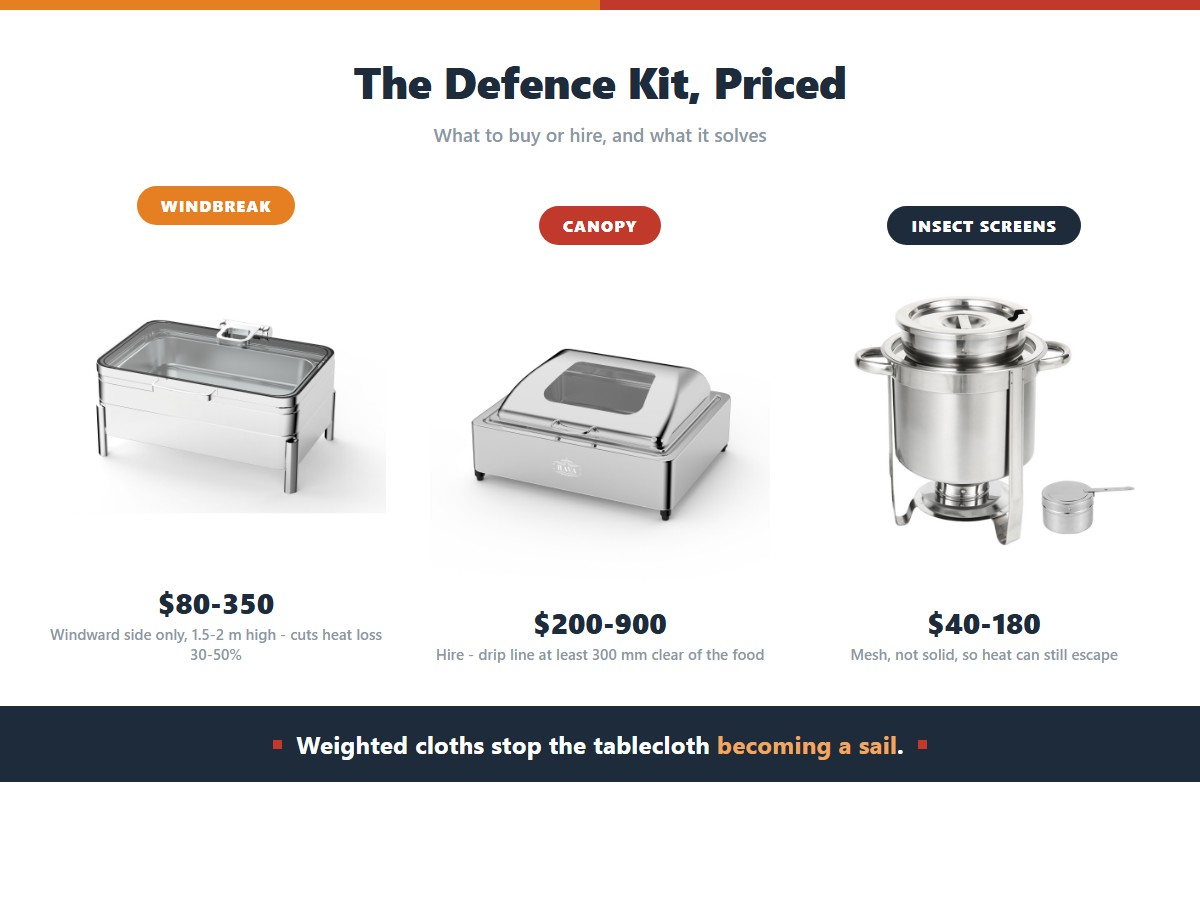
The list is short and every item does a job that no other item does. The windbreak is first because it is the only item that improves every other line at once, and the weights are second because an unweighted tablecloth in wind is the most common outdoor buffet accident there is. The figures assume a 100 guest wedding on a lawn or terrace.
| Item | Cost | What it solves | Specification that matters | Skip it and |
| Windbreak or side screens | $80 to $350 | Cuts heat loss 30 to 50 percent and blocks dust | Windward side only, 1.5 to 2 m high | Fuel use rises 20 to 40 percent and pans collect debris |
| Canopy or marquee | $200 to $900 to hire | Shade, rain and a defined service area | Drip line at least 300 mm clear of the food | Sun cooks the food and rain ends the service |
| Weighted tablecloths | $20 to $60 | Stops the cloth becoming a sail | Weights on every corner and at 600 mm intervals | The cloth lifts and takes the plate stack with it |
| Ground protection or decking | $100 to $400 | Level, dry footing for staff and guests | Level, and drained | Tables rock and hot pans tip |
| Insect screens or domes | $40 to $180 | Flies, wasps and airborne pollen | Mesh, not solid, so heat can escape | Every open pan is a wasp station |
| Fuel cans with a weather shield | $2 to $6 each | A can that keeps burning in wind | Shielded holder, not an open cup | The can blows out mid-service |
| Insulated carriers for the backup | $60 to $200 each | Keeps the refill food out of the danger zone | Rated, with a gasket that closes | Backup food cools in transit and cannot be used |
| Cold wells with a lot of ice | Included | Holding cold items above 5 C is impossible outdoors | Drain plug, and a restock plan | Salad passes 8 C within 30 to 60 minutes |
The temperature plan is what ties the list together. Outdoors, hold hot food 3 to 5 C hotter than the indoor target, refill in half-pan batches, and probe the centre of the pan every 30 minutes rather than hourly, because the wind and the sun both move faster than a kitchen does. Cold items are the real constraint: an ice well holds 2 to 5 C for 90 to 150 minutes outdoors and then needs the ice replaced, so the restock plan for the ice has to be as explicit as the restock plan for the food.
Frequently Asked Questions
How do I keep a chafing dish hot outdoors in wind?
Build a windbreak on the windward side, set the flame one notch higher than you would indoors, and check the water level every 30 minutes because the evaporation rate doubles. A 10 to 20 km/h breeze increases heat loss by 30 to 50 percent, so the same fuel that holds 80 C indoors will hold 68 to 72 C in wind. Hold the food 3 to 5 C hotter to keep the same safety margin, and use a shielded fuel holder rather than an open cup, because an open flame in wind goes out unpredictably.
What happens to food in direct sun on a buffet?
It climbs above 80 C, which cooks rather than holds, and it dries at the surface while the centre stays cooler. Sun on a covered pan is worse than sun on an open one, because the cover traps the heat. The fix is shade over the whole line, not just over the guests, and a canopy that only covers the serving side leaves the pan in the sun. Cold items are worse affected: a salad in direct sun passes 8 C within 30 to 60 minutes, so cold wells outdoors need a shade cover and a much shorter service window.
Can I run an electric buffet outdoors?
Only with a properly rated outdoor supply and weatherproof connections, and it is usually not worth the risk. A domestic extension lead across a lawn is an electrical hazard the moment it rains, and a GFCI or RCD protected outdoor circuit has to be installed rather than improvised. For an outdoor event, fuel is the correct choice for the hot line, and electric should be reserved for a covered, dry area with a proper supply. The running-cost saving of electric is irrelevant if the supply is not safe.
What is the minimum weather backup for an outdoor wedding buffet?
A written indoor fallback, and it has to be a room rather than a bigger canopy. A canopy handles light rain and it does not handle wind, and a storm that arrives at 4 pm does not care about the plan you made at 9 am. The fallback should specify the room, the number of guests it holds, the layout that fits, and who makes the call and when. The most common failure is a venue that has a beautiful outdoor plan and an indoor room that cannot physically take the buffet.
How do I stop flies and wasps at an outdoor buffet?
Mesh domes over the open dishes, and solid covers over anything with sugar, because wasps are attracted to sweet drinks and fruit rather than to the savoury food. Keep the bins 5 m or more from the line and empty them during the service, because a full bin in sun is what brings the wasps in the first place. Avoid strongly scented florals on the buffet table itself, and serve desserts in covered batches rather than all at once, because a dessert table left open for two hours outdoors is the single biggest attractant on the site.
Related reading
- Chafing Dishes for Weddings: Rent, Don't Buy (Here's Why)
- Chafing Dish Rental for Weddings: Packages & Pricing
- Chafing Dish Rental for Weddings: Packages, Pricing, Pitfalls
- 10 Wedding Buffet Ideas Guests Actually Remember
- Outdoor Catering: Buffet Stoves That Survive Wind
- Outdoor Catering Equipment: Wind, Power and Weather Planning
- Wedding Receptions: Keeping Food Fresh for 3 Hours