



School Cafeteria Buffet: HACCP Checklist That Passes Audit
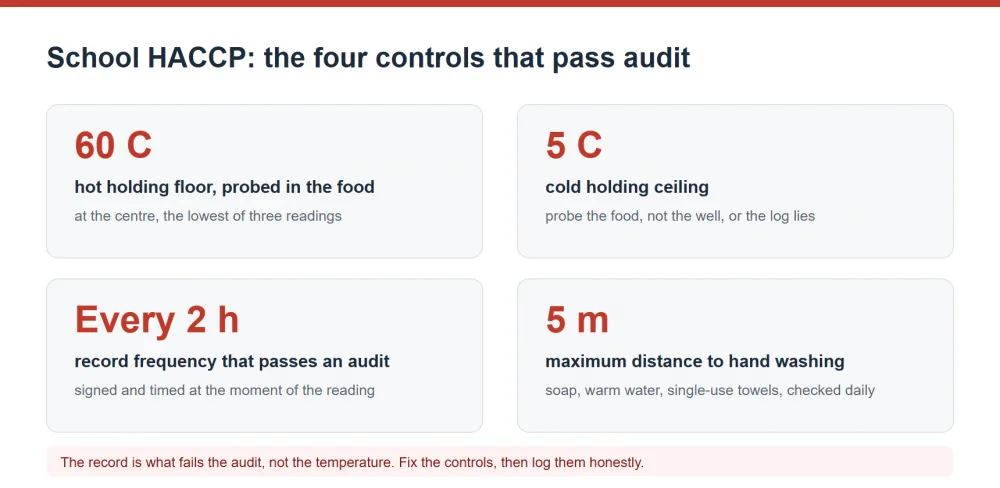
Short answer: A school cafeteria buffet passes a HACCP audit on four controls: hot food at 60°C or above with a recorded probe reading every 2 hours, cold food at 5°C or below, allergen labelling on every dish with a printed card, and a hand washing station within 5 metres of the line. The most common failing point is the temperature record, not the temperature: a school that holds 68°C but logs nothing fails, while one that logs 63°C twice a day passes. See chafing dishes and heat lamps.
School cafeteria buffets have stricter food safety rules than restaurants. Health inspections happen twice a year, and one failure can shut down the lunch program.
Inspectors don't just look at the food. They look at your temperature logs. They look at your allergen labels. They look at your hand washing station. Miss one thing, and you fail.
This checklist covers everything inspectors look for.
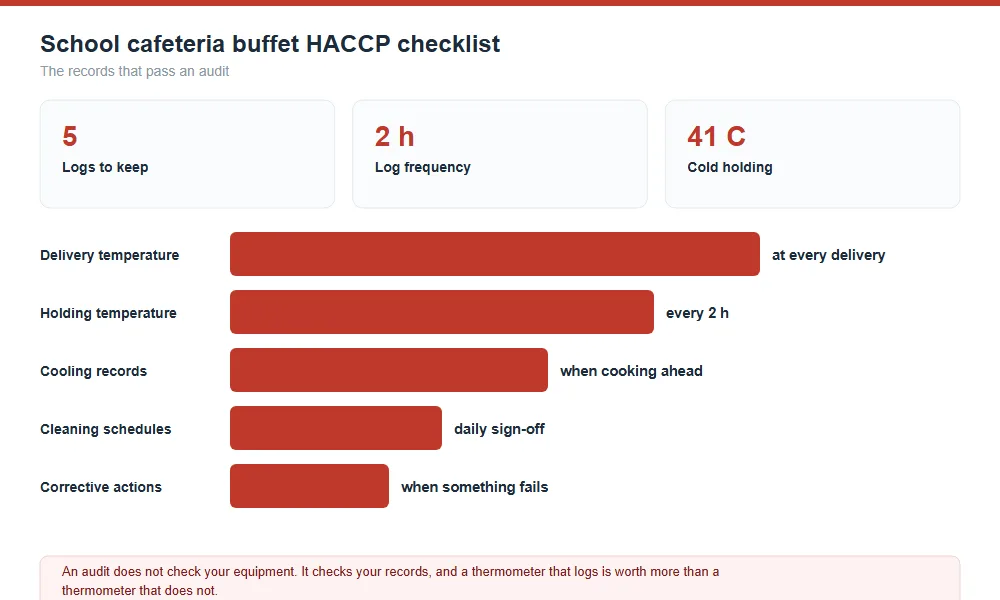
PRO TIP: Keep 30 days of temperature logs.
Inspectors ask for the last 30 days of logs — no log, no pass. Record temperature every 2 hours. Hot food must be 60°C+. Cold food must be 5°C or below.
KEY TAKEAWAY: 9 major allergens must be labeled.
Every dish must have a label listing all 9 major allergens: milk, eggs, fish, crustacean shellfish, tree nuts, peanuts, wheat, soybeans, sesame. Use large, clear labels. Pictures help younger students identify allergens.
Quick Answer: The HACCP Checklist
| Category | Requirement | Frequency |
|---|---|---|
| Temperature Control | Hot 60°C+, Cold 5°C- | Every 2 hours |
| Allergen Labeling | 9 major allergens labeled | Every dish |
| Hand Washing | Hand washing station available | Always |
| Cross-Contamination | Separate utensils for each dish | Always |
| Cleaning | Clean display surfaces between services | Every service |
Temperature Control (Every 2 Hours)
Hot food must be at 60°C (140°F) or above. Cold food must be at 5°C (41°F) or below. Record every 2 hours on a temperature log.
What to measure:
- Chafing dish water temp: 85°C+
- Food internal temp: 60°C+
- Refrigerated display temp: 5°C or below
- Ice beds: ice still partially frozen at service end
See our food holding temperature chart for more details.
Allergen Labeling (Non-Negotiable)
Every dish must have a label listing all 9 major allergens:
- Milk
- Eggs
- Fish
- Crustacean shellfish
- Tree nuts
- Peanuts
- Wheat
- Soybeans
- Sesame
How to do it: Use large, clear labels. Pictures help younger students identify allergens.
Serving Station Setup
Separate serving utensils for each dish. No sharing spoons. This prevents cross-contamination.
What inspectors look for:
- One utensil per dish
- Utensil holders between dishes
- No utensil resting on food
- Clean display surfaces
Hand Washing Station
A hand washing station must be available near the buffet line. Soap, paper towels, and warm water.
Why it matters: Students touch the serving spoon after touching their face, phone, or each other. Hand washing stops the spread of germs.
What Inspectors Check
| What They Check | What They Want to See |
|---|---|
| Temperature logs | Last 30 days, filled out every 2 hours |
| Allergen labels | All 9 allergens labeled on every dish |
| Chafing dishes | Clean, no rust, water level correct |
| Hand washing | Station available, soap stocked |
| Cross-contamination | Separate utensils, clean surfaces |
See our buffet equipment checklist for more equipment tips.
Common Failing Points
- No temperature log: Most common failure. Start logging today.
- Missing allergen labels: Sesame was added in 2023. Make sure it's on every label.
- Chafing dish water too low: Inspectors check. Keep water at 1-2cm.
- Shared serving utensils: One spoon for two dishes = cross-contamination.
- Dirty display surfaces: Wipe down between services. Every time.
HACCP Checklist Terms to Know
- school cafeteria HACCP checklist
- food holding temperature chart
- buffet equipment checklist
- commercial chafing dish for school
- buffet equipment maintenance
The Bottom Line
School cafeteria inspections are strict, but they're passable. Keep 30 days of temperature logs. Label all 9 allergens on every dish. Have a hand washing station. Use separate utensils for each dish. Clean display surfaces between services. Do that, and you'll pass every inspection.
Looking for School Cafeteria Equipment?
BAVA manufactures commercial chafing dishes perfect for school cafeterias. Durable, easy to clean, temperature consistent. All products CE/FDA certified, OEM/ODM available.
The four controls, and what an auditor asks for
HACCP in a school cafeteria is not a food safety philosophy, it is a set of documents that a local authority or a third-party auditor asks to see. Each control below has a physical requirement and a documentary requirement, and the documentary one is what fails the audit. The table covers the four that apply to a buffet line, with the evidence that satisfies each.
| Control | Physical requirement | Documentary requirement | Frequency | What fails | Cost of compliance |
| Hot holding temperature | 60 C or above in the food, measured at the centre | A signed log with time, dish and reading | Every 2 hours | A pan at 58 C with no record, or a record with no times | $20 probe, $2 log sheet |
| Cold holding temperature | 5 C or below in the food, not in the well | A signed log with time, dish and reading | Every 2 hours | Salad at 9 C, or a well temperature recorded instead of a food temperature | $20 probe, $2 log sheet |
| Allergen information | A printed card naming every allergen per dish | A dated recipe card per dish, and a card on the line | Per dish, per day | A verbal answer, or a card that lists the dish but not the allergens | $5 of card per dish |
| Hand washing | A station within 5 m of the line, with soap and single-use towels | A cleaning log for the station | Checked daily | A station that is out of soap, or more than 5 m away | $30 of consumables a week |
What an inspector actually checks, in order
An inspection follows a sequence, and knowing it removes most of the anxiety. The inspector looks at the records first, then at the equipment, then at the people, because the records tell them where to look. The table below is the order in which a typical school cafeteria inspection proceeds, with the finding that each step produces.
| Step | What they ask for | What they are checking | Common finding | Severity | Fix before the visit |
| 1. Records | Temperature logs for the last 30 days | That they exist, are signed and have times | Gaps, or a whole month in one handwriting | Major | Log at the time of the reading, not at the end of the day |
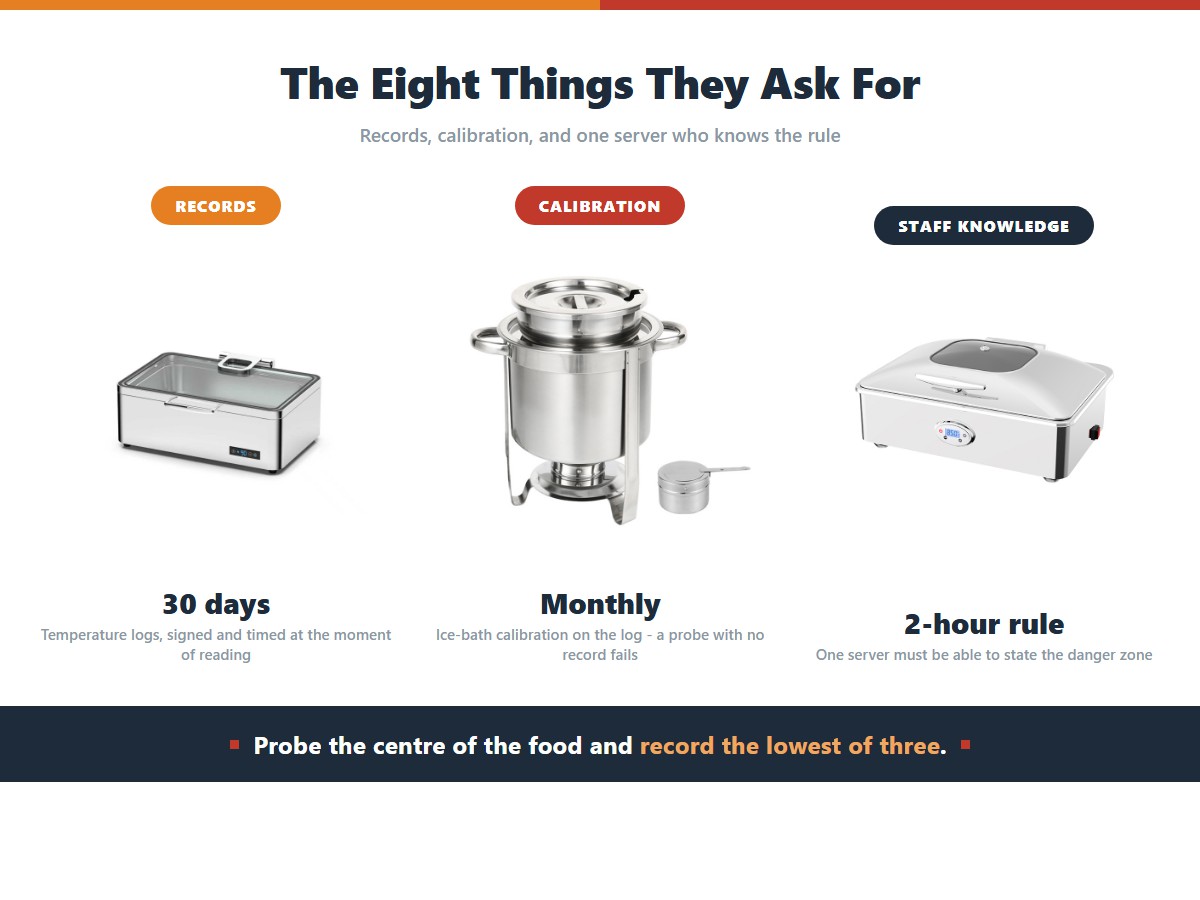
| 2. Calibration | Probe calibration record | That the probe is known to be accurate | No calibration record at all | Major | Ice-bath calibration, monthly, on the log |
| 3. Hot holding | A live probe reading from the centre of a pan | That the reading matches the log | A reading 8 C below the log | Critical | Probe the centre, and record the lowest of three |
| 4. Cold holding | A live probe reading from a cold dish | That the food is cold, not just the well | Well at 4 C, salad at 9 C | Critical | Probe the food, and log the food temperature |
| 5. Allergens | The recipe card and the line card for one dish | That they agree with each other | A line card that omits an allergen | Critical | One source of truth, printed twice |
| 6. Cross-contamination | A look at the layout and the utensils | Separate utensils, and a serving order | One tong for the salad and the pasta | Major | Colour-coded utensils, one per dish |
| 7. Cleaning | The cleaning schedule and the chemical log | That it is done and recorded | A schedule with no signatures | Major | Sign at the time, not at the end of the week |
| 8. Staff knowledge | A question to one server | That they know the 2-hour rule | Nobody can state the danger zone | Major | One briefing a term, and a card at the line |
The pattern in that sequence is that a school which is genuinely compliant can still fail on documentation, and a school which is not genuinely compliant cannot pass on documentation alone, because step 3 and step 4 are live readings. The honest preparation is to fix the physical controls first and then make the record match them, rather than the reverse. A school that writes down a number it did not measure has created a document that will be used against it.
Frequently Asked Questions
How often must I record temperatures on a school buffet?
At least every 2 hours during service, and at the start of service as a baseline, because the 2-hour rule is cumulative and the record is the only evidence that it was respected. Most authorities want the reading taken at the centre of the food rather than in the water pan, and the lowest of three readings across the pan recorded. The log must be signed and timed at the moment of the reading, because a log completed from memory at the end of the day is a document that will fail an audit on its face.
What is the most common reason a school cafeteria fails an audit?
The temperature record, and specifically a record that exists but is not credible. A whole month in one handwriting, or readings that are identical every day, or times that do not match the service pattern, all fail before anyone looks at the food. The second most common is a cold holding reading taken from the well rather than from the food, which produces a log that says 4 C while the salad is at 9 C. Both are fixed by probing the food and writing down the number at the moment you read it.
Do I need allergen labels on a school buffet?
Yes, and they must be printed rather than verbal, because a verbal answer cannot be verified and a printed card can be checked against the recipe. Each card should name the dish and list every allergen in it, including the ones that are not obvious, such as a sauce thickener containing wheat or a dressing containing egg. The card on the line and the recipe card in the kitchen must agree, and a mismatch between the two is a critical finding rather than a paperwork issue.
How far can the hand washing station be from the buffet?
Within 5 metres, and it must have soap, warm running water and single-use towels. The station is not decoration: it is the control that stops a server who has handled a raw ingredient from touching a served dish, and it is one of the first things an inspector checks. If the room layout puts the only sink more than 5 metres away, a dedicated station next to the line is the fix, and it costs about $30 a week in consumables.
Can a school buffet hold food for the whole lunch period?
Yes, provided the temperature is held and recorded, but a 2-hour limit applies to any food that has been in the 5 to 60 C zone, and that clock starts when the food leaves the kitchen rather than when it is plated. A 40 minute lunch period is comfortable. A 90 minute period with staggered sittings is not, unless the food is refilled from a held backup rather than sitting in the pan from the start. For a staggered service, refill in half-pan batches and keep the backup above 60 C.
Related reading
- School & University Cafeteria Buffet Equipment Guide
- HACCP for Buffet Lines: Temperature Logs That Pass Audit
- Opening a Buffet? The 2026 Equipment Checklist
- How to Choose a Chafing Dish: 6 Checks, 5 Sizes, 1 Checklist
- Electric Chafing Dish Buffet Set: What's in the Box?
- Buffet Stove Setup for Catering: Field Checklist