



Free Buffet Setup Checklist: Printable for Your Next Event
Short answer: A buffet setup runs on a fixed clock: 24 hours before, confirm the count and the layout; 1 hour before, lay the tables and set the stations; 30 minutes before, light the fuel or switch on the power and load the food; and during service, refill in half-pan batches and probe every 30 minutes. The three mistakes that cost the most are laying the line before the room is set, loading food before the heat is up, and not rehearsing the takedown. See chafing dishes and buffet stations.
This is the buffet setup checklist professional caterers use. Print it, clip it to your clipboard, and tick off every item before guests arrive.
Most buffet disasters happen because someone forgot something. Forgot the serving spoon. Forgot the fuel cans. Forgot to preheat the chafing dishes. This checklist prevents all of that.
PRO TIP: Preheat chafing dishes 30 minutes before food goes in.
Most people put food in cold chafing dishes and light the fuel. The fuel spends 15 minutes heating the water and the pan. Preheat: boil water, pour it in, light the fuel, wait 15 minutes, then add food. Food stays hotter, longer.
KEY TAKEAWAY: Bring a probe thermometer.
Never guess the temperature. Bring a probe thermometer. Check every dish before service. Hot food must be 60°C+. Cold food must be 5°C or below. No thermometer = no idea if your food is safe.
Quick Answer: The Setup Timeline
| When | What to Do |
|---|---|
| 3 Days Before | Order food, confirm guest count |
| 1 Day Before | Clean equipment, pack supplies |
| 1 Hour Before | Set up tables, preheat chafing dishes |
| 30 Min Before | Arrange food, check temperatures |
| During Service | Monitor temps, restock as needed |
Before the Event (Day Before)
- [ ] Confirm guest count and dietary restrictions
- [ ] Order all food and ingredients
- [ ] Clean and sanitize all chafing dishes and serving utensils
- [ ] Check fuel cans / electric cords and plugs
- [ ] Pack extra serving spoons, tongs, and ladles
- [ ] Pack tablecloths, napkins, and plates
- [ ] Pack probe thermometer and temperature log
- [ ] Pack cleaning supplies (spray, cloths, garbage bags)
See our buffet equipment maintenance schedule for cleaning tips.
Setup (1 Hour Before Guests Arrive)
- [ ] Set up tables and position buffet line
- [ ] Lay tablecloths and smooth out wrinkles
- [ ] Place chafing dishes in order: appetizers, sides, mains, desserts
- [ ] Preheat chafing dishes (boiling water + fuel/electric)
- [ ] Arrange serving utensils next to each dish
- [ ] Set up heat lamps over hot stations
- [ ] Set up beverage dispensers (cold and hot)
30 Minutes Before Service
- [ ] Arrange food in chafing dishes
- [ ] Check food temperatures with probe thermometer
- [ ] Hot food: 60°C+? Cold food: 5°C or below?
- [ ] Add labels to each dish (allergens, names)
- [ ] Final check: napkins, plates, utensils
- [ ] Staff briefing: who does what during service
See our food holding temperature chart for more details.
During Service
- [ ] Monitor temperatures every 2 hours
- [ ] Restock food as needed
- [ ] Keep chafing dish water at 1-2cm level
- [ ] Keep lids on except when serving
- [ ] Clean up spills immediately
- [ ] Check fuel cans / electric cords
Essential Equipment Checklist
| Item | Quantity | Purpose |
|---|---|---|
| Chafing dishes | 4-6 half-size | Keep hot food hot |
| Heat lamps | 2 | Keep crispy food crispy |
| Beverage dispensers | 2-3 | Water, juice, iced tea |
| Probe thermometer | 1 | Check food temperatures |
| Serving utensils | 1 per dish | No cross-contamination |
| Tablecloths | 1 per table | Professional look |
See our buffet equipment checklist for the full list.
Common Setup Mistakes
| Mistake | What Happens | Fix |
|---|---|---|
| No preheating | Food takes 15 min to heat | Preheat 30 min before |
| Forgot serving spoons | Guests use forks | Pack extras |
| No thermometer | Guessing temperature | Bring probe thermometer |
| Wrong water level | Boils dry or too much | 1-2cm water level |
| No labels | Guests ask "what's this?" | Label every dish |
Buffet Setup Terms to Know
- buffet setup checklist printable
- buffet equipment checklist
- food holding temperature chart
- catering startup equipment
- commercial buffet equipment
The Bottom Line
A good buffet setup doesn't happen by accident. It happens with a checklist. 3 days before: order food. 1 day before: clean and pack. 1 hour before: set up and preheat. 30 minutes before: arrange food and check temperatures. During service: monitor and restock. Do that, and your buffet goes smoothly every time.
Looking for Buffet Equipment?
BAVA manufactures commercial buffet equipment for caterers and hotels. Chafing dishes, heat lamps, dispensers. All products CE/FDA certified, OEM/ODM available.
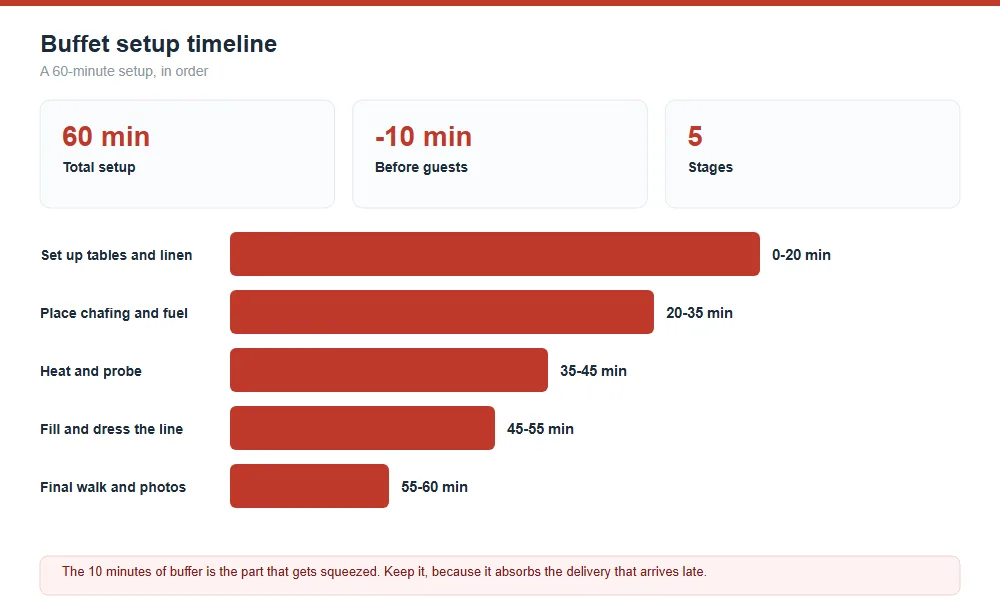
The setup clock, with the checks at each stage
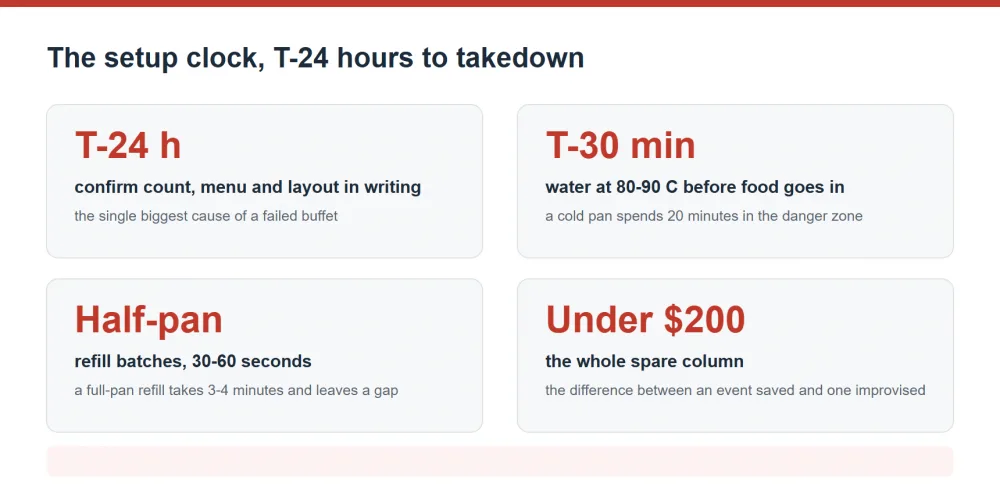
Every buffet failure is a timing failure in disguise, and the reason is that two things have to be ready at the same moment: the heat and the food. A pan loaded before the water is hot spends 20 minutes in the danger zone, and a pan that reaches temperature after the doors open has a queue in front of it. The table below is the clock, with the check that closes each stage.
| Time | Stage | What happens | Check before moving on | What it prevents | Who owns it |
| T-24 h | Confirm | Guest count, menu, layout, equipment list, dietary requirements | Written confirmation of the count and the layout | The single biggest cause of a failed buffet | Manager |
| T-4 h | Prepare equipment | Clean, count, pack, load the transport | Equipment count against the list, and the spares | Arriving without a unit | Kitchen |
| T-1 h | Lay the line | Tables, cloths, stations, signage, plates, cutlery | Walk the line as a guest would, from entry to exit | A layout that jams once it is full | Setup team |
| T-30 min | Heat up | Water pans filled to the line, fuel lit or power on, lids on | Water at 80 to 90 C before any food goes in | Food sitting in a cold pan | Setup team |
| T-10 min | Load food | Food into the pans, from the held backup above 60 C | Probe the centre of the first pan and record it | No baseline temperature record | Kitchen |
| T-0 | Open | Lids off, staff in position, signage visible | One staff member watching the queue, not the food | The queue becoming the experience | Floor |
| Every 30 min | Service | Refill in half-pan batches, probe the centre, top up water | A reading written on the log at the time | An unrecorded temperature drop | Floor |
| T+end | Takedown | Extinguish, cool, strip, wash, dry, count back in | Nothing left lit, and the count matches the list | A burnt-out can and a missing pan | Setup team |
The equipment list, and the spare that goes with each
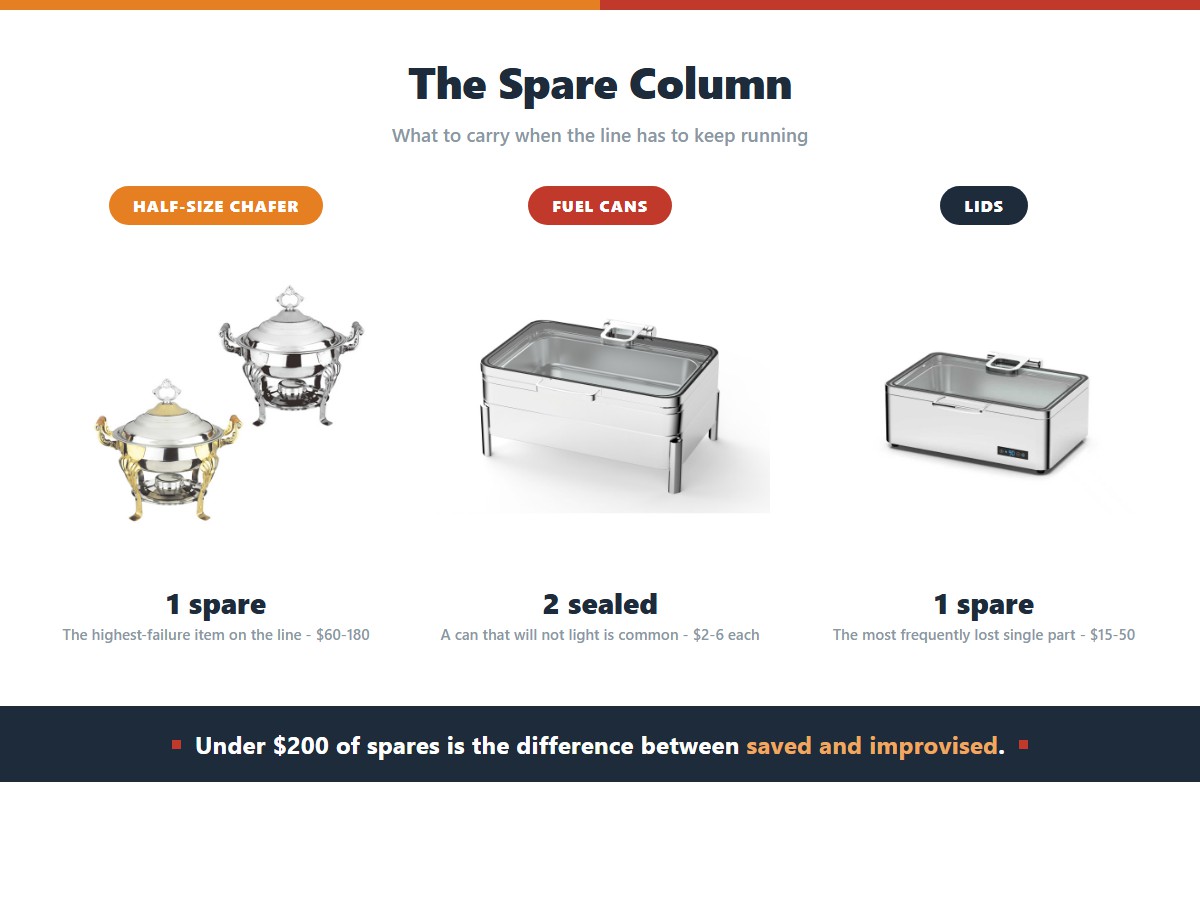
A checklist is only useful if it includes the thing you will forget, and the thing you will forget is almost always the spare. The table below is the equipment list with the spare against each line, because the spare is what turns a failure into an inconvenience and the item itself is what you will remember.
| Item | Quantity per 50 guests | Spare to carry | Why this spare | Cost of the spare |
| Half-size chafers | 2 to 3 | 1 | The highest-failure item on the line | $60 to $180 |
| Fuel cans | 6 to 10 | 2 sealed | A can that will not light is common | $2 to $6 each |
| Water pans | 2 to 3 | 1 | A pan runs dry and the base scorches | $12 to $40 |
| Lids | 2 to 3 | 1 | The most frequently lost single part | $15 to $50 |
| Heat lamps | 1 to 2 | 1 bulb | Bulbs fail at around 1,000 hours | $6 to $18 |
| Probe thermometer | 1 | 1 battery set | A dead probe means no temperature record | $2 |
| Tongs and serving utensils | 1 per dish | 2 | Utensils get taken to the kitchen | $4 to $15 each |
| Tablecloths | 1 per table | 1 | Spills and wind | $10 to $30 |
| Signage cards | 1 per dish | 2 blanks | A dish changes on the day | $1 |
| Extension leads and boards | 2 | 1 | The venue outlet is never where you planned | $15 to $45 |
The reason the spare column matters is that a buffet is a system with no redundancy, and the failure of any single part stops the line. A missing lid means the food dries. A dead probe means no record. A lost tong means one dish is unservable. The total cost of the spare column is under $200, and it is the difference between a caterer who finishes an event and one who improvises in front of 50 guests.
Frequently Asked Questions
How long before the event should I light the chafing dish fuel?
30 minutes before the food goes in, and the water must be at 80 to 90 C before the first pan is loaded. Lighting the fuel 5 minutes before the doors open means the food spends the first 20 minutes of the service in a cold pan, which is both a temperature risk and the reason a queue forms at a station that cannot serve fast. Fill with hot water rather than cold to cut the heat-up time, and use the marked water level, because overfilling roughly doubles the time to temperature.
What is the most common setup mistake?
Loading the food before the heat is up. It is almost universal, because the kitchen finishes cooking at the moment the room is ready and the two timelines collide. The fix is to sequence them deliberately: heat the water first, then bring the food, then load. The second most common mistake is laying the line before the room is set, which means the layout is fixed by the tables rather than by the flow, and it cannot be changed once the cloths are down.
Should the plates be at the start or the end of the line?
At the start, and the cutlery and napkins at the end. Guests take a plate first because they need it to serve, and putting cutlery at the end means nobody carries a fork through the hot food. The commonest error is putting cutlery at the entry, which creates a stationary guest in the middle of the flow holding a fork while they decide what to eat. For a dessert station, a small plate at the start and a fork at the end is the standard arrangement.
How do I plan the takedown?
Rehearse it, because it is the part that gets improvised and it is where the equipment gets damaged. Extinguish the fuel first and let the units cool for 10 minutes before anything is quenched in water, because a hot pan in cold water warps the base. Then strip, wash, rinse, dry for 4 hours and count everything back in against the list. A takedown that runs in the wrong order is how a fleet of chafing dishes develops warped bases and perished seals, and it costs nothing to fix.
What should I check 30 minutes before the doors open?
Four things, in this order. The water in every pan is at 80 to 90 C and at the marked level. The food is held above 60 C and the first probe reading is written on the log. The signage is visible from the entry, so guests can see what is where. And someone is assigned to watch the queue rather than the food, because the queue is the constraint and the food will hold for 20 minutes without attention while the queue will not.
Related reading
- Buffet Stove Setup for Catering: Field Checklist
- Opening a Buffet? The 2026 Equipment Checklist
- Buffet Restaurant Equipment Checklist: What You Need to Open
- How to Choose a Chafing Dish: 6 Checks, 5 Sizes, 1 Checklist
- Buffet Food Temperature Log Template (Free Structure)
- Buffet Stove Setup: Water, Heat and Placement