



Catering Event Timeline: From Setup to Takedown
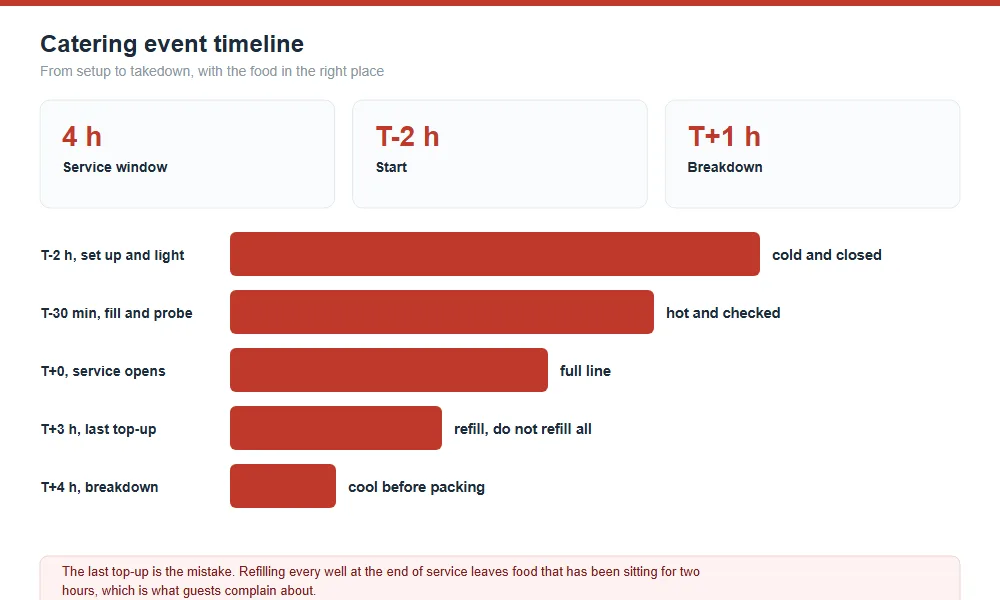
Short answer: A catering event runs on a 3-hour clock from arrival to takedown, and the only stage with no slack is the 60 minutes before service, when food, heat and layout all have to be ready at the same moment. The two sequencing errors that cause most failures are loading food into a cold pan and laying the line before the room is set. For a 100 guest buffet, the realistic allocation is 45 minutes of setup, 60 minutes of food prep, 30 minutes of final checks, then service. See chafing dishes and buffet stations.
Timing is everything in catering. Arrive too early and you waste staff hours. Arrive too late and you are still setting up when guests walk in.
This timeline works for a 100-guest wedding or corporate lunch. It's the 3-hour countdown that professional caterers use. Follow it, and you'll never be scrambling at the last minute.
PRO TIP: Walk the line as a guest before the cloths go down.
Enter at the door, take a plate, and trace the full route to the exit before anything is dressed. The layout is fixed by the flow once the cloths are down and the equipment is on them, so fix the flow first. A line that jams at twenty guests will jam at fifty, and it cannot be re-laid once service has started.
KEY TAKEAWAY: Preheat chafing dishes 1 hour before food goes in.
Most people put food in cold chafing dishes. The fuel spends 15 minutes heating the water. Preheat: boil water, pour it in, light the fuel, wait 15 minutes, then add food. Food stays hotter, longer.
Quick Answer: The 3-Hour Timeline
| Time | What to Do |
|---|---|
| T-3 Hours | Arrival, setup tables, position chafing dishes |
| T-2 Hours | Food prep, heat soups, set up cold stations |
| T-1 Hour | Final checks, check temperatures, labels |
| T-30 Minutes | Service start, staff at stations |
| During Service | Monitor temps, restock as needed |
| After Service | Takedown, pack equipment, clean up |
T-3 Hours: Arrival and Setup
- Unload equipment and ingredients
- Set up tables, chairs, and buffet line
- Position chafing dishes and serving stations
- Plug in electric chafing dishes, preheat
- Set up heat lamps
- Set up beverage dispensers
See our buffet setup checklist for the full list.
T-2 Hours: Food Prep
- Start heating soups, stews, and sides
- Prepare cold stations: salads, fruit, desserts
- Set up beverage dispensers (fill with water, juice, iced tea)
- Plate appetizers (if being passed)
- Preheat chafing dish water pans (boiling water)
T-1 Hour: Final Checks
The hour before service is the one stage with no slack, because food, heat and layout all have to be ready at the same moment. Run it as a sequence rather than a list: confirm every water pan is at temperature and write the first probe reading; confirm a utensil sits beside every dish; place the plate stack and cutlery where the walkthrough set them; and put allergen labels and menu signs where they are visible from the entry. End with a full walkthrough of the line exactly as a guest would take it, and a five-minute staff briefing that names who owns each station. A check that covers food but misses the layout is how a service opens smoothly and jams fifteen minutes in.
See our food holding temperature chart for temperature requirements.
T-30 Minutes: Service Start
- Staff at their stations
- Final temperature check
- Open buffet line
- Greet guests as they enter
During Service
Service is where a timeline either holds or drifts, and the discipline is a fixed rotation rather than a checklist. Refill pans in half-pan batches instead of topping up a full pan, because a half-pan swap takes about a minute while a full refill leaves a visible gap in the line. Probe the centre of the busiest pan every 30 minutes and write the reading on the log at the moment you take it, not later. Keep the water in each pan at the marked level and keep lids on between serves, because an open lid loses heat far faster than a covered one and dries the surface of the food. Give one person the single job of watching the queue rather than the food, because the queue is the constraint and the food will hold for twenty minutes without attention while the queue will not.
See our chafing dish fuel hacks to save fuel during service.
After Service: Takedown
- Pack leftover food
- Turn off chafing dishes / fuel cans
- Let equipment cool down
- Pack up all equipment
- Clean tables and floors
- Load everything back into the van
Timing Mistakes to Avoid
| Mistake | What Happens | Fix |
|---|---|---|
| Arrive too late | Still setting up when guests arrive | Arrive 3 hours early |
| No preheating | Food takes 15 min to heat | Preheat 1 hour before |
| No temperature check | Food not hot enough | Check with probe thermometer |
| No staff briefing | No one knows what to do | Brief staff 1 hour before |
| No walkthrough | Missing something at service | Full walkthrough 1 hour before |
Catering Timeline Terms to Know
- catering event timeline checklist
- buffet setup checklist
- catering startup equipment
- buffet equipment checklist
- commercial chafing dish for catering
The Bottom Line
Timing is everything in catering. Arrive 3 hours before service. 1 hour for setup, 1 hour for food prep, 1 hour for final checks. Preheat chafing dishes. Check temperatures. Brief staff. Do a walkthrough. Follow this timeline, and your event goes smoothly every time.
Looking for Catering Equipment?
BAVA manufactures commercial buffet equipment for caterers. Chafing dishes, heat lamps, dispensers. All products CE/FDA certified, OEM/ODM available.
The three-hour clock, with the critical path
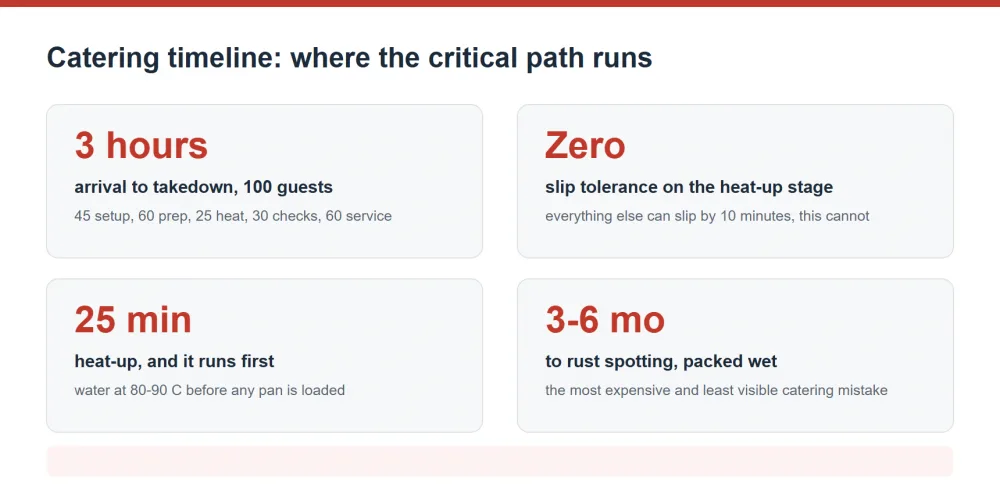
A catering timeline is a critical path, not a list, and the critical path runs through the heat. Everything else can slip by 10 minutes; the water reaching 80 to 90 C cannot, because the food is already cooked and is cooling while it waits. The table below is the clock for a 100 guest buffet with a 60 minute service, and the stage that cannot slip is marked.
| Time | Stage | Duration | What happens | Depends on | Slip tolerance | Consequence of a slip |
| T-3:00 | Arrival and setup | 45 min | Unload, position, lay the line, signage | Room access | 15 minutes | The layout gets fixed by the tables |
| T-2:15 | Food prep | 60 min | Final cook, plate, portion, hold above 60 C | Kitchen access | 10 minutes | Food spends longer in the danger zone |
| T-1:15 | Heat up | 25 min | Water pans filled, fuel lit or power on, lids on | Nothing, it is first | Zero | The whole service is late |
| T-1:00 | Final checks | 30 min | Probe, log, signage, plate stack, staff briefing | Heat up | 10 minutes | No baseline temperature record |
| T-0:30 | Load and open | 15 min | Food into the pans, lids off, staff in position | Final checks | Zero | Guests arrive at an empty line |
| T-0:00 | Service | 60 min | Refill in half-pan batches, probe every 30 minutes | Everything above | Not applicable | Not applicable |
| T+1:00 | Takedown | 45 min | Extinguish, cool, strip, wash, dry, count in | Service end | 20 minutes | Equipment is packed wet and spots |
The sequencing rules that the clock depends on
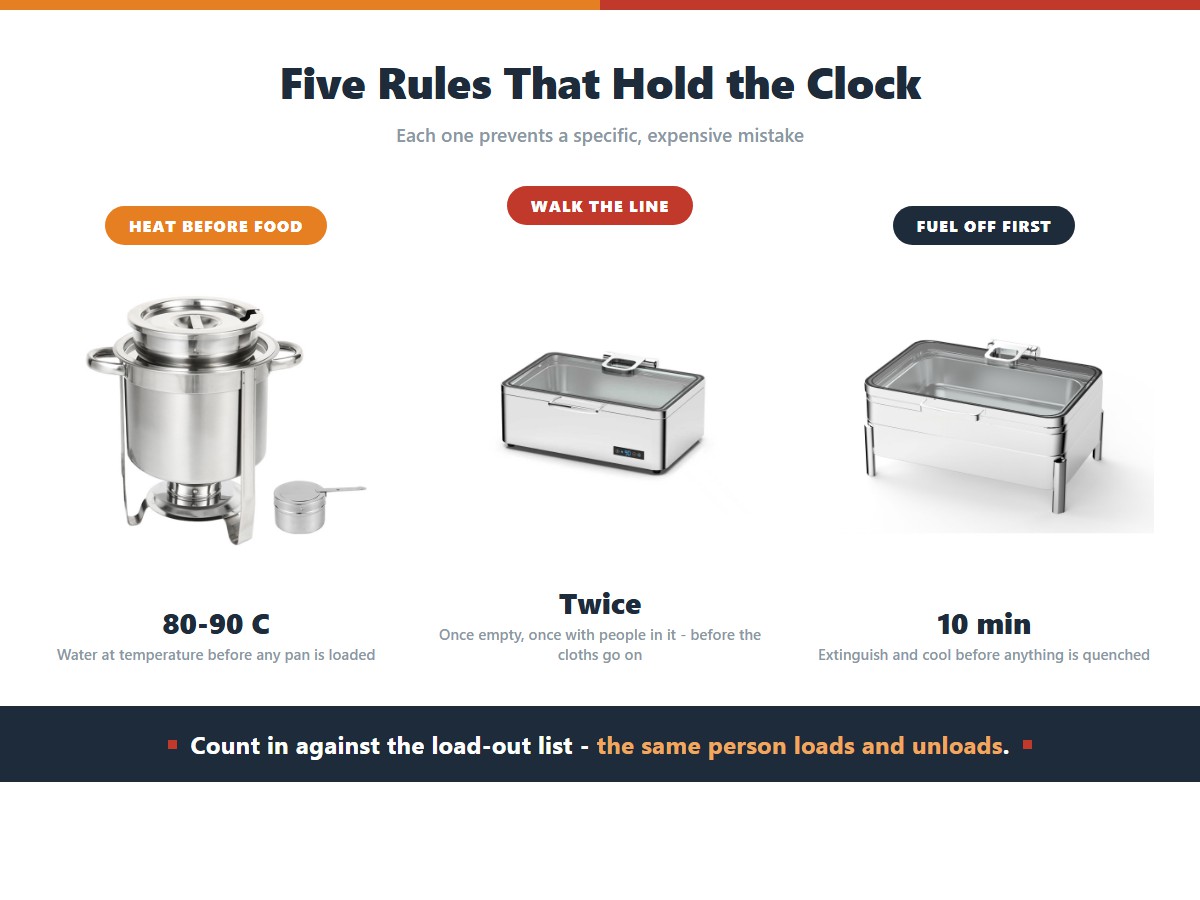
Three rules govern whether the clock holds, and all three are about doing things in an order that is not obvious. The first is that heat comes before food, always. The second is that the layout is walked before the cloths go down. The third is that the takedown starts with the fuel, not with the packing. The table below states each rule, the mistake it prevents and the cost of getting it wrong.
| Rule | What it means | Mistake it prevents | Cost of getting it wrong | How to enforce it |
| Heat before food | Water at 80 to 90 C before any pan is loaded | Food sitting in a cold pan for 20 minutes | A temperature failure and a slow first 15 minutes | One person owns the heat stage and reports when it is done |
| Walk the line before the cloths | Enter as a guest, exit as a guest, then dress the tables | A layout that jams once it is full | 30 to 45 percent of the throughput, permanently | Walk it twice, once empty and once with people in it |
| Fuel off first | Extinguish and cool for 10 minutes before anything is quenched | Warped pan bases and perished seals | $40 to $200 per pan, and a shortened fleet life | Nobody touches a pan until the lead says so |
| Count in against the list | Everything is checked back in against the load-out list | Missing equipment found at the next event | A replacement and a lost booking | Same person loads and unloads |
| Probe the food, not the pan | The reading is taken at the centre of the food | A log that says 70 C while the middle is 58 C | A failed audit and a food safety incident | Three readings across the pan, record the lowest |
The clock also has to be communicated, because a catering team is several people doing different jobs at the same moment. The most effective version is a single printed sheet with the times on it, one copy per person, and a five-minute stand-up at T-1:15 where the lead confirms that the heat stage is complete. A timeline that exists only in the lead's head produces a team that is each ten minutes out of phase with the others, and the phase error shows up as a cold pan at the moment the doors open.
Frequently Asked Questions
How early should I arrive at a catering venue?
Three hours before service for a 100 guest buffet, which breaks down as 45 minutes of setup, 60 minutes of food prep, 25 minutes of heat-up and 30 minutes of checks. For a smaller event of 40 guests you can compress to two hours, but not below that, because the heat-up stage cannot be shortened and the food prep cannot start before the kitchen is available. The commonest mistake is arriving two hours before service for a 100 guest event, which leaves no room for a single delay.
What is the first thing to do on arrival?
Walk the room and fix the layout before anything is unloaded, because the position of the tables determines everything that follows. Identify the entry, the exit, the queue space, the staff route and the power points, and only then start unloading. A team that unloads first and decides the layout second ends up working around the tables rather than around the guests, and the layout cannot be changed once the cloths are down and the equipment is on them.
Can I start cooking before the buffet line is set?
Yes, and you should, but only if the kitchen is available and the food can be held above 60 C. The heat-up stage comes first in the equipment sequence, not the food sequence, and the two run in parallel. The error is starting the food before the kitchen is confirmed available, because food that is cooked and then waiting is spending time in the danger zone, and a 100 guest buffet has no margin for that.
How do I keep the service on time once it starts?
Refill in half-pan batches rather than full ones, because a half-pan refill takes 30 to 60 seconds and a full one takes 3 to 4 minutes and leaves a visible gap. Keep a backup held above 60 C at the end of the line so the refill is a swap rather than a reheat, and probe the centre of the busiest pan every 30 minutes. Assign one person to watch the queue rather than the food, because the queue is the constraint and the food will hold for 20 minutes without attention.
What is the last thing to do before leaving the venue?
Count everything back in against the load-out list, and confirm the equipment is dry before it is packed. A fleet packed wet develops rust spotting within 3 to 6 months, which is the most expensive and least visible mistake a catering operation makes. The count matters just as much, because a missing pan is discovered at the next event when it is needed, and the replacement is both a cost and a lost booking. The same person who loaded the vehicle should unload it.
Related reading
- Chafing Dish Buffet Set: Complete Kits for Catering Events
- How to Keep Food Warm at a Catering Event (Step-by-Step)
- Buffet Stove Setup for Catering: Field Checklist
- Insulated Food Warmer for Long-Duration Catering Events
- Starting a Catering Business? Buy These 5 Things First
- Corporate Event & Conference Catering Equipment Guide