



Stainless Steel Grades Explained: 201 vs 304 vs 316 for Buffets
Short answer: 201 is the budget grade, magnetic, and it spots within months in wet or salted service; 304 is the industry standard, non-magnetic, and correct for a dry indoor kitchen; 316 adds molybdenum, costs 1.4 to 1.8 times more, and is the right choice within a few kilometres of the coast or wherever salt and humidity are constant. The quick field test is a magnet, but it only tells you the grade is not 304 or 316, not that it is 201. See 304 chafing dishes.
All stainless steel looks the same. But 201, 304, and 316 are very different metals. The grade you choose determines how long your chafing dishes last, how well they resist rust, and how much you should pay.
Most caterers buy cheap 201 stainless steel. It looks the same as 304 when new. But 6-12 months later, it starts rusting. Brown spots everywhere. That's when they realize they bought the wrong grade.
Here's the difference between 201, 304, and 316 stainless steel — and which one you should buy.
PRO TIP: 304 is the sweet spot for most buffets.
304 stainless steel is the industry standard. 10+ year lifespan. Resists rust. Easy to clean. 201 is cheaper but rusts in 6-12 months. 316 is overkill for most inland locations. Buy 304.
KEY TAKEAWAY: 316 is for coastal areas.
316 stainless steel has molybdenum, which makes it marine-grade. It resists salt air corrosion. If you're in a coastal area (within 10 miles of the ocean), buy 316. Otherwise, 304 is fine.
Quick Answer: The 3 Grades
| Grade | Nickel | Lifespan | Price | Best For |
|---|---|---|---|---|
| 201 | 4.5% | 1-2 years | $ | Rental companies, dry environments |
| 304 | 8% | 10+ years | $$ | Most buffets, restaurants |
| 316 | 10% | 20+ years | $$$ | Coastal areas, high humidity |
201 Stainless Steel: The Budget Option
Composition: Low nickel (4.5%), high manganese. Cheaper to produce.
Pros: Cheaper upfront. Looks the same as 304 when new.
Cons:
- Rusts easily in high-humidity environments
- Tea staining (brown spots) appears within 6-12 months
- Less durable — dents easier
Best for: Rental companies that replace equipment often. Dry indoor environments. Short-term use.
See our stainless steel rust guide for how to fix rust spots.
304 Stainless Steel: The Industry Standard
Composition: 18% chromium, 8% nickel. The most common food-grade stainless steel.
Pros:
- Resists rust and corrosion well
- Easy to clean
- 10+ year lifespan with proper care
- Food-safe for all types of food
Best for: Most buffets, restaurants, hotels. The sweet spot for commercial use.
See our chafing dish collection for 304 stainless steel options.
316 Stainless Steel: The Premium Option
Composition: 16% chromium, 10% nickel, 2% molybdenum. Marine-grade stainless steel.
Pros:
- Best corrosion resistance
- Resists salt air (coastal areas)
- Resists acidic foods (tomato, citrus)
- 20+ year lifespan
Cons: 2-3x more expensive than 304.
Best for: Coastal areas (within 10 miles of ocean). High humidity environments. Premium restaurants.
How to Tell the Difference
Can't tell if it's 201, 304, or 316? Here's how:
| Test | 201 | 304 | 316 |
|---|---|---|---|
| Magnet test | Slightly magnetic | Not magnetic | Not magnetic |
| Rust test (salt spray) | Rusts in days | Rusts in months | No rust |
| Price | Cheapest | Mid-range | Most expensive |
Which Grade Should You Buy?
- Dry indoor environment, budget tight: 201. But expect rust in 6-12 months.
- Most buffets, restaurants, hotels: 304. The sweet spot. 10+ years.
- Coastal area, high humidity: 316. Worth the extra cost.
See our hard water scale removal guide for how to keep stainless steel clean.
Stainless Steel Grade Terms to Know
- stainless steel grades explained
- stainless steel rust guide
- hard water scale removal
- 304 stainless steel chafing dish
- buffet equipment checklist
The Bottom Line
All stainless steel looks the same, but they're not. 201 is cheap but rusts fast. 304 is the industry standard — 10+ year lifespan. 316 is marine-grade — for coastal areas. Buy 304 for most buffets. Buy 316 if you're near the ocean. Don't buy 201 unless you're a rental company.
Looking for 304 Stainless Steel Chafing Dishes?
BAVA manufactures commercial chafing dishes in 304 stainless steel. Food-grade, durable, 10+ year lifespan. All products CE/FDA certified, OEM/ODM available.
The three grades side by side
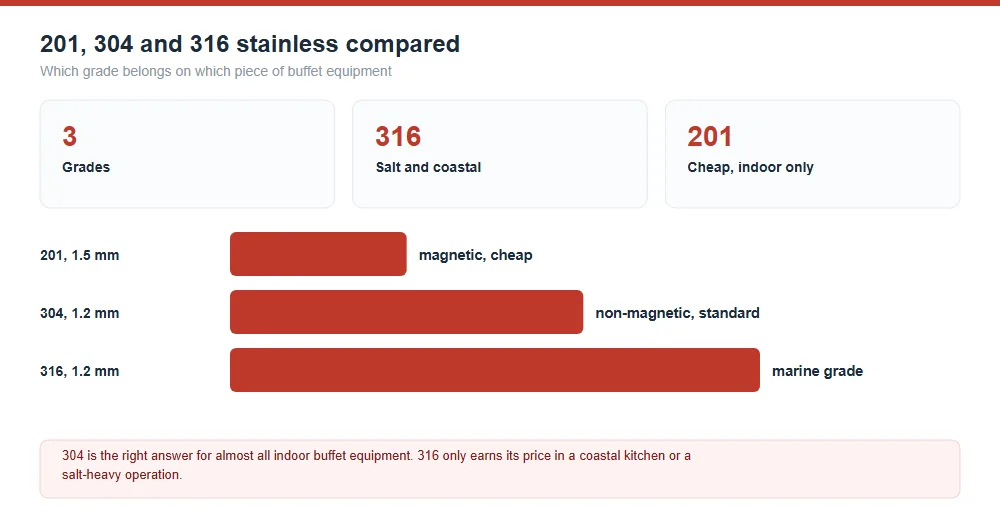
The grade number is not a quality score, it is a recipe. What separates 201, 304 and 316 is the nickel content and, in the case of 316, the molybdenum, and both of those elements are what buy corrosion resistance. The table below is the comparison that matters for buffet service: what each grade is made of, what it costs relative to the others, and how long it actually lasts in a dry room and near the coast.
| Property | 201 | 304 | 316 | Why it matters on a buffet |
| Chromium | 16 to 18 percent | 18 to 20 percent | 16 to 18 percent | Chromium forms the passive film that makes stainless stainless |
| Nickel | 3.5 to 5.5 percent | 8 to 10.5 percent | 10 to 14 percent | Nickel stabilises the film against acids and salt |
| Molybdenum | None | None | 2 to 3 percent | Molybdenum is what resists chloride pitting |
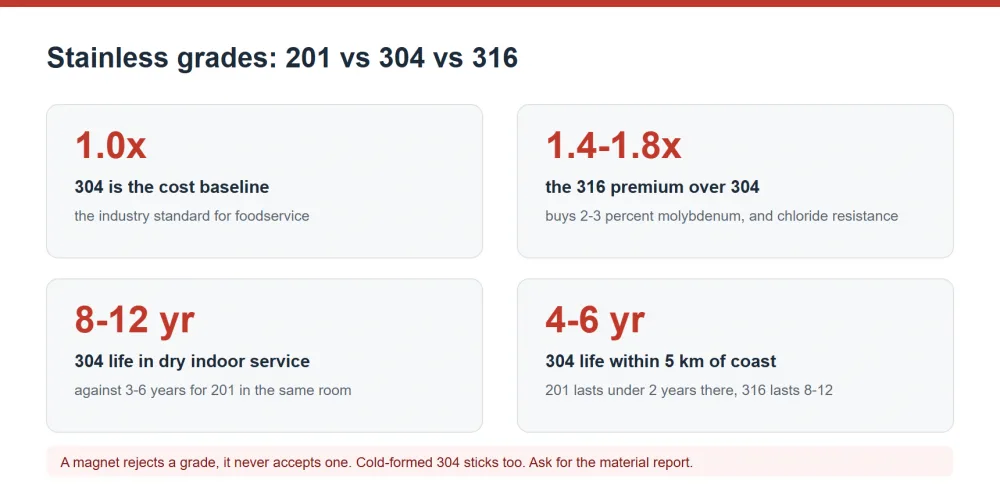
| Relative material cost | 0.6 to 0.7 times | 1.0 times, the baseline | 1.4 to 1.8 times | Most of the price difference between chafer lines |
| Magnetic when annealed | Yes | No | No | The only field test that works without a lab |
| Life in dry indoor use | 3 to 6 years | 8 to 12 years | 12 to 20 years | Wiped down, no standing water, low humidity |
| Life within 5 km of coast | Under 2 years | 4 to 6 years | 8 to 12 years | Salt aerosol beats every grade eventually |
| Correct use | Dry indoor, price-led | Standard foodservice | Coastal, salted, chlorinated | Match the grade to the room, not to the budget |
Four ways to check a grade, and what each one proves
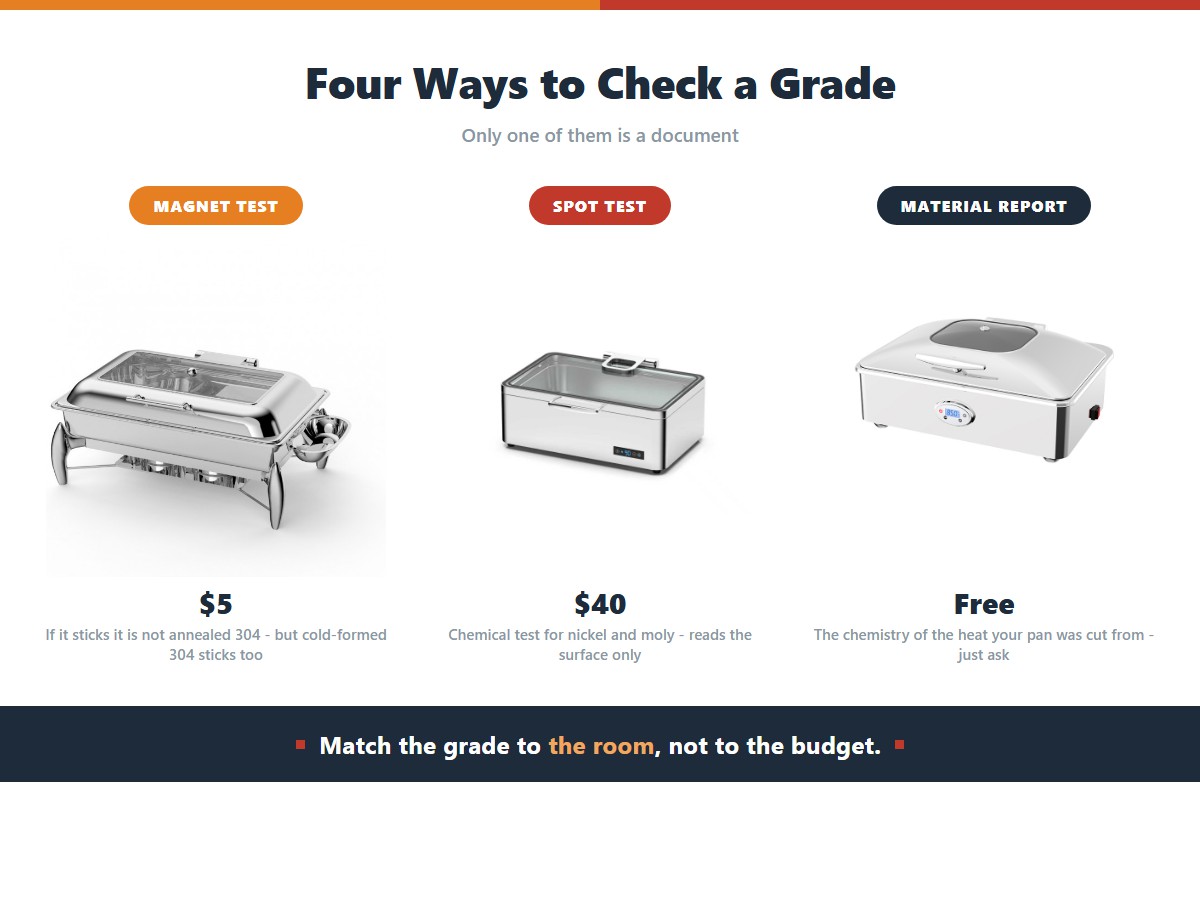
Every operator wants a ten-second test, and the magnet is the one that circulates. The problem is that the magnet answers a narrower question than people think, and a rolled or welded 304 pan will hold a magnet along the forming edge. The table below ranks the checks by what they actually prove, and the only reliable one is the paperwork.
| Check | What it proves | What it does not prove | Reliability | Cost |
| Magnet on the flat base | If it sticks, the grade is not annealed 304 or 316 | It does not prove 201, because cold-formed and welded 304 is locally magnetic too | Low on its own | $5 |
| Chemical spot test | Approximate nickel and molybdenum content from the reaction colour | Not a certificate, and it reads the surface only | Medium | $40 per 100 tests |
| Material test report | The actual chemistry of the heat your pan was cut from | Nothing about fabrication quality or welds | High | Free, if you ask |
| Price and weight signal | A 60 dollar half-size chafer is not 316, whatever the listing says | Nothing about the actual grade | Low | Free |
The rule that follows is simple: use the magnet to reject, never to accept. A pan that does not hold a magnet is probably 304 or 316; a pan that does hold one might be 201, or might be 304 that was pressed too hard at the rim. For anything above a nominal spend, ask for the material test report with the heat number before the order is placed, and keep it on file against the purchase order, because that document is the only thing that ties the metal in your kitchen to a real chemistry.
Frequently Asked Questions
Is 201 stainless steel bad?
No, it is a legitimate food-contact grade, it is just used in the wrong place very often. In a dry indoor kitchen that is wiped down after service, 201 will give 3 to 6 years. In a coastal kitchen, a poolside service or anything salted, the same pan starts spotting within months and pits within two years. The grade is not the problem, the match between grade and environment is.
Can a magnet tell 304 from 316?
No. Both are austenitic and both are non-magnetic in the annealed condition, so a magnet treats them identically. The only practical difference between the two is the 2 to 3 percent molybdenum in 316, and that needs a chemical spot test or a material test report to detect. If a supplier claims a magnet proves 316, they are selling you something else.
Why does my 304 chafer still rust?
Three causes, in order of frequency: iron contamination from steel wool or a carbon steel scraper, chloride attack from salt and sanitiser that is not rinsed off, and standing water that breaks the passive film in one spot. All three are surface rust, and all three are removable with a passivating paste or a citric acid solution followed by a full rinse. The pan is not failing, the film was damaged.
Do I need 316 for an inland hotel?
Almost never. 304 is the correct grade for any indoor kitchen that is more than a few hundred kilometres from the coast, as long as the equipment is rinsed and dried. 316 earns its 1.4 to 1.8 times premium in three places only: within a few kilometres of salt water, around chlorinated pools, and in kitchens that run salted or acidic service at volume. Paying for 316 inland is paying for chemistry you will never use.
How do I make sure I get the grade I ordered?
Write the grade and the standard on the purchase order, for example 304 to AISI 304 or 1.4301, and ask for the material test report with the heat number before shipment. Keep both documents on file, and spot-check the first delivery with a magnet and a spot test. Suppliers who cannot produce the report for a 304 order are usually shipping 201, and the saving shows up as a rust bill two years later.
Related reading
- 201 vs 304 Stainless Steel: Chafer Durability Test
- Best Stainless Steel Chafing Dishes for Commercial Use
- Why Stainless Buffet Gear Gets Rust Spots (And Fixes)
- Stainless Steel Food Warmer for Supermarket Deli Departments
- 304 vs 201 Stainless Steel: Which Alloy for Buffet Equipment?
- Chafing Dish Noise Ruining Your Event? Silent Stainless Steel Solution