
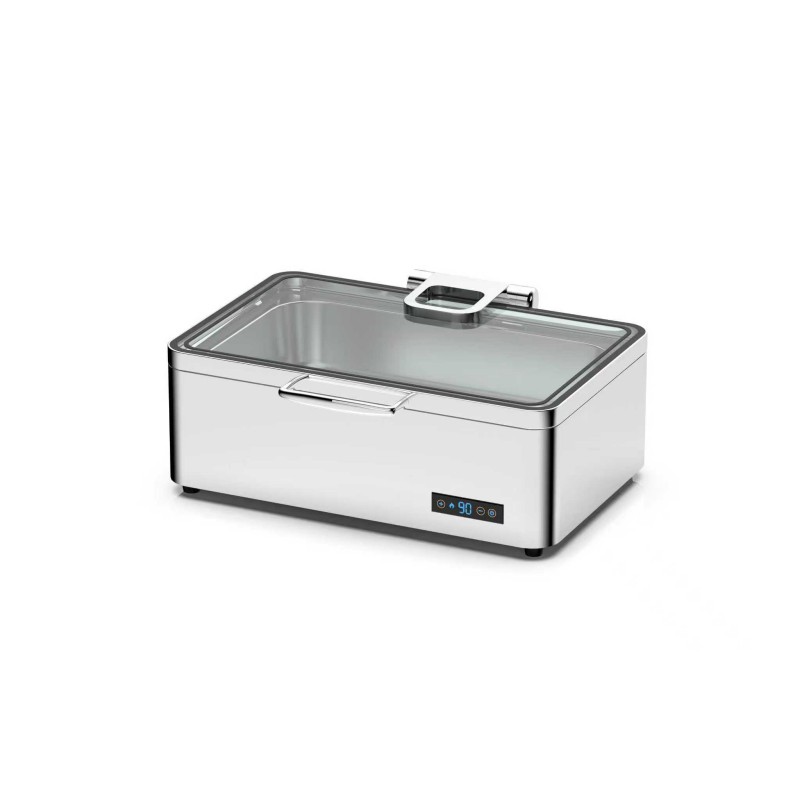
Why Is My Chafing Dish Not Heating Up? 7 Causes and Fixes
Short answer: a chafing dish that will not reach temperature is almost always one of seven faults: an empty or cold water pan, the wrong or a spent fuel can, a blocked burner, a failed heating element, a tripped thermostat, a warped food pan sitting in the water, or a lid left open through service. Work through them in that order — the first three account for roughly 80% of cases and take under two minutes to check. Replacement parts and guidance are available for every unit in our chafing dish range.
Diagnose in the order of likelihood
Start with the cheapest and most common causes before assuming a component has failed. A service call for a "broken" chafer turns out to be an empty water pan more often than anything else, and the fix costs nothing.
| Rank | Cause | Symptom | Check | Fix |
| 1 | Water pan empty or cold | Food lukewarm, pan dry | Look at water level | Fill with hot water |
| 2 | Fuel can spent or wrong type | Flame small or out | Check flame height | Replace can |
| 3 | Lid left open | Top of food cold | Observe service | Close lid between guests |
| 4 | Blocked burner or air gap | Yellow, sooty flame | Inspect burner ports | Clear ports, check gap |
| 5 | Element failed (electric) | No heat, no light | Continuity test | Replace element |
| 6 | Thermostat tripped or failed | Heats then stops | Listen for click, test | Reset or replace |
| 7 | Warped pan sitting in water | Uneven heating | Remove pan, inspect base | Replace pan |
Temperature is the objective test: after 20 minutes of correct operation, the food surface should read at least 60°C. If it does not, the fault is real and one of the seven causes applies.
Fuel-specific faults
Fuel chafers fail in ways that are visible if you know what to look at. Flame characteristics tell you most of what you need to know, and a correct flame is a steady blue cone roughly 25-40 mm high.
| Flame appearance | Likely cause | Fix | Prevention |
| No flame at all | Can spent, wick dry | Replace can | Check before service |
| Yellow, sooty flame | Insufficient air | Open air gap, clear ports | Clean burner weekly |
| Very small flame | Can nearly spent or cold | Replace, pre-warm can | Use fresh cans |
| Flame blows out | Draught or wind | Fit a wind guard | Standard outdoors |
| Flame too high | Wrong can, over-fuelled | Use specified fuel | Match fuel to unit |
| Excess smoke | Spilled gel or debris | Clean burner tray | Wipe after each use |
Keep the fuel holder height correct. If the can sits too far from the water pan, up to half the heat misses the pan entirely, which looks like a fuel problem but is actually a setup problem.
Electric-specific faults
Electric units have fewer moving parts but fail less visibly. Work through power, then element, then thermostat.
| Symptom | Test | Result meaning | Action |
| No heat, no indicator | Check socket with another device | No power at outlet | Check breaker and lead |
| Indicator on, no heat | Continuity test on element | Open circuit = failed element | Replace element |
| Heats then stops early | Thermostat click test | Thermostat cutting in early | Replace thermostat |
| Trips the breaker | Insulation resistance test | Earth leakage | Replace element or lead |
| Heats slowly | Measure with hot vs cold water | Cold water start | Fill hot, allow 15 min |
| Uneven heating | Inspect pan base contact | Warped pan | Replace pan |
Most electric chafer elements are rated for several thousand hours and are replaceable as a part rather than requiring a whole new unit. Keeping two spare elements per ten units removes chafer downtime entirely.
Preventing the fault from returning
Once a chafer is heating correctly, the question is what routine keeps it that way. Most repeat failures come from a missing setup step rather than from component wear.
| Routine | Frequency | Task | Failure prevented |
| Water level check | Every 60 min in service | Top up with hot water | Cold food, dry pan damage |
| Burner inspection | Weekly | Clear ports, check air gap | Yellow flame, poor heating |
| Element test | Quarterly | Continuity and visual check | Mid-service element failure |
| Thermostat accuracy | Quarterly | Probe comparison test | Silent temperature drift |
| Pan base check | Monthly | Confirm pans sit flat | Uneven heating |
| Spares audit | Quarterly | Elements, hinges, cans in stock | Downtime waiting for parts |
Keep a simple fault log with the unit number, date and cause. After three months the pattern is obvious, and it usually shows one or two units that need replacing rather than a fleet-wide problem.
Frequently Asked Questions
How long should a chafer take to heat up?
10-15 minutes to bring a full water pan to working temperature when you start with hot water, and 20-25 minutes from cold. Load food only after the water is hot.
Why is my food hot on top but cold underneath?
The water pan is too full and the food pan is floating, or the food is too deep for the pan. Lower the water level so there is a 10-20 mm gap below the food pan.
Can I use a chafer without the water pan?
No, not for holding. Without water the heat is direct and uneven, and the food scorches at the bottom while staying cold on top.
Why does my chafer heat fine empty but not with food?
The load is too large or too cold. Food should go in at 75°C or above; a chafer is designed to hold temperature, not to cook food from cold.
Is a yellow flame dangerous?
It indicates incomplete combustion and produces carbon monoxide and soot. Ventilate, clear the burner ports and restore the correct air gap before further use.
Related reading
Related Articles

How Many Chafing Dishes Do You Need Per 50 Guests?
Plan 1 full-size chafer per 25-30 guests for each entree and 1 per 35-40 for sides. Includes a guest...

How Long Can Food Stay Under a Heat Lamp? The 4-Hour Rule
Food can stay under a heat lamp for up to 4 hours if it stays above 135°F (57°C); quality usually ...

How Much Does a Commercial Chafing Dish Cost? 2026 Price Ranges
Wholesale chafing dishes run $22-55 for 201 fuel units, $45-90 for 304 stainless, $65-180 for electr...

What Size Food Pan Fits a Full-Size Chafing Dish? GN Sizes Explained
A full-size chafer takes one GN 1/1 pan (530 x 325 mm), or two GN 1/2, or three GN 1/3. Includes ful...
Is Food Under a Heat Lamp Safe? A Straight Answer
Food under a heat lamp is safe when three conditions are met: above 135°F (57°C), under 4 hours, a...

How Much Water Goes in a Chafing Dish Water Pan?
Fill a full-size water pan with 1.5-2.5 L of hot water to about two-thirds depth, keeping the level ...