
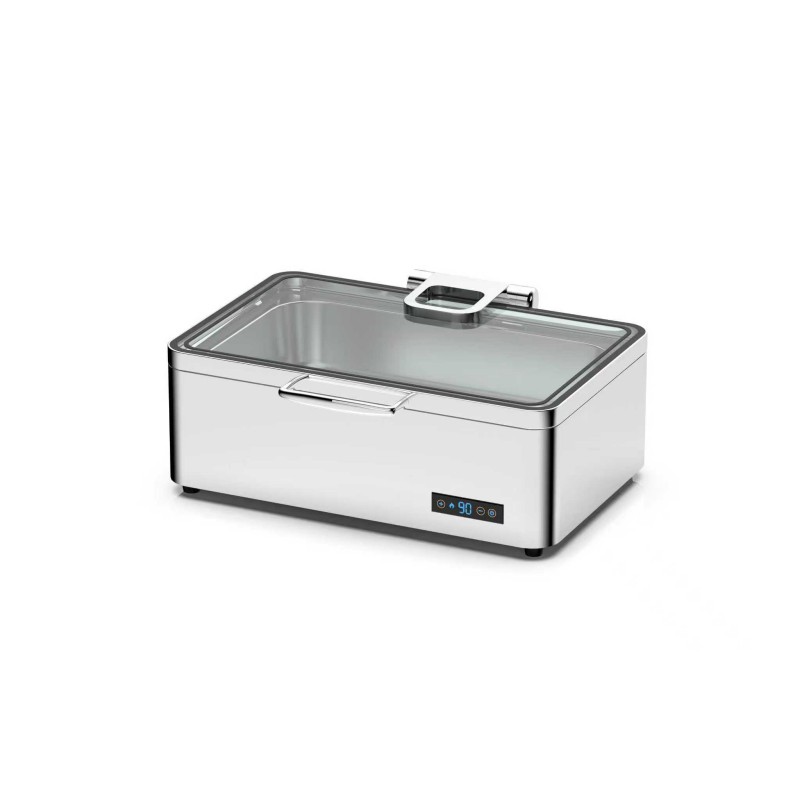
Chafing Dish Lid Won't Stay Open: Hinge Problems and Fixes
Short answer: a chafing dish lid that will not stay open has one of 4 faults: a worn friction hinge, a loose pivot screw, a bent lid or frame, or a failed hydraulic damper. Tightening the pivot fixes the majority of mechanical cases; a hydraulic unit that drops slowly needs its damper replaced. Hinges and dampers are serviceable spares across our chafing dish range, so a lid problem rarely means replacing the whole unit.
Mechanism types and how they fail
Different lid mechanisms fail in characteristic ways. Identifying the type narrows the diagnosis to one or two parts.
| Mechanism | How it holds position | Common failure | Fix | Life |
| Friction hinge | Clamped pivot with tension | Tension lost over time | Tighten or replace hinge | 3-5 years |
| Hydraulic damper | Oil-filled soft-close cylinder | Seal leak, drops closed | Replace damper | 5-8 years |
| Roll top | Curved track and balance | Track bent or obstructed | Realign track | 5-8 years |
| Lift-off | No mechanism at all | None | Not applicable | Indefinite |
| Stay arm | Notched support arm | Notch worn or arm bent | Replace arm | 3-5 years |
Lift-off lids have no hinge to fail at all, which is why high-volume operations such as schools and staff canteens often prefer them despite the lack of convenience.
Diagnosis sequence
Work from the simplest check to the most invasive. Most lid faults are resolved at step two.
| Step | Check | Finding | Action |
| 1 | Pivot screws tight? | Loose | Tighten and retest |
| 2 | Hinge tension adjustable? | Tension lost | Adjust or replace hinge |
| 3 | Hydraulic damper leaking? | Oil visible, drops | Replace damper |
| 4 | Lid or frame bent? | Gap at one side | Realign or replace lid |
| 5 | Track obstructed (roll top)? | Debris or dent | Clear and realign |
| 6 | Mounting points stripped? | Screw turns freely | Repair thread or replace frame |
A bent lid usually comes from transport rather than service. Lids stacked without separators in a catering van take repeated impact, and a lid that looked fine on arrival may already be slightly deformed.
Choosing a replacement mechanism
When a hinge has genuinely worn out, the replacement decision depends on how the unit is used.
| Use case | Recommended mechanism | Why |
| Fine dining, banqueting | Hydraulic soft-close | Quiet, premium feel |
| Hotel buffet | Hydraulic or quality friction | Balance of feel and cost |
| School or canteen | Lift-off or heavy friction | Survives abuse, cheap to replace |
| Outdoor catering | Latching friction | Stays put in wind |
| Mobile or transport | Lift-off | Nothing to damage in transit |
| High-frequency self-service | Roll top | Guests operate it without lifting |
Keep two spare hinges per ten units in service. It costs very little and removes the most common reason a chafer sits unused in the store room.
Transport and storage damage prevention
Most lid and hinge damage happens between events rather than during service. Storage method is the variable operators control most easily.
| Measure | Effect | Cost |
| Separator between stacked lids | Prevents scuffing and bending | Very low |
| Dedicated lid rack | Removes stacking entirely | Low |
| Padded transport case | Prevents impact damage in transit | Medium |
| Never stack more than 8 lids | Limits load on the bottom unit | None |
| Store upright, not on edge | Prevents slow deformation | None |
| Transport hydraulic units lid-up | Protects the damper | None |
A simple padded case pays for itself within a season on hydraulic units, where a single damaged damper costs more than the case.
Hinge specification at purchase
Hinge quality varies more than any other component between price tiers, and it is the part most likely to fail first. Specify it explicitly rather than accepting whatever is standard.
| Feature | Basic | Recommended | Why it matters |
| Pivot | Plain rivet | Bolted, serviceable | Can be replaced |
| Bush | None | Brass or nylon bush | Prevents wear |
| Tension | Fixed | Adjustable | Extends service life |
| Material | Plated steel | Stainless | Survives washing |
| Spares | Not available | Available 5+ years | Repairable fleet |
| Cycle rating | Not stated | Stated by supplier | Comparable between quotes |
Ask for the cycle rating in writing. It is the only way to compare two hinges on paper, and suppliers who publish it generally build the rest of the unit to the same standard.
Frequently Asked Questions
Can I tighten a hydraulic hinge to stop it dropping?
No. A hydraulic unit that drops has lost its oil seal; adjustment will not restore damping and the damper must be replaced.
Why does the lid slam shut?
The damper has failed completely or was never fitted. Replacing the damper restores soft close; without it the lid will slam and eventually deform.
How long should a chafing dish hinge last?
Three to five years for a friction hinge in daily service and five to eight for a hydraulic damper. High-frequency operations shorten both.
Can a bent lid be straightened?
A slight bend can often be corrected by a technician, but a creased lid will not sit flat again and should be replaced, since a poor seal loses heat continuously.
Is a roll top better than a hinged lid?
For self-service, yes — guests can open it without lifting a hot lid. For attended service, a hydraulic hinged lid gives better access and a quieter room.
Related reading
Related Articles

How Many Chafing Dishes Do You Need Per 50 Guests?
Plan 1 full-size chafer per 25-30 guests for each entree and 1 per 35-40 for sides. Includes a guest...

How Long Can Food Stay Under a Heat Lamp? The 4-Hour Rule
Food can stay under a heat lamp for up to 4 hours if it stays above 135°F (57°C); quality usually ...

How Much Does a Commercial Chafing Dish Cost? 2026 Price Ranges
Wholesale chafing dishes run $22-55 for 201 fuel units, $45-90 for 304 stainless, $65-180 for electr...

What Size Food Pan Fits a Full-Size Chafing Dish? GN Sizes Explained
A full-size chafer takes one GN 1/1 pan (530 x 325 mm), or two GN 1/2, or three GN 1/3. Includes ful...
Is Food Under a Heat Lamp Safe? A Straight Answer
Food under a heat lamp is safe when three conditions are met: above 135°F (57°C), under 4 hours, a...

How Much Water Goes in a Chafing Dish Water Pan?
Fill a full-size water pan with 1.5-2.5 L of hot water to about two-thirds depth, keeping the level ...